Table of Contents for
Learning Linux Shell Scripting
 Learning Linux Shell Scripting
Published by
Packt Publishing, 2015
Learning Linux Shell Scripting
Published by
Packt Publishing, 2015
- Cover
- Table of Contents
- Learning Linux Shell Scripting
- Learning Linux Shell Scripting
- Credits
- About the Author
- Acknowledgments
- About the Reviewers
- www.PacktPub.com
- Preface
- What you need for this book
- Who this book is for
- Conventions
- Reader feedback
- Customer support
- 1. Getting Started and Working with Shell Scripting
- Tasks done by shell
- Working in shell
- Learning basic Linux commands
- Our first script – Hello World
- Compiler and interpreter – difference in process
- When not to use scripts
- Various directories
- Working more effectively with shell – basic commands
- Working with permissions
- Summary
- 2. Drilling Deep into Process Management, Job Control, and Automation
- Monitoring processes using ps
- Process management
- Process monitoring tools – top, iostat, and vmstat
- Understanding "at"
- Understanding "crontab"
- Summary
- 3. Using Text Processing and Filters in Your Scripts
- IO redirection
- Pattern matching with the vi editor
- Pattern searching using grep
- Summary
- 4. Working with Commands
- Command substitution
- Command separators
- Logical operators
- Pipes
- Summary
- 5. Exploring Expressions and Variables
- Working with environment variables
- Working with read-only variables
- Working with command line arguments (special variables, set and shift, getopt)
- Understanding getopts
- Understanding default parameters
- Working with arrays
- Summary
- 6. Neat Tricks with Shell Scripting
- The here document and the << operator
- The here string and the <<< operator
- File handling
- Debugging
- Summary
- 7. Performing Arithmetic Operations in Shell Scripts
- Using the let command for arithmetic
- Using the expr command for arithmetic
- Binary, octal, and hex arithmetic operations
- A floating-point arithmetic
- Summary
- 8. Automating Decision Making in Scripts
- Understanding the test command
- Conditional constructs – if else
- Switching case
- Implementing simple menus with select
- Looping with the for command
- Exiting from the current loop iteration with the continue command
- Exiting from a loop with a break
- Working with the do while loop
- Using until
- Piping the output of a loop to a Linux command
- Running loops in the background
- The IFS and loops
- Summary
- 9. Working with Functions
- Passing arguments or parameters to functions
- Sharing the data by many functions
- Declaring local variables in functions
- Returning information from functions
- Running functions in the background
- Creating a library of functions
- Summary
- 10. Using Advanced Functionality in Scripts
- Using the trap command
- Ignoring signals
- Using traps in function
- Running scripts or processes even if the user logs out
- Creating dialog boxes with the dialog utility
- Summary
- 11. System Startup and Customizing a Linux System
- User initialization scripts
- Summary
- 12. Pattern Matching and Regular Expressions with sed and awk
- sed – noninteractive stream editor
- Using awk
- Summary
- Index
In the last chapter, we introduced ourselves to the Bash shell environment in Linux. You learned basic commands and wrote your first Shell script as well.
You also learned about process management and job control. This information will be very useful for system administrators in automation and solving many problems.
In this chapter, we will cover the following topics:
- Monitoring processes with ps
- Job management—working with fg, bg, jobs, and kill
- Exploring at and crontab
A running instance of a program is called as process. A program stored in the hard disk or pen drive is not a process. When that stored program starts executing, then we say that process has been created and is running.
Let's very briefly understand the Linux operating system boot-up sequence:
- In PCs, initially the BIOS chip initializes system hardware, such as PCI bus, display device drivers, and so on.
- Then the BIOS executes the boot loader program.
- The boot loader program then copies kernel in memory, and after basic checks, it calls a kernel function called
start_kenel(). - The kernel then initiates the OS and creates the first process called
init. - You can check the presence of this process with the following command:
$ ps –ef - Every process in the OS has one numerical identification associated with it. It is called a process ID. The process ID of the
initprocess is 1. This process is the parent process of all user space processes. - In the OS, every new process is created by a system call called
fork(). - Therefore, every process has a process ID as well as the parent process ID.
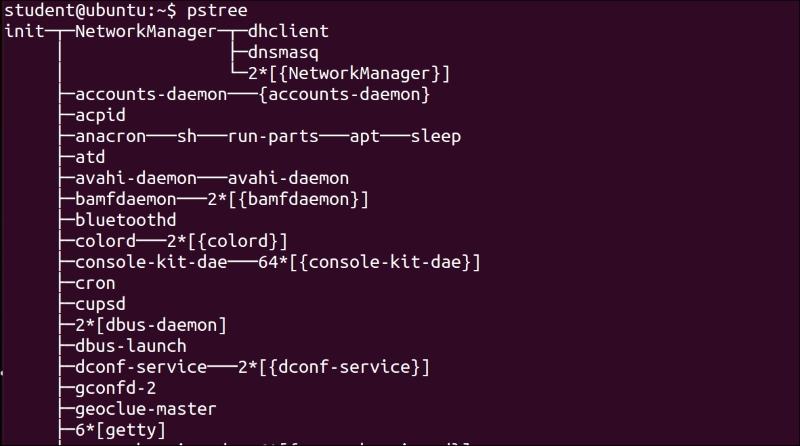
- We can see the complete process tree using the following command:
$ pstree
You can see the very first process as init as well as all other processes with a complete parent and child relation between them. If we use the $ps –ef command, then we can see that the init process is owned by root and its parent process ID is 0. This means that there is no parent for init:
Therefore, except the init process, all other processes are created by some other process. The init process is created by the kernel itself.
The following are the different types of processes:
- Orphan process: If by some chance the parent process is terminated, then the child process becomes an orphan process. The process which created the parent process, such as the grandparent process, becomes the parent of orphan child process. In the last resort, the
initprocess becomes the parent of the orphan process. - Zombie process: Every process has one data structure called the process control table. This is maintained in the operating system. This table contains the information about all the child processes created by the parent process. If by chance the parent process is sleeping or is suspended due to some reason and the child process is terminated, then the parent process cannot receive the information about the child process termination. In such cases, the child process that has been terminated is called the zombie process. When the parent process awakes, it will receive a signal regarding the child process termination and the process control block data structure will be updated. The child process termination is then completed.
- Daemon process: Until now, we had started every new process in a Bash terminal. Therefore, if we print any text with the
$ echo "Hello"command, it will be printed in the terminal itself. There are certain processes that are not associated with any terminal. Such processes are called a daemon process. These processes are running in background. An advantage of the daemon process is they are immune to the changes happening to Bash shell, which has created it. When we want to run certain background processes, such as DHCP server and so on, then the daemon processes are very useful.