Table of Contents for
Learning Linux Shell Scripting
 Learning Linux Shell Scripting
Published by
Packt Publishing, 2015
Learning Linux Shell Scripting
Published by
Packt Publishing, 2015
- Cover
- Table of Contents
- Learning Linux Shell Scripting
- Learning Linux Shell Scripting
- Credits
- About the Author
- Acknowledgments
- About the Reviewers
- www.PacktPub.com
- Preface
- What you need for this book
- Who this book is for
- Conventions
- Reader feedback
- Customer support
- 1. Getting Started and Working with Shell Scripting
- Tasks done by shell
- Working in shell
- Learning basic Linux commands
- Our first script – Hello World
- Compiler and interpreter – difference in process
- When not to use scripts
- Various directories
- Working more effectively with shell – basic commands
- Working with permissions
- Summary
- 2. Drilling Deep into Process Management, Job Control, and Automation
- Monitoring processes using ps
- Process management
- Process monitoring tools – top, iostat, and vmstat
- Understanding "at"
- Understanding "crontab"
- Summary
- 3. Using Text Processing and Filters in Your Scripts
- IO redirection
- Pattern matching with the vi editor
- Pattern searching using grep
- Summary
- 4. Working with Commands
- Command substitution
- Command separators
- Logical operators
- Pipes
- Summary
- 5. Exploring Expressions and Variables
- Working with environment variables
- Working with read-only variables
- Working with command line arguments (special variables, set and shift, getopt)
- Understanding getopts
- Understanding default parameters
- Working with arrays
- Summary
- 6. Neat Tricks with Shell Scripting
- The here document and the << operator
- The here string and the <<< operator
- File handling
- Debugging
- Summary
- 7. Performing Arithmetic Operations in Shell Scripts
- Using the let command for arithmetic
- Using the expr command for arithmetic
- Binary, octal, and hex arithmetic operations
- A floating-point arithmetic
- Summary
- 8. Automating Decision Making in Scripts
- Understanding the test command
- Conditional constructs – if else
- Switching case
- Implementing simple menus with select
- Looping with the for command
- Exiting from the current loop iteration with the continue command
- Exiting from a loop with a break
- Working with the do while loop
- Using until
- Piping the output of a loop to a Linux command
- Running loops in the background
- The IFS and loops
- Summary
- 9. Working with Functions
- Passing arguments or parameters to functions
- Sharing the data by many functions
- Declaring local variables in functions
- Returning information from functions
- Running functions in the background
- Creating a library of functions
- Summary
- 10. Using Advanced Functionality in Scripts
- Using the trap command
- Ignoring signals
- Using traps in function
- Running scripts or processes even if the user logs out
- Creating dialog boxes with the dialog utility
- Summary
- 11. System Startup and Customizing a Linux System
- User initialization scripts
- Summary
- 12. Pattern Matching and Regular Expressions with sed and awk
- sed – noninteractive stream editor
- Using awk
- Summary
- Index
We have used the command ps in the introduction. Let's learn more about it:
- To list the process associated with our current Bash shell terminal, enter the following command:
$ ps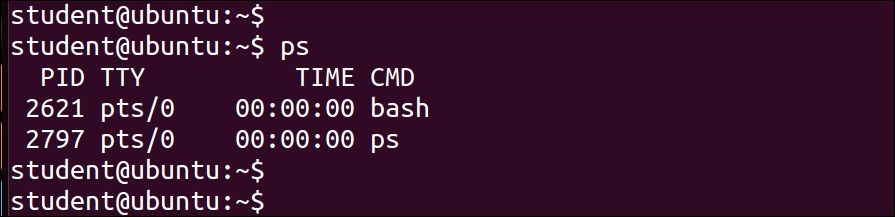
- To list processes along with the parent process ID associated with the current terminal, enter the following command:
$ ps –f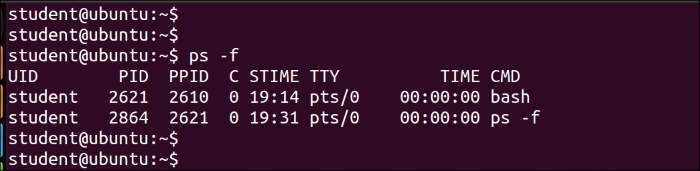
We can see the process ID in the
PIDcolumn and the parent process ID in thePPIDcolumn in the preceding output. - To list processes with the parent process ID along with the process state, enter the following command:
$ ps –lf
In the preceding output, the column with
S(state) shows the current state of a process, such asRfor running andSfor suspended state. - To list all the processes running in the operating system including system processes, enter the following command:
$ ps –ef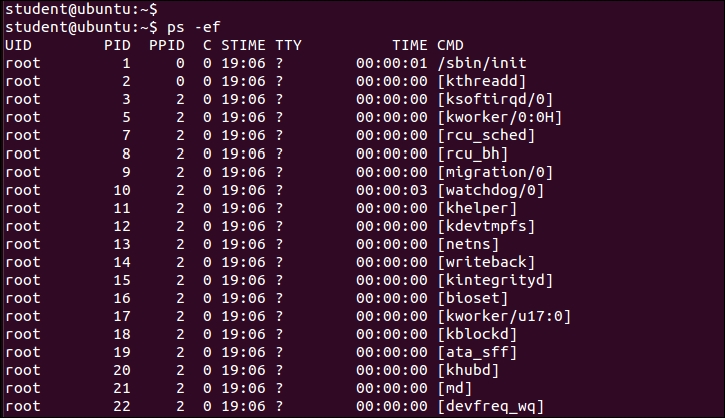
The process names in
[]are kernel threads. If you are interested in more options to learn about thepscommand, you can use the following command:$ man ps.To find a particular process, you can use the following command:
$ ps –ef | grep "process_name"The command with
grepwill display the process withprocess_name. - If we want to terminate the running process, enter following command:
$ kill pid_of_process_to_be_killed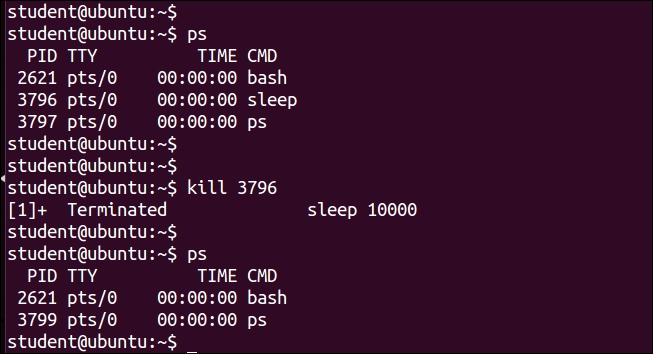
- Many a time, if the process is not killed by the
$ killcommand, you may need to pass additional option to ensure that the required process is killed, which is shown as follows:$ kill -9 pid_of_process_to_be_killed - We can terminate the process by the name of a process instead of using the process ID as follows:
$ pkill command_name
$ pkill sleep
Or:
$ pkill -9 command_name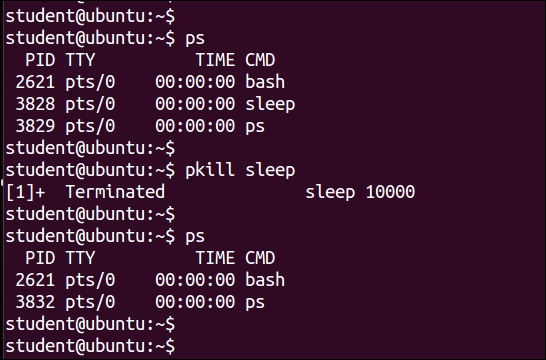
- To know more about various flags of
kill, enter following command:$ kill –lThis displays all the signals or software interrupts used by the operating system. When we enter the
$ killcommand, the operating system sends theSIGTERMsignal to the process. If the process is not killed by this command, then we enter the following command:$ kill -9 process_nameThis sends
SIGKILLto the process to be killed.