Table of Contents for
Node.js for Embedded Systems
 Node.js for Embedded Systems
Published by
O'Reilly Media, Inc., 2016
Node.js for Embedded Systems
Published by
O'Reilly Media, Inc., 2016
- Cover
- nav
- Node.js for Embedded Systems
- Node.js for Embedded Systems
- Foreword
- Preface
- 1. Connecting Worlds
- 2. Blink with Arduino
- 3. Espruino
- 4. The Tessel 2
- 5. Particle Photon
- 6. Single-Board Computers
- 7. Components for Prototyping
- 8. Node.js Libraries for Hardware
- 9. Exploring Network Protocols
- 10. Web Frontends for Things
- 11. Entering the Cloud
- 12. Making Robots with Node.js
- 13. Wireless Data with Bluetooth
- 14. Toward the Physical Internet
- 15. From Products to Toolkits
- A. Node.js
- B. Early Hardware for IoT Systems
- Index
- About the Authors
- Colophon
Colophon
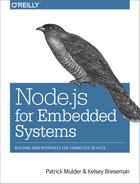
The animal on the cover of Node.js for Embedded Systems is a common cuckoo (Cuculus canorus).
The cuckoo family gets its common name and genus name by onomatopoeia for the call of the male common cuckoo. In France, for example, it is known as the coucou, in Holland koekoek, in Germany kuckuk, in Russia kukush-ka and in Japan kak-ko.
Common cuckoos spend their winters in West Africa and in the spring they migrate 10,000 miles north to England. They inhabit various types of countryside, including woodland margins, open farmland, hedgerows, and marshes. They feed on the ground and are one of the few British birds to relish hairy caterpillars. They also eat grasshoppers, flies, beetles, and small snails.
The cuckoo’s life strategy is built on deceiving other birds. The cuckoo is well known as a brood parasite because it tricks other birds to raise its young, allowing for more cuckoos to be reared than would otherwise be possible. Cuckoos can adapt different plumage patterns to match a local bird of prey; a deliberate ruse to frighten small birds away from their nests. The hen cuckoo flies to an unattended nest and lays one egg. The cuckoo egg mimics the color and shape of the host egg, except the cuckoo egg has a thicker shell and a shorter incubation time. The cuckoo chick hatches first and wiggles around the nest, ejecting the host eggs. The chick needs the same amount of food as a whole brood of nestlings so to compensate for the visual stimulus of just one gape, the chick makes rapid begging calls that sound like an entire brood. Many hosts have evolved defenses against these tactics but both sides are fighting to get the upper hand. This behavior is a vivid demonstration of evolution: for every stage that the parasite tries to deceive the host, the host evolves at that stage.
Many of the animals on O’Reilly covers are endangered; all of them are important to the world. To learn more about how you can help, go to animals.oreilly.com.
The cover image is from Lydekker’s Royal Natural History. The cover fonts are URW Typewriter and Guardian Sans. The text font is Adobe Minion Pro; the heading font is Adobe Myriad Condensed; and the code font is Dalton Maag’s Ubuntu Mono.