Table of Contents for
Learning Linux Binary Analysis
 Learning Linux Binary Analysis
Published by
Packt Publishing, 2016
Learning Linux Binary Analysis
Published by
Packt Publishing, 2016
- Cover
- Table of Contents
- Learning Linux Binary Analysis
- Learning Linux Binary Analysis
- Credits
- About the Author
- Acknowledgments
- About the Reviewers
- www.PacktPub.com
- Preface
- What you need for this book
- Who this book is for
- Conventions
- Reader feedback
- Customer support
- 1. The Linux Environment and Its Tools
- Useful devices and files
- Linker-related environment points
- Summary
- 2. The ELF Binary Format
- ELF program headers
- ELF section headers
- ELF symbols
- ELF relocations
- ELF dynamic linking
- Coding an ELF Parser
- Summary
- 3. Linux Process Tracing
- ptrace requests
- The process register state and flags
- A simple ptrace-based debugger
- A simple ptrace debugger with process attach capabilities
- Advanced function-tracing software
- ptrace and forensic analysis
- Process image reconstruction – from the memory to the executable
- Code injection with ptrace
- Simple examples aren't always so trivial
- Demonstrating the code_inject tool
- A ptrace anti-debugging trick
- Summary
- 4. ELF Virus Technology �� Linux/Unix Viruses
- ELF virus engineering challenges
- ELF virus parasite infection methods
- The PT_NOTE to PT_LOAD conversion infection method
- Infecting control flow
- Process memory viruses and rootkits – remote code injection techniques
- ELF anti-debugging and packing techniques
- ELF virus detection and disinfection
- Summary
- 5. Linux Binary Protection
- Stub mechanics and the userland exec
- Other jobs performed by protector stubs
- Existing ELF binary protectors
- Downloading Maya-protected binaries
- Anti-debugging for binary protection
- Resistance to emulation
- Obfuscation methods
- Protecting control flow integrity
- Other resources
- Summary
- 6. ELF Binary Forensics in Linux
- Detecting other forms of control flow hijacking
- Identifying parasite code characteristics
- Checking the dynamic segment for DLL injection traces
- Identifying reverse text padding infections
- Identifying text segment padding infections
- Identifying protected binaries
- IDA Pro
- Summary
- 7. Process Memory Forensics
- Process memory infection
- Detecting the ET_DYN injection
- Linux ELF core files
- Summary
- 8. ECFS – Extended Core File Snapshot Technology
- The ECFS philosophy
- Getting started with ECFS
- libecfs – a library for parsing ECFS files
- readecfs
- Examining an infected process using ECFS
- The ECFS reference guide
- Process necromancy with ECFS
- Learning more about ECFS
- Summary
- 9. Linux /proc/kcore Analysis
- stock vmlinux has no symbols
- /proc/kcore and GDB exploration
- Direct sys_call_table modifications
- Kprobe rootkits
- Debug register rootkits – DRR
- VFS layer rootkits
- Other kernel infection techniques
- vmlinux and .altinstructions patching
- Using taskverse to see hidden processes
- Infected LKMs – kernel drivers
- Notes on /dev/kmem and /dev/mem
- /dev/mem
- K-ecfs – kernel ECFS
- Kernel hacking goodies
- Summary
- Index
This type of infection is relatively easy to detect. This type of infection was also discussed in Chapter 4, ELF Virus Technology – Linux/Unix Viruses. This technique relies on the fact that there is always going to be a minimum of 4,096 bytes between the text and the data segment because they are loaded into memory as two separate memory segments, and memory mappings are always page aligned.
On 64-bit systems, there is typically 0x200000 (2MB) free due to
PSE (Page size extension) pages. This means that a 64-bit ELF binary can be inserted with a 2MB parasite, which is much larger than what is typically needed for an injection space. With this type of infection, like any other, you can often identify the parasite location by examining the control flow.
With the lpv virus which I wrote in 2008, for instance, the entry point is modified to start execution at the parasite that is inserted using the text segment padding infection. If the executable that has been infected has a section header table, you will see that the entry point address resides in the range of the last section within the text segment. Let's take a look at a 32-bit ELF executable that has been infected using this technique.
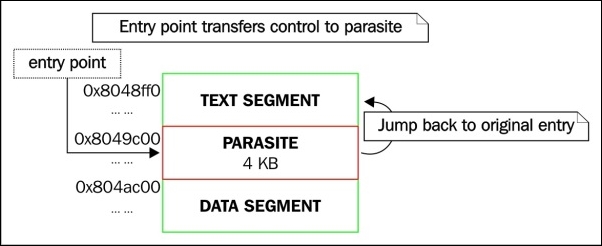
Illustration – Diagram showing a text segment padding infection
The following is an ELF file header of the lpv infected file:
$ readelf -h infected.lpv
ELF Header:
  Magic:   7f 45 4c 46 01 01 01 00 00 00 00 00 00 00 00 00
  Class:                             ELF32
  Data:                              2's complement, little endian
  Version:                           1 (current)
  OS/ABI:                            UNIX - System V
  ABI Version:                       0
  Type:                              EXEC (Executable file)
  Machine:                           Intel 80386
  Version:                           0x1
  Entry point address:               0x80485b8
  Start of program headers:          52 (bytes into file)
  Start of section headers:          8524 (bytes into file)
  Flags:                             0x0
  Size of this header:               52 (bytes)
  Size of program headers:           32 (bytes)
  Number of program headers:         9
  Size of section headers:           40 (bytes)
  Number of section headers:         30
  Section header string table index: 27
Notice the entry point address, 0x80485b8. Does this address point somewhere inside the .text section? Let's take a peek at the section header table and find out.
The following is an ELF section headers of the lpv infected file:
$ readelf -S infected.lpv
There are 30 section headers, starting at offset 0x214c:

Section Headers:
  [Nr] Name              Type         Addr        Off
       Size              ES           Flg Lk Inf Al
  [ 0]                   NULL         00000000    000000
       000000            00           0   0  0
  [ 1] .interp           PROGBITS     08048154    000154
       000013            00           A   0  0   1
  [ 2] .note.ABI-tag     NOTE         08048168    000168
       000020            00           A   0  0   4
  [ 3] .note.gnu.build-i NOTE         08048188    000188
       000024            00           A   0  0   4
  [ 4] .gnu.hash         GNU_HASH     080481ac    0001ac
       000020            04           A   5  0   4
  [ 5] .dynsym           DYNSYM       080481cc    0001cc
       000050            10           A   6  1   4
  [ 6] .dynstr           STRTAB       0804821c    00021c
       00004a            00           A   0  0   1
  [ 7] .gnu.version      VERSYM       08048266    000266
       00000a            02           A   5  0   2
  [ 8] .gnu.version_r    VERNEED      08048270    000270
       000020            00           A   6  1   4
  [ 9] .rel.dyn          REL          08048290    000290
       000008            08           A   5  0   4
  [10] .rel.plt          REL          08048298    000298
       000018            08           A   5  12  4
  [11] .init             PROGBITS     080482b0    0002b0
       000023            00           AX  0  0   4
  [12] .plt              PROGBITS     080482e0    0002e0
       000040            04           AX  0  0   16

  [13] .text             PROGBITS     08048320    000320
       000192            00           AX  0  0   16
  [14] .fini             PROGBITS     080484b4    0004b4
       000014            00           AX  0  0   4
  [15] .rodata           PROGBITS     080484c8    0004c8
       000014            00           A   0  0   4
  [16] .eh_frame_hdr     PROGBITS     080484dc    0004dc
       00002c            00           A   0  0   4
  [17] .eh_frame         PROGBITS     08048508    000508
       00083b            00           A   0  0   4
  [18] .init_array       INIT_ARRAY   08049f08    001f08
       000004            00           WA   0  0   4
  [19] .fini_array       FINI_ARRAY   08049f0c    001f0c
       000004            00           WA   0  0   4
  [20] .jcr              PROGBITS     08049f10    001f10
       000004            00           WA   0  0   4
  [21] .dynamic          DYNAMIC      08049f14    001f14
       0000e8            08           WA   6  0   4
  [22] .got              PROGBITS     08049ffc    001ffc
       000004            04           WA   0  0   4
  [23] .got.plt          PROGBITS     0804a000    002000
       000018            04           WA   0  0   4
  [24] .data             PROGBITS     0804a018    002018
       000008            00           WA   0  0   4
  [25] .bss              NOBITS       0804a020    002020
       000004            00           WA   0  0   1
  [26] .comment          PROGBITS     00000000    002020
       000024            01           MS   0  0   1
  [27] .shstrtab         STRTAB       00000000    002044
       000106            00           0   0  1
  [28] .symtab           SYMTAB       00000000    0025fc
       000430            10           29  45 4
  [29] .strtab           STRTAB       00000000    002a2c
       00024f            00           0   0  1
The entry point address falls within the .eh_frame section that is the last section in the text segment. This is clearly not the .text section that is enough reason to become immediately suspicious, and because the .eh_frame section is the last section in the text segment (which you can verify by using readelf -l), we are able to deduce that this Virus infection is probably using a text segment padding infection.The following are ELF program headers of the lpv infected file:
$ readelf -l infected.lpv

Elf file type is EXEC (Executable file)
Entry point 0x80485b8
There are 9 program headers, starting at offset 52

Program Headers:
  Type          Offset   VirtAddr   PhysAddr   FileSiz MemSiz  Flg Align
  PHDR          0x000034 0x08048034 0x08048034 0x00120 0x00120 R E 0x4
  INTERP        0x000154 0x08048154 0x08048154 0x00013 0x00013 R   0x1
      [Requesting program interpreter: /lib/ld-linux.so.2]
  LOAD          0x000000 0x08048000 0x08048000 0x00d43 0x00d43 R E 0x1000
  LOAD          0x001f08 0x08049f08 0x08049f08 0x00118 0x0011c RW  0x1000
  DYNAMIC       0x001f14 0x08049f14 0x08049f14 0x000e8 0x000e8 RW  0x4
  NOTE          0x001168 0x08048168 0x08048168 0x00044 0x00044 R   0x4
  GNU_EH_FRAME  0x0014dc 0x080484dc 0x080484dc 0x0002c 0x0002c R   0x4
  GNU_STACK     0x001000 0x00000000 0x00000000 0x00000 0x00000 RW  0x10
  GNU_RELRO     0x001f08 0x08049f08 0x08049f08 0x000f8 0x000f8 R   0x1

 Section to Segment mapping:
  Segment Sections...
   00
   01     .interp
   02     .interp .note.ABI-tag .note.gnu.build-id .gnu.hash .dynsym .dynstr .gnu.version .gnu.version_r .rel.dyn .rel.plt .init .plt .text .fini .rodata .eh_frame_hdr .eh_frame
   03     .init_array .fini_array .jcr .dynamic .got .got.plt .data .bss
   04     .dynamic
   05
   06
   07
   08     .init_array .fini_array .jcr .dynamic .got
Based on everything highlighted in the preceding program header output, you can see the program entry point, the text segment (the first LOAD program header), and the fact that .eh_frame is the last section in the text segment.