Table of Contents for
Learning Linux Binary Analysis
 Learning Linux Binary Analysis
Published by
Packt Publishing, 2016
Learning Linux Binary Analysis
Published by
Packt Publishing, 2016
- Cover
- Table of Contents
- Learning Linux Binary Analysis
- Learning Linux Binary Analysis
- Credits
- About the Author
- Acknowledgments
- About the Reviewers
- www.PacktPub.com
- Preface
- What you need for this book
- Who this book is for
- Conventions
- Reader feedback
- Customer support
- 1. The Linux Environment and Its Tools
- Useful devices and files
- Linker-related environment points
- Summary
- 2. The ELF Binary Format
- ELF program headers
- ELF section headers
- ELF symbols
- ELF relocations
- ELF dynamic linking
- Coding an ELF Parser
- Summary
- 3. Linux Process Tracing
- ptrace requests
- The process register state and flags
- A simple ptrace-based debugger
- A simple ptrace debugger with process attach capabilities
- Advanced function-tracing software
- ptrace and forensic analysis
- Process image reconstruction – from the memory to the executable
- Code injection with ptrace
- Simple examples aren't always so trivial
- Demonstrating the code_inject tool
- A ptrace anti-debugging trick
- Summary
- 4. ELF Virus Technology �� Linux/Unix Viruses
- ELF virus engineering challenges
- ELF virus parasite infection methods
- The PT_NOTE to PT_LOAD conversion infection method
- Infecting control flow
- Process memory viruses and rootkits – remote code injection techniques
- ELF anti-debugging and packing techniques
- ELF virus detection and disinfection
- Summary
- 5. Linux Binary Protection
- Stub mechanics and the userland exec
- Other jobs performed by protector stubs
- Existing ELF binary protectors
- Downloading Maya-protected binaries
- Anti-debugging for binary protection
- Resistance to emulation
- Obfuscation methods
- Protecting control flow integrity
- Other resources
- Summary
- 6. ELF Binary Forensics in Linux
- Detecting other forms of control flow hijacking
- Identifying parasite code characteristics
- Checking the dynamic segment for DLL injection traces
- Identifying reverse text padding infections
- Identifying text segment padding infections
- Identifying protected binaries
- IDA Pro
- Summary
- 7. Process Memory Forensics
- Process memory infection
- Detecting the ET_DYN injection
- Linux ELF core files
- Summary
- 8. ECFS – Extended Core File Snapshot Technology
- The ECFS philosophy
- Getting started with ECFS
- libecfs – a library for parsing ECFS files
- readecfs
- Examining an infected process using ECFS
- The ECFS reference guide
- Process necromancy with ECFS
- Learning more about ECFS
- Summary
- 9. Linux /proc/kcore Analysis
- stock vmlinux has no symbols
- /proc/kcore and GDB exploration
- Direct sys_call_table modifications
- Kprobe rootkits
- Debug register rootkits – DRR
- VFS layer rootkits
- Other kernel infection techniques
- vmlinux and .altinstructions patching
- Using taskverse to see hidden processes
- Infected LKMs – kernel drivers
- Notes on /dev/kmem and /dev/mem
- /dev/mem
- K-ecfs – kernel ECFS
- Kernel hacking goodies
- Summary
- Index
The art of virus writing has been around for several decades now. In fact, it goes all the way back to the Elk Cloner Apple virus that was successfully launched in the wild in 1981 through a floppy disk video game. Since the mid '80s and through the '90s, there have been various secret groups and hackers who have used their arcane knowledge to design, release, and publish viruses in virus and hacker e-zines (see http://vxheaven.org/lib/static/vdat/ezines1.htm).
The art of virus writing is usually of great inspiration to hackers and underground technical enthusiasts, not because of the destruction that they are capable of, but rather the challenge in designing them and the unconventional coding techniques that are required to succeed in programming a parasite that keeps its residency by hiding in other executables and processes. Also, the techniques and solutions that come with keeping a parasite stealthy, such as polymorphic and metamorphic code, present a unique challenge to programmers.
UNIX viruses have been around since the early '90s, but I think many would agree to say that the true father of the UNIX virus is Silvio Cesare (http://vxheaven.org/lib/vsc02.html), who published many papers in the late 90s on ELF virus infection methods. These methods are still being used today in different variations.
Silvio was the first to publish some awesome techniques, such as PLT/GOT redirection, text segment padding infections, data segment infections, relocatable code injection, /dev/kmem patching, and kernel function hijacking. Not only that, but he personally played a big role in my introduction to ELF binary hacking, and I will always remain grateful for his influence.
In this chapter, we will discuss why it is important to understand ELF virus technology and how to design them. The technology behind an ELF virus can be utilized for many things other than writing viruses, such as general binary patching and hot patching, which can be used in security, software engineering, and reversing. In order to reverse-engineer a virus, it would behoove you to understand how many of them work. It is worth noting that I recently reverse-engineered and wrote a profile for a unique and exceptional ELF virus called Retaliation. This work can be found at http://www.bitlackeys.org/#retaliation.
The world of ELF virus technology shall open up many doors to you as a hacker and engineer. To begin, let's discuss what an ELF virus is. Every executable program has a control flow, also called the path of execution. The first aim of an ELF virus is to hijack the control flow so that the path of execution is temporarily altered in order to execute the parasite code. The parasite code is usually responsible for setting up hooks to hijack functions and also for copying itself (the body of the parasite code) into another program that hasn't yet been infected by the virus. Once the parasite code is done running, it usually jumps to the original entry point or the regular path of execution. This way, the virus goes unnoticed, since the host program appears to be executing normally.
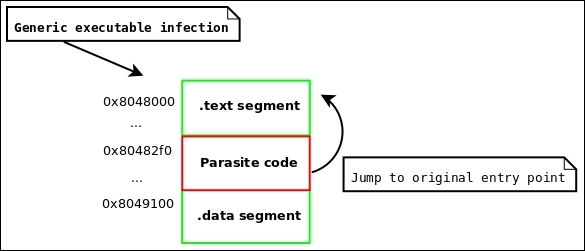
Figure 4.1: Generic infection to an executable