Table of Contents for
Learning Linux Binary Analysis
 Learning Linux Binary Analysis
Published by
Packt Publishing, 2016
Learning Linux Binary Analysis
Published by
Packt Publishing, 2016
- Cover
- Table of Contents
- Learning Linux Binary Analysis
- Learning Linux Binary Analysis
- Credits
- About the Author
- Acknowledgments
- About the Reviewers
- www.PacktPub.com
- Preface
- What you need for this book
- Who this book is for
- Conventions
- Reader feedback
- Customer support
- 1. The Linux Environment and Its Tools
- Useful devices and files
- Linker-related environment points
- Summary
- 2. The ELF Binary Format
- ELF program headers
- ELF section headers
- ELF symbols
- ELF relocations
- ELF dynamic linking
- Coding an ELF Parser
- Summary
- 3. Linux Process Tracing
- ptrace requests
- The process register state and flags
- A simple ptrace-based debugger
- A simple ptrace debugger with process attach capabilities
- Advanced function-tracing software
- ptrace and forensic analysis
- Process image reconstruction – from the memory to the executable
- Code injection with ptrace
- Simple examples aren't always so trivial
- Demonstrating the code_inject tool
- A ptrace anti-debugging trick
- Summary
- 4. ELF Virus Technology �� Linux/Unix Viruses
- ELF virus engineering challenges
- ELF virus parasite infection methods
- The PT_NOTE to PT_LOAD conversion infection method
- Infecting control flow
- Process memory viruses and rootkits – remote code injection techniques
- ELF anti-debugging and packing techniques
- ELF virus detection and disinfection
- Summary
- 5. Linux Binary Protection
- Stub mechanics and the userland exec
- Other jobs performed by protector stubs
- Existing ELF binary protectors
- Downloading Maya-protected binaries
- Anti-debugging for binary protection
- Resistance to emulation
- Obfuscation methods
- Protecting control flow integrity
- Other resources
- Summary
- 6. ELF Binary Forensics in Linux
- Detecting other forms of control flow hijacking
- Identifying parasite code characteristics
- Checking the dynamic segment for DLL injection traces
- Identifying reverse text padding infections
- Identifying text segment padding infections
- Identifying protected binaries
- IDA Pro
- Summary
- 7. Process Memory Forensics
- Process memory infection
- Detecting the ET_DYN injection
- Linux ELF core files
- Summary
- 8. ECFS – Extended Core File Snapshot Technology
- The ECFS philosophy
- Getting started with ECFS
- libecfs – a library for parsing ECFS files
- readecfs
- Examining an infected process using ECFS
- The ECFS reference guide
- Process necromancy with ECFS
- Learning more about ECFS
- Summary
- 9. Linux /proc/kcore Analysis
- stock vmlinux has no symbols
- /proc/kcore and GDB exploration
- Direct sys_call_table modifications
- Kprobe rootkits
- Debug register rootkits – DRR
- VFS layer rootkits
- Other kernel infection techniques
- vmlinux and .altinstructions patching
- Using taskverse to see hidden processes
- Infected LKMs – kernel drivers
- Notes on /dev/kmem and /dev/mem
- /dev/mem
- K-ecfs – kernel ECFS
- Kernel hacking goodies
- Summary
- Index
This method is extremely powerful and, although easily detectable, is also relatively easy to implement and provides reliable code insertion. The idea is to convert the PT_NOTE segment to the PT_LOAD type and move its position to go after all of the other segments. Of course, you could also just create an entirely new segment by creating a PT_LOAD phdr entry, but since a program will still execute without a PT_NOTE segment, you might as well convert it to PT_LOAD. I have not personally implemented this technique for a virus, but I have designed a feature in Quenya v0.1 that allows you to add a new segment. I also did an analysis of the Retaliation Linux virus authored by Jpanic, which uses this method for infection:
http://www.bitlackeys.org/#retaliation.
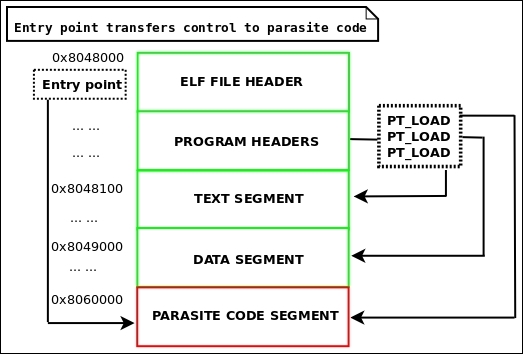
Figure 4.5: PT_LOAD infection
There are no strict rules about the PT_LOAD infection. As mentioned here, you may convert PT_NOTE into PT_LOAD or create an entirely new PT_LOAD phdr and segment.
- Locate the data segment
phdr:- Find the address where the data segment ends:
ds_end_addr = phdr->p_vaddr + p_memsz
- Find the file offset of the end of the data segment:
ds_end_off = phdr->p_offset + p_filesz
- Get the alignment size used for the loadable segment:
align_size = phdr->p_align
- Find the address where the data segment ends:
- Locate the
PT_NOTEphdr:- Convert phdr to PT_LOAD:
phdr->p_type = PT_LOAD;
- Assign it this starting address:
ds_end_addr + align_size
- Assign it a size to reflect the size of your parasite code:
    phdr->p_filesz += parasite_size
    phdr->p_memsz += parasite_size
- Convert phdr to PT_LOAD:
- Use
ehdr->e_shoff += parasite_sizeto account for the new segment. - Insert the parasite code by writing a new binary to reflect the ELF header changes and new segment.