So far, we’ve considered decision trees and random forest algorithms. We saw that random forest is a bagging (bootstrap aggregating) algorithm—it combines the output of multiple decision trees to give the prediction. Typically, in a bagging algorithm trees are grown in parallel to get the average prediction across all trees, where each tree is built on a sample of original data.
Gradient boosting , on the other hand, does the predictions using a different format. Instead of parallelizing the tree building process, boosting takes a sequential approach to obtaining predictions. In gradient boosting, each decision tree predicts the error of the previous decision tree—thereby boosting (improving) the error (gradient).
Working details of gradient boosting
How gradient boosting is different from random forest
The working details of AdaBoost
The impact of various hyper-parameters on boosting
How to implement gradient boosting in R and Python
Gradient Boosting Machine
Gradient refers to the error, or residual, obtained after building a model. Boosting refers to improving. The technique is known as gradient boosting machine, or GBM. Gradient boosting is a way to gradually improve (reduce) error.
To see how GBM works, let’s begin with an easy example. Assume you’re given a model M (which is based on decision tree) to improve upon. Let’s say the current model accuracy is 80%. We want to improve on that.
We’ll express our model as follows:
Y is the dependent variable and M(x) is the decision tree using the x independent variables.
Now we’ll predict the error from the previous decision tree:
G(x) is another decision tree that tries to predict the error using the x independent variables.
In the next step, similar to the previous step, we build a model that tries to predict error2 using the x independent variables:
Now we combine all these together:
The preceding equation is likely to have an accuracy that is greater than 80% as individually model M (single decision tree) had 80% accuracy, while in the above equation we are considering 3 decision trees.
The next section explores the working details of how GBM works. In a later section, we will see how an AdaBoost (adaptive boosting) algorithm works.
Working details of GBM
- 1.
Initialize predictions with a simple decision tree.
- 2.
Calculate residual - which is the (actual-prediction) value.
- 3.
Build another shallow decision tree that predicts residual based on all the independent values.
- 4.
Update the original prediction with the new prediction multiplied by learning rate.
- 5.
Repeat steps 2 through 4 for a certain number of iterations (the number of iterations will be the number of trees).
In the preceding code, we are fitting the decision tree where the dependent variable is the residual and the independent variables are the original independent variables of the dataset.
In that code, the original predictions (which are stored in the X_train dataset) are updated with the predicted residuals we obtained in the previous step.
Note that we are updating our predictions by the prediction of residual (dt_pred_train_errorn). We have explicitly given a *1 in the preceding code because the concept of shrinkage or learning rate will be explained in the next section (the *1 will be replaced by *learning_rate).
Here we update the predictions on the test dataset. We do not know the residuals of test dataset, but we update predictions on the test dataset on the basis of the decision tree that got built to predict the residuals of the training dataset. Ideally, if the test dataset has no residuals, the predicted residuals should be close to 0, and if the original decision tree of the test dataset had some residuals, then the predicted residuals would be away from 0.
Once the predictions of the test dataset are updated, we print out the AUC of the test dataset.
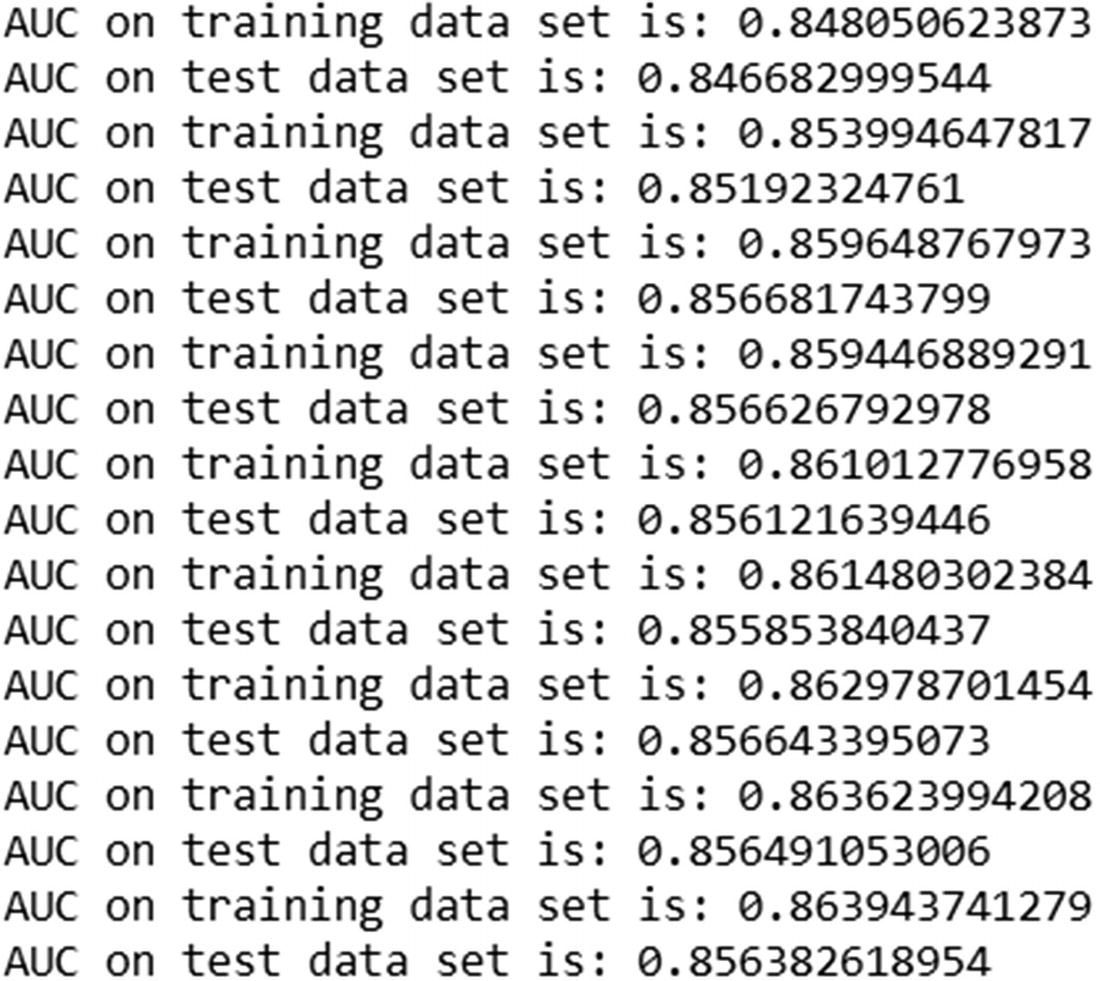
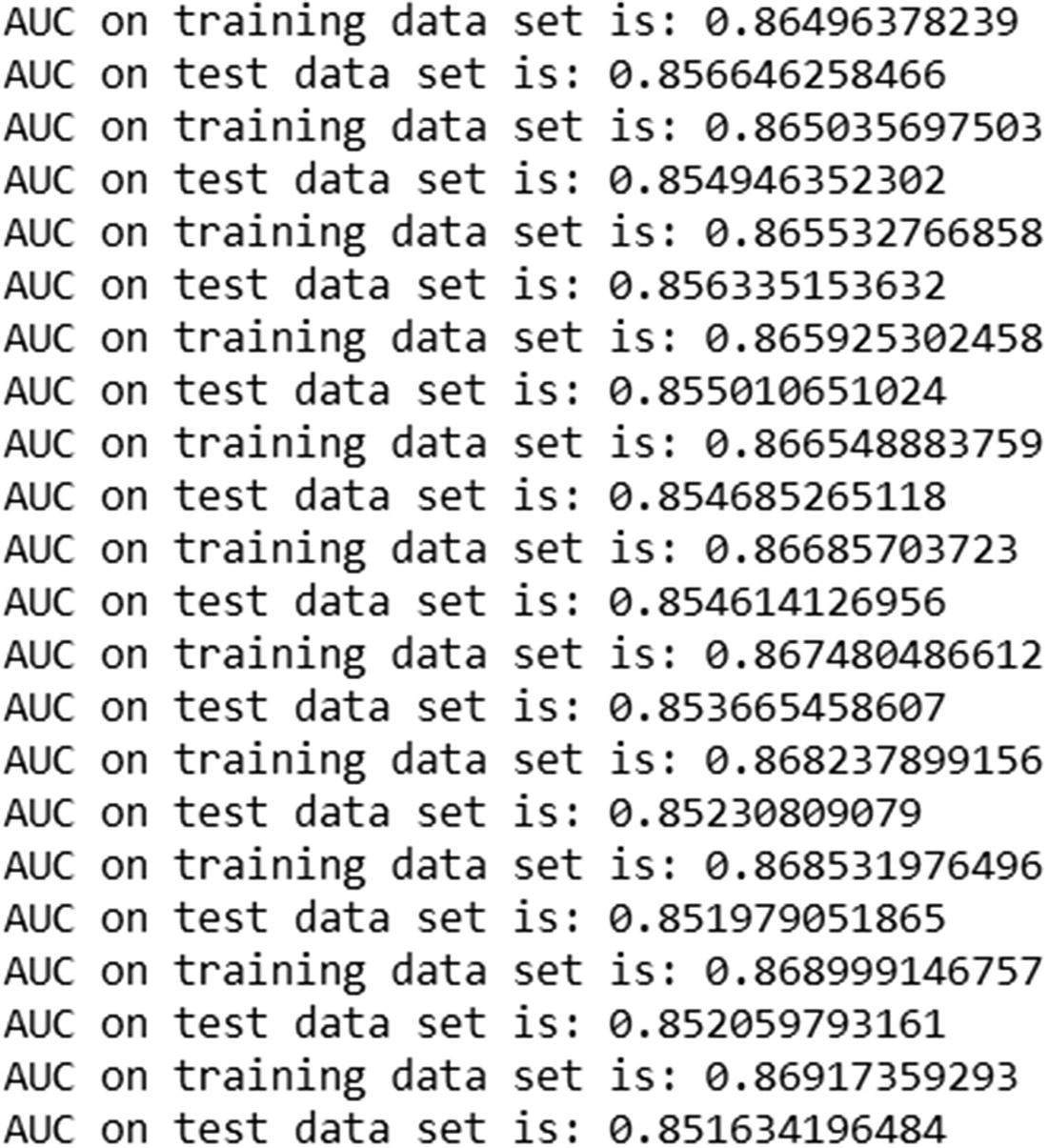
Note that the AUC of train dataset keeps on increasing with more trees. But the AUC of the test dataset decreases after a certain iteration.
Shrinkage
The output of the preceding code is:
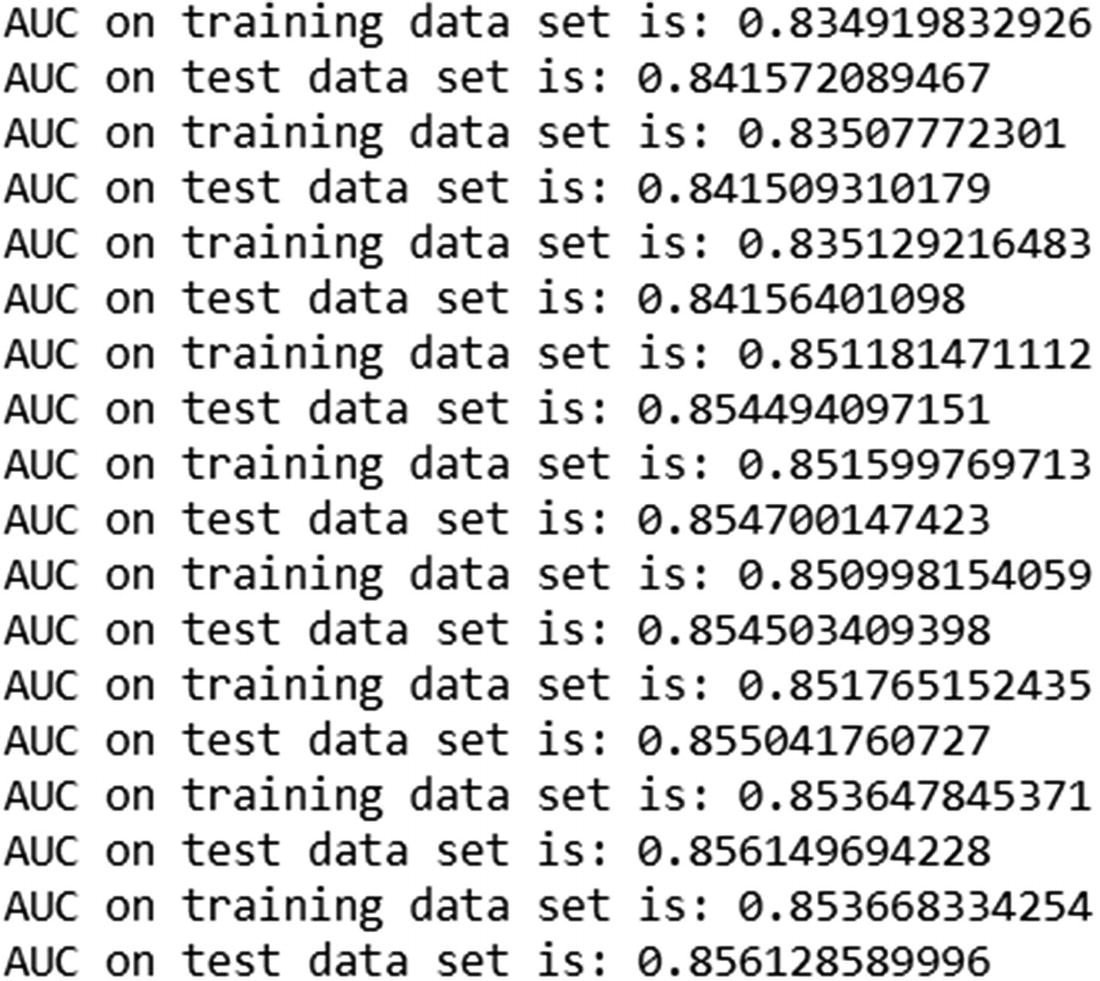
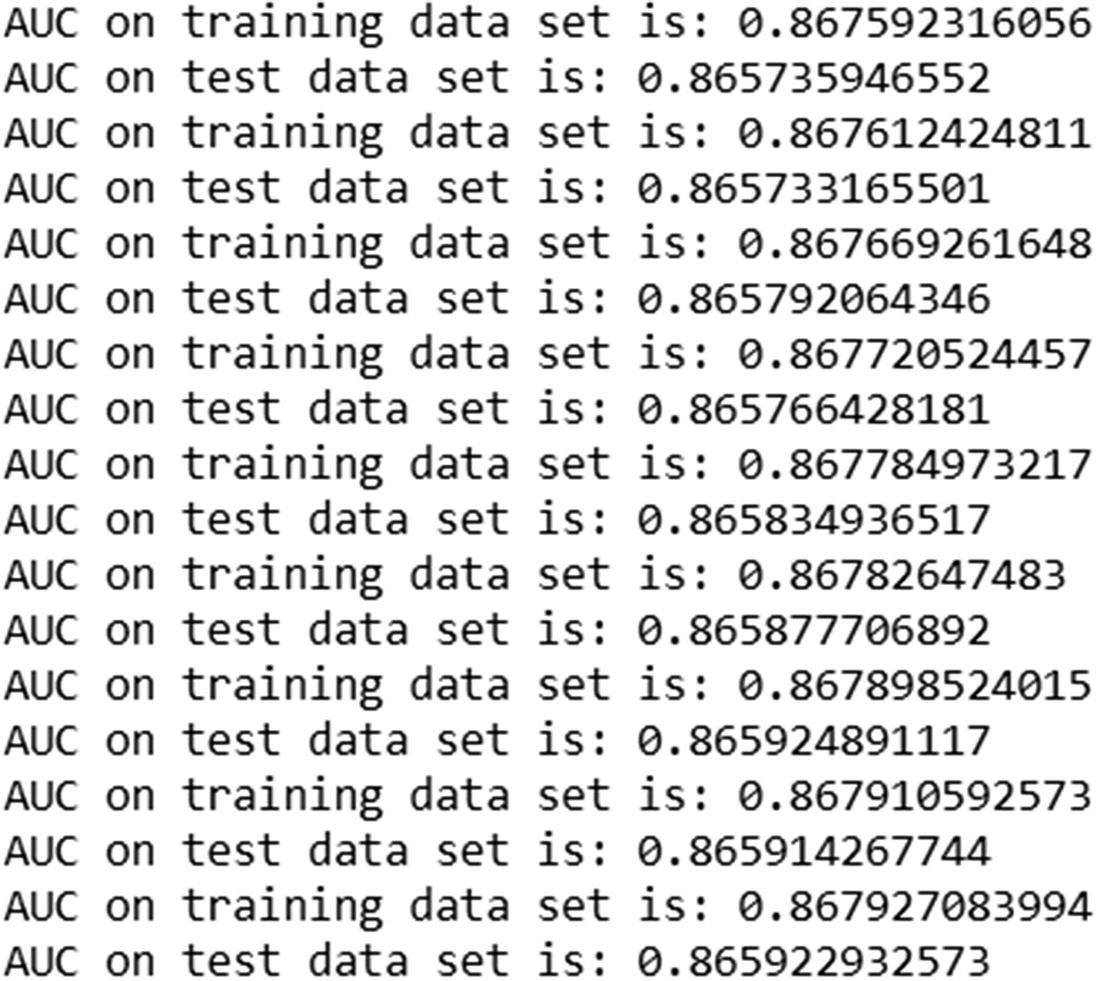
Unlike in the previous case, where learning_rate = 1, lower learning_rate resulted in the test dataset AUC increasing consistently along with the training dataset AUC.
AdaBoost
Before proceeding to the other methods of boosting, I want to draw a parallel from what we’ve seen in previous chapters. While calculating the error metric for logistic regression, we could have gone with the traditional squared error. But we moved to the entropy error, because it penalizes more for high amount of error.
In a similar manner, residual calculation can vary by the type of dependent variable. For a continuous dependent variable, residual calculation can be Gaussian ((actual – prediction) of dependent variable), whereas for a discrete variable, residual calculation could be different.
Theory of AdaBoost
- 1.Build a weak learner (decision tree technique in this case) using only a few independent variables.
- a.
Note that while building the first weak learner, the weightage associated with each observation is the same.
- a.
- 2.
Identify the observations that are classified incorrectly based on the weak learner.
- 3.
Update the weights of the observations in such a way that the misclassifications in the previous weak learner are given more weightage and the correct classifications in the previous weak learner are given less weightage.
- 4.
Assign a weightage for each weak learner based on the accuracy of its predictions.
- 5.
The final prediction will be based on the weighted average prediction of multiple weak learners.
Adaptive potentially refers to the updating of weights of observations, depending on whether the previous classification was correct or incorrect. Boosting potentially refers to assigning the weightages to each weak learner.
Working Details of AdaBoost
- 1.
Build a weak learner.
Let’s say the dataset is the first two columns in the following table (available as “adaboost.xlsx” in github):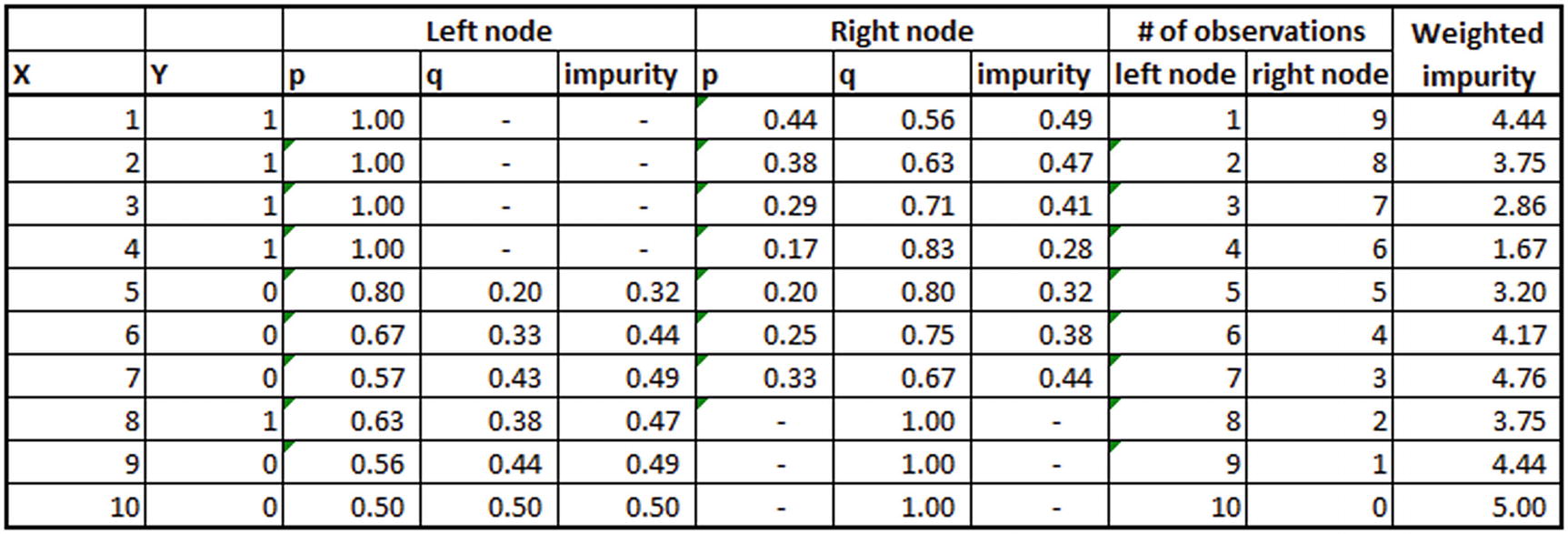
Once we have the dataset, we build a weak learner (decision tree) according to the steps laid out to the right in the preceding table. From the table we can see that X <= 4 is the optimal splitting criterion for this first decision tree.
- 2.Calculate the error metric (the reason for having “Changed Y” and “Yhat” as new columns in the below table will be explained after step 4):
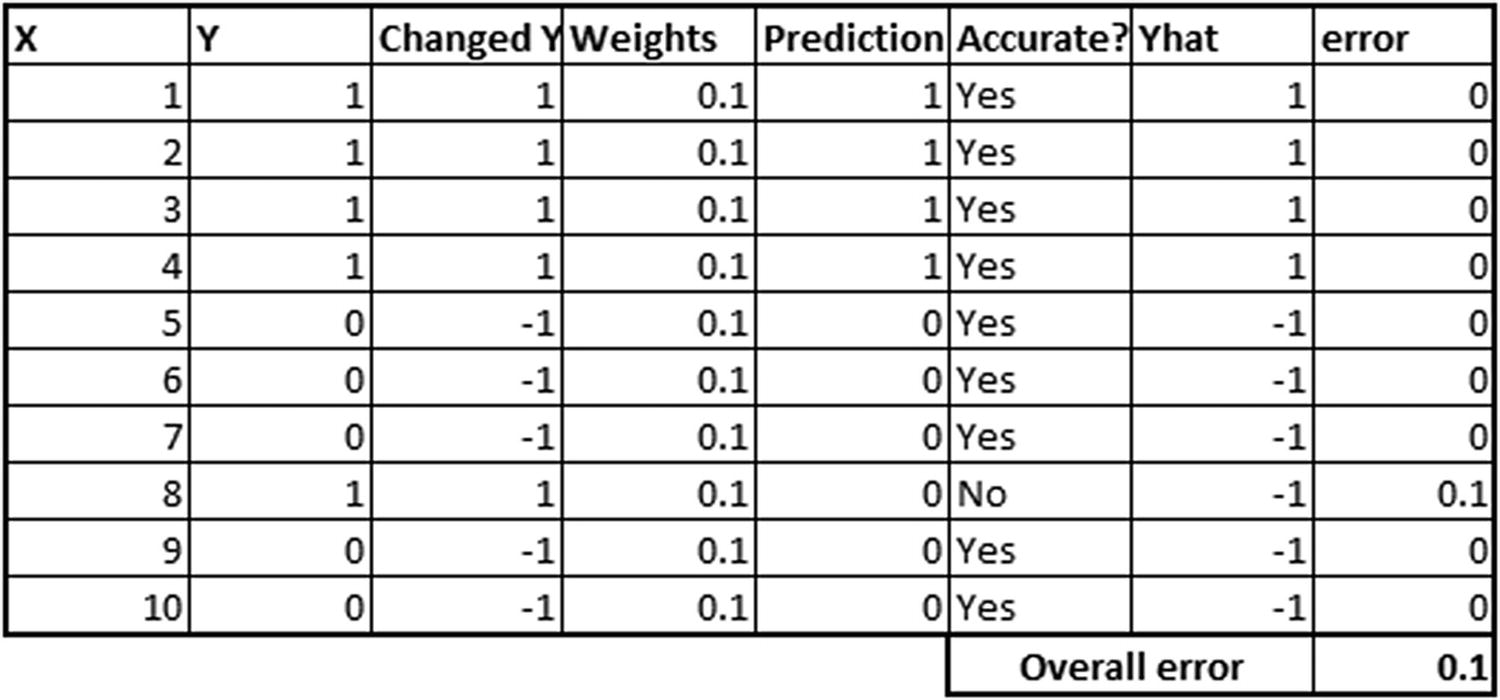 The formulae used to obtain the preceding table are as follows: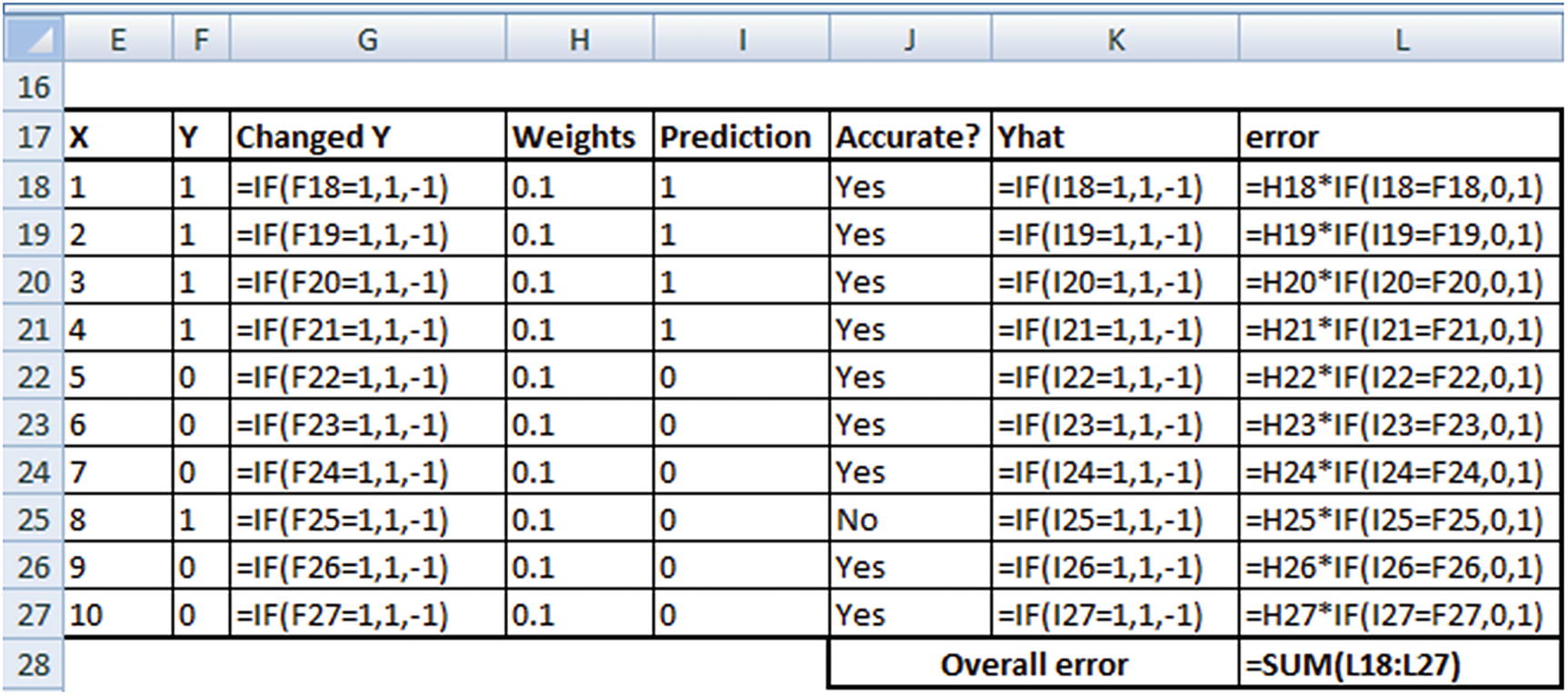
- 3.
Calculate the weightage that should be associated with the first weak learner:
0.5 × log((1 – error)/error) = 0.5 × log(0.9 / 0.1) = 0.5 × log(9) = 0.477
- 4.Update the weights associated with each observation in such a way that the previous weak learner’s misclassifications have high weight and the correct classifications have low weight (essentially, we are tuning the weights associated with each observation in such a way that, in the new iteration, we try and make sure that the misclassifications are predicted more accurately):
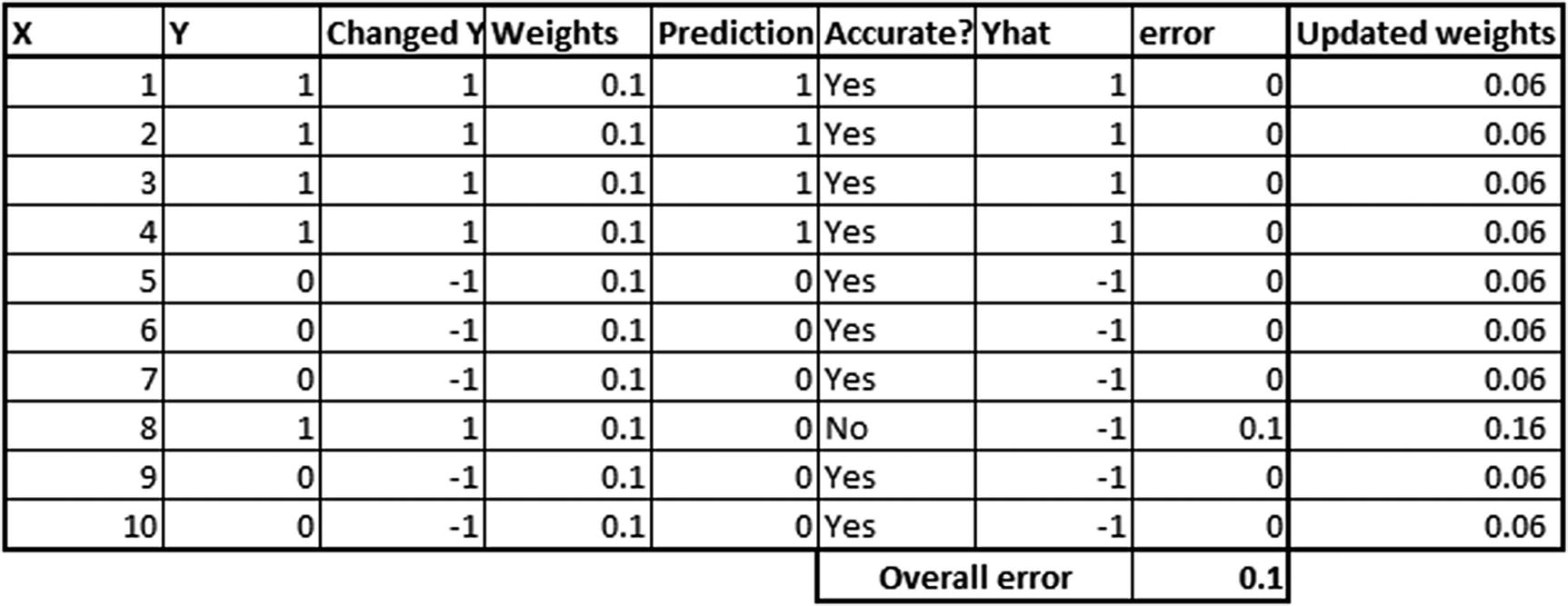 Note that the updated weights are calculated by the following formula:
That formula should explain the need for changing the discrete values of y from {0,1} to {–1,1}. By changing 0 to –1, we are in a position to perform the multiplication better. Also note that in the preceding formula, weightage associated with the learner in general would more often than not be positive.
When yhat and changed_y are the same, the exponential part of formula would be a lower number (as the – weightage of learner × yhat × changed_y part of the formula would be negative, and an exponential of a negative is a small number).
When yhat and changed_y are different values, that’s when the exponential would be a bigger number, and hence the updated weight would be more than the original weight.
- 5.
We observe that the updated weights we obtained earlier do not sum up to 1. We update each weight in such a way that the sum of weights of all observations is equal to 1. Note that, the moment weights are introduced, we can consider this as a regression exercise.
Now that the weight for each observation is updated, we repeat the preceding steps until the weight of the misclassified observations increases so much that it is now correctly classified: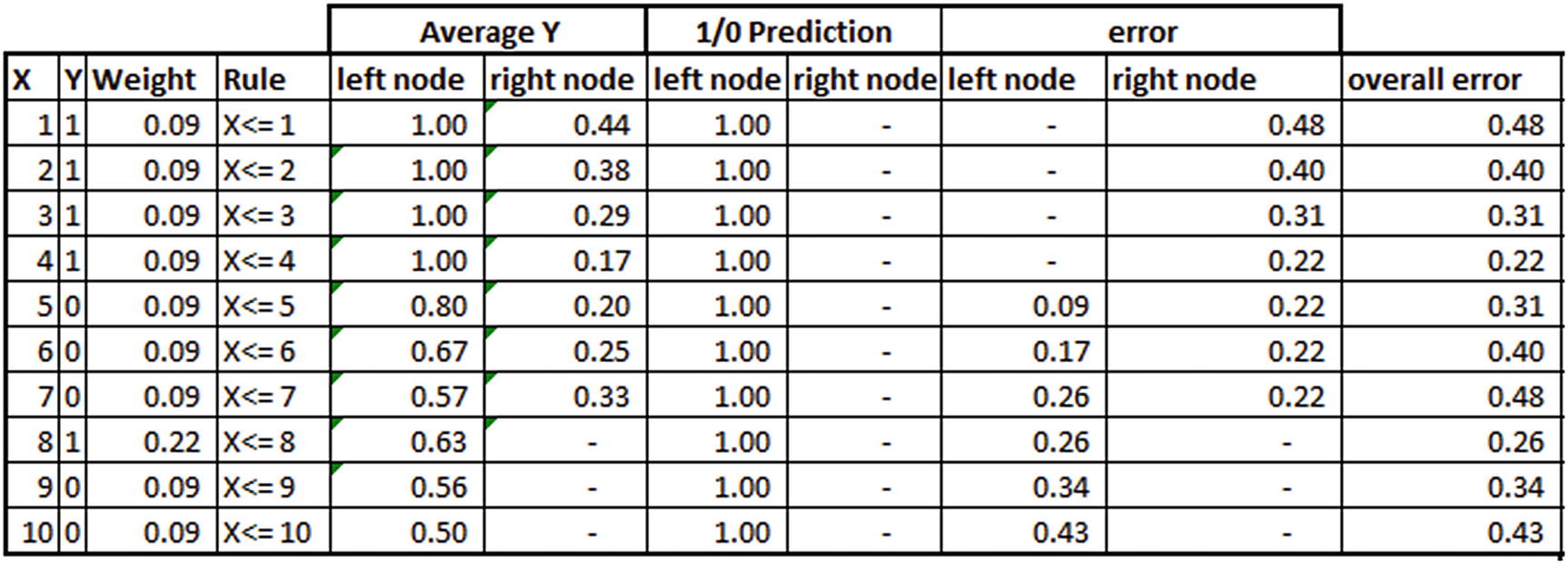
Note that the weights in the third column in the preceding table are updated based on the formula we derived earlier post normalization (ensuring that the sum of weights is 1).
You should be able to see that the weight associated with misclassification (the eighth observation with the independent variable value of 8) is more than any other observation.
Note that although everything is similar to a typical decision tree till the prediction columns, error calculation gives emphasis to weights of observations. error in the left node is the summation of the weight of each observation that was misclassified in the left node and similarly for the right node.
overall error is the summation of error across both nodes (error in left node + error in right node).
In this instance, overall error is still the least at the fourth observation.
The updated weights based on the previous step are as follows: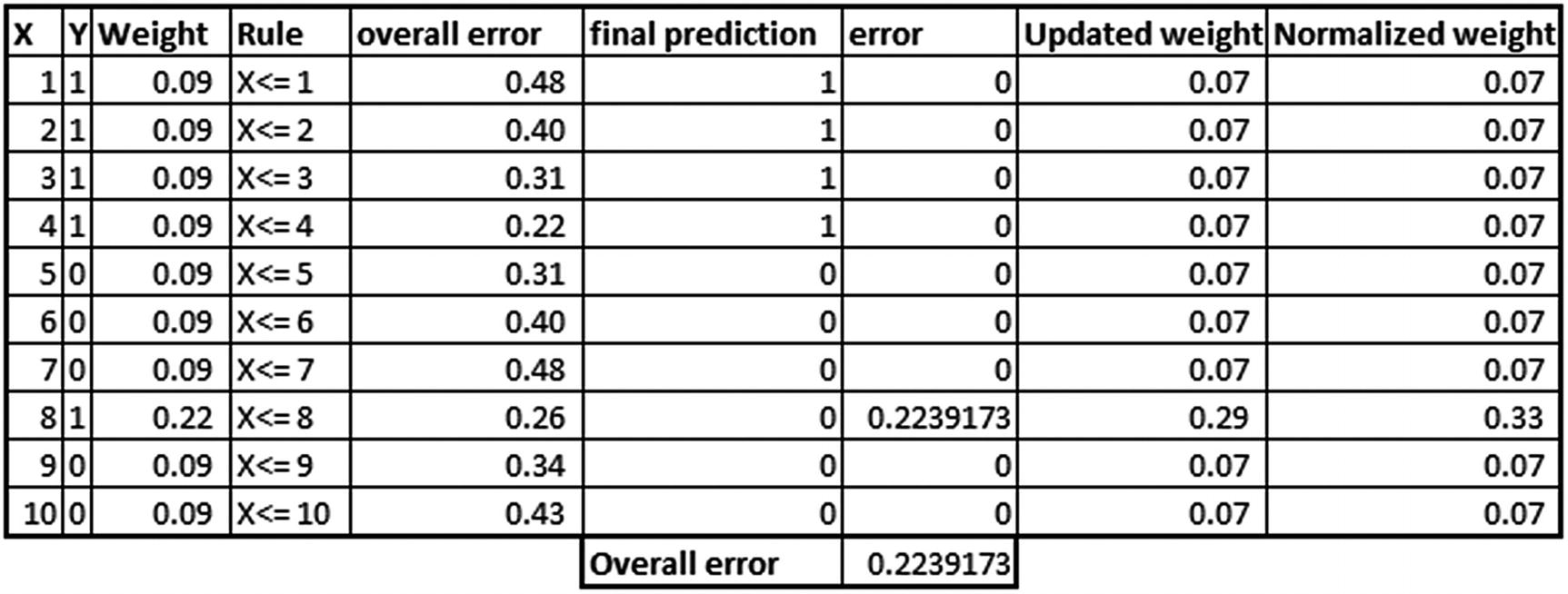 Continue the process one more time: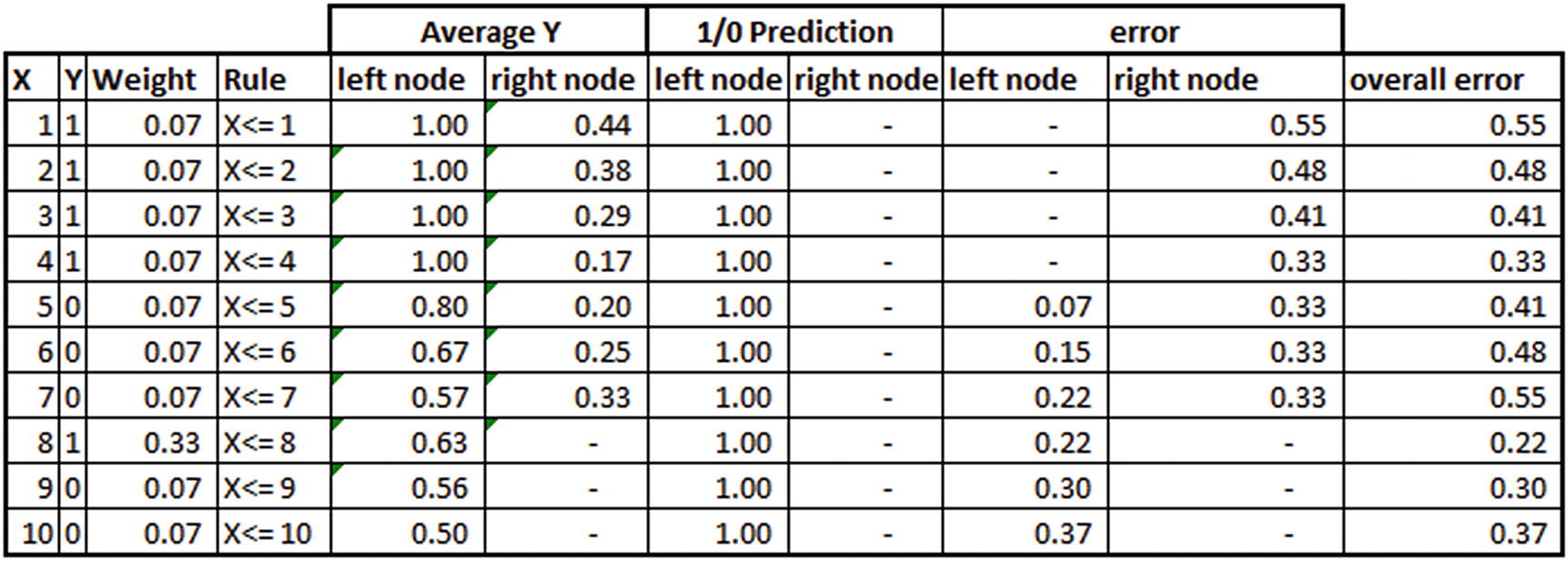
From the preceding table, note that overall error in this iteration is minimum at X <= 8, as the weight associated with the eighth observation is a lot more than other observations, and hence overall error came up as the least at the eighth observation this time. However, note that the weightage associated with the preceding tree would be low, because the accuracy of that tree is low when compared to the previous two trees.
- 6.
Once all the predictions are made, the final prediction for an observation is calculated as the summation of the weightage associated with each weak learner multiplied by the probability output for each observation.
Additional Functionality for GBM
Row sampling: In random forest, we saw that sampling a random selection of rows results in a more generalized and better model. In GBM, too, we can potentially sample rows to improve the model performance further.
Column sampling: Similar to row sampling, some amount of overfitting can be avoided by sampling columns for each decision tree.
Both random forest and GBM techniques are based on decision tree. However, a random forest can be thought of as building multiple trees in parallel, where in the end we take the average of all the multiple trees as the final prediction. In a GBM, we build multiple trees, but in sequence, where each tree tries to predict the residual of its previous tree.
Implementing GBM in Python
Note that the key input parameters are a loss function (whether it is a normal residual approach or an AdaBoost-based approach), learning rate, number of trees, depth of each tree, column sampling, and row sampling.
Implementing GBM in R
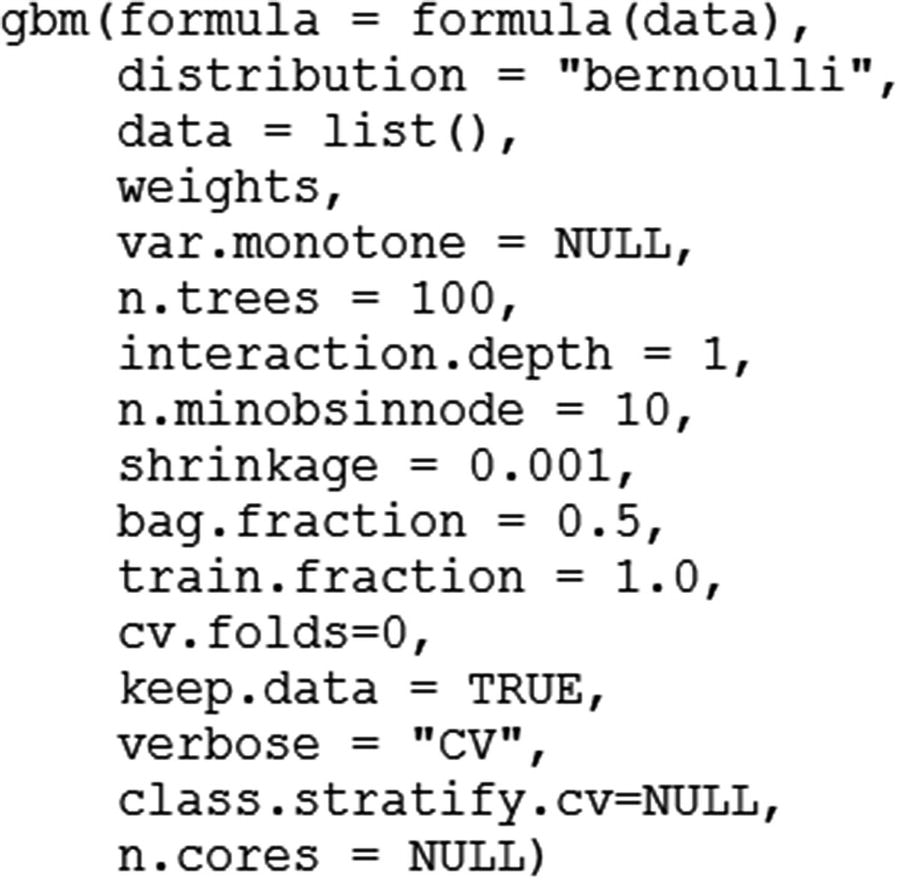
In that formula, we specify the dependent and independent variables in the following fashion: dependent_variable ~ the set of independent variables to be used.
n. trees specifies the number of trees to be built.
interaction.depth is the max_depth of the trees.
n.minobsinnode is the minimum number of observations in a node.
shrinkage is the learning rate.
bag.fraction is the fraction of the training set observations randomly selected to propose the next tree in the expansion.
GBM algorithm in R is run as follows:
Summary
GBM is a decision tree–based algorithm that tries to predict the residual of the previous decision tree in a given decision tree.
Shrinkage and depth are some of the more important parameters that need to be tuned within GBM.
The difference between gradient boosting and adaptive boosting.
How tuning the learning rate parameter improves prediction accuracy in GBM.