Table of Contents for
DK Eyewitness Travel Guide Scotland
 DK Eyewitness Travel Guide Scotland
Published by
DK Eyewitness Travel, 2019
DK Eyewitness Travel Guide Scotland
Published by
DK Eyewitness Travel, 2019
- COVER
- Half Title
- CONTENTS
- DISCOVER SCOTLAND
- Welcome to Scotland
- Reasons to Love Scotland
- Explore Scotland
- Discover Itineraries
- Scotland Itineraries
- 7 Days On the North Coast 500
- Scotland for Outdoor Adventures
- Scotland for Wildlife Encounters
- Scotland for Spectacular Castles
- Scotland for Bookworms
- Scotland for Art Lovers
- Scotland for Music Lovers
- Scotland for Foodies
- Scottish Spirit
- Scotland for Families
- Scotland for Beachgoers
- Scotland on Screen
- A Year in Scotland
- A Brief History
- EXPERIENCE SCOTLAND
- Edinburgh
- Area Map - Edinburgh
- 2 Days
- Edinburgh’s Summer Festivals
- Quiet Escapes Edinburgh’s
- Edinburgh Castle
- The Royal Mile
- Calton Hill
- National Museum of Scotland
- Scottish National Gallery
- Experience More
- A Short Walk - New Town
- A Long Walk - Water of Leith Walkway
- Southern Scotland
- Area Map - Southern Scotland
- Culzean Castle and Country Park
- Abbotsford
- Experience More
- Glasgow
- Area Map - Glasgow
- 2 Days in Glasgow
- Glasgow’s Industrial Heritage
- Basilica di San Marco
- Kelvingrove Art Gallery and Museum
- Experience More
- Central and Northeast Scotland
- Area Map - Central and Northeast Scotland
- The Veneto and Friuli
- Scone Palace
- Loch Lomond and the Trossachs National Park
- Stirling Castle
- Experience More
- The Highlands and Islands
- Area Map - The Highlands and Islands
- Highland Traditions and Culture
- Remote Island Getaways
- Ben Nevis
- Cairngorms National Park
- The Great Glen
- Isle of Skye
- Orkney Islands
- Shetland Islands
- Outer Hebrides
- Experience More
- A Driving Tour - Road to the Isles
- NEED TO KNOW
- Before You Go
- Getting Around
- Practical Information
- Scottish Vocabulary
- ACKNOWLEDGEMENTS AND IMPRINTS
- Copyright
- Navigational Contents
A3, B2⌂ Western Isles, Outer Hebrides~ Stornoway, Benbecula, Barrag from Uig (Skye), Oban, Mallaig, Kyle of Lochalsh & Ullapooln 26 Cromwell St, Stornoway, Lewis
∑ visitouterhebrides.co.uk
Western Scotland ends with this remote chain of islands, made of some of the oldest rock on earth. Barren landscapes are divided by countless waterways, while the western, windward coasts are edged by white sandy beaches.
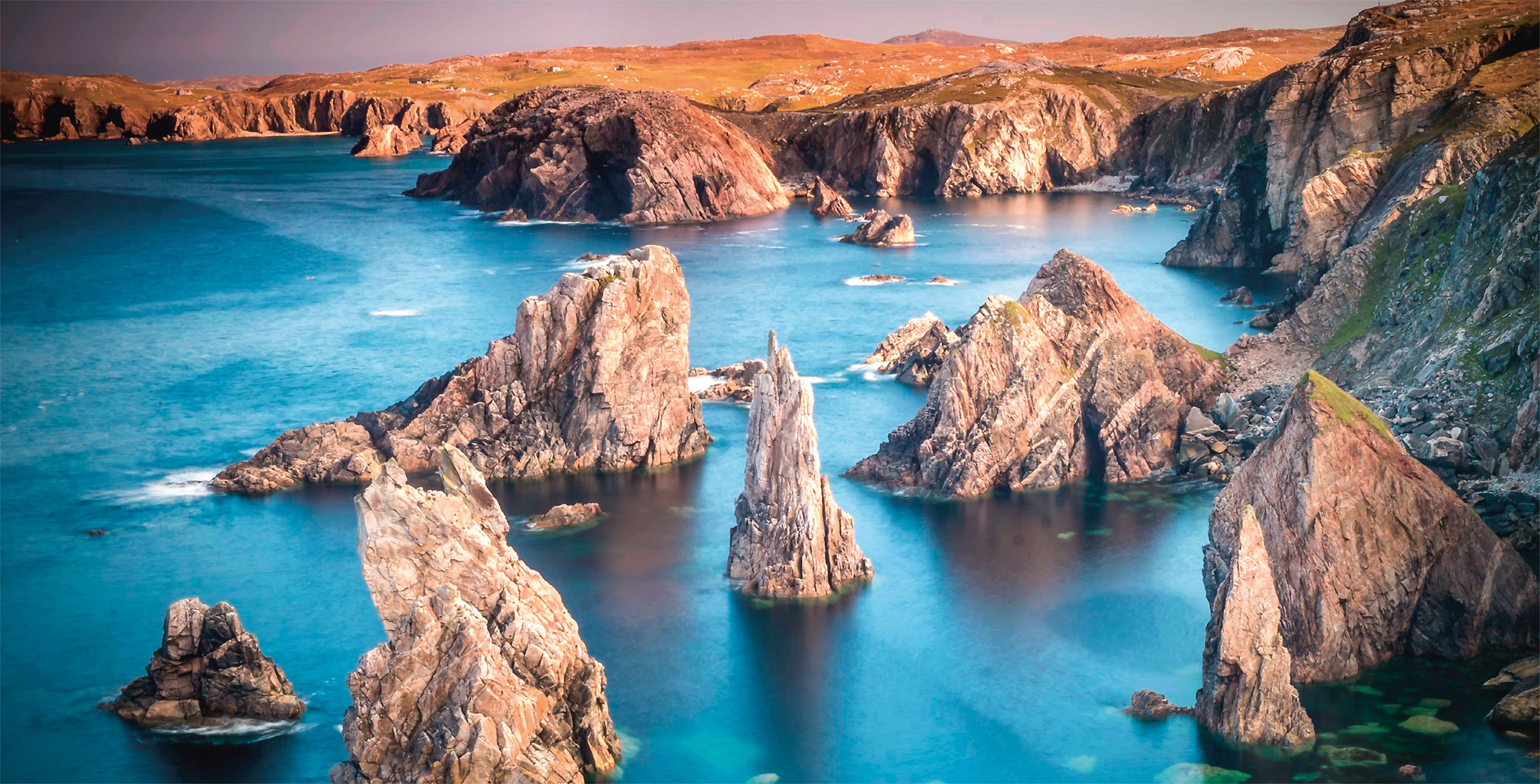
t Cliffs and sea stacks near Mangersta, on the west coast of Lewis
Hundreds of windswept and beautiful islands lie scattered off Scotland’s northwest coast. Some are tiny rocky skerries inhabited only by seabirds, while others are home to bustling farming and fishing communities. White sandy bays fringe these rugged coasts, bordered by sweet-smelling natural wild-flower meadows known as machair that pepper the land with splashes of yellow, white, blue and pink.
In the low-lying hinterlands, vast peat bogs provide many homes with fuel, and the rich tang of peat smoke is the signature scent of the isles. These are some of the longest-inhabited parts of Scotland, with ancient standing stones attesting to over 6,000 years of human settlement, though abandoned dwellings and monuments attest to the difficulties in commercializing traditional local skills. Home to Scotland’s largest Gaelic-speaking community, many islanders use the ancient Celtic tongue as their first language.
Experience The Highlands and Islands
n Double-tap image to read the labels
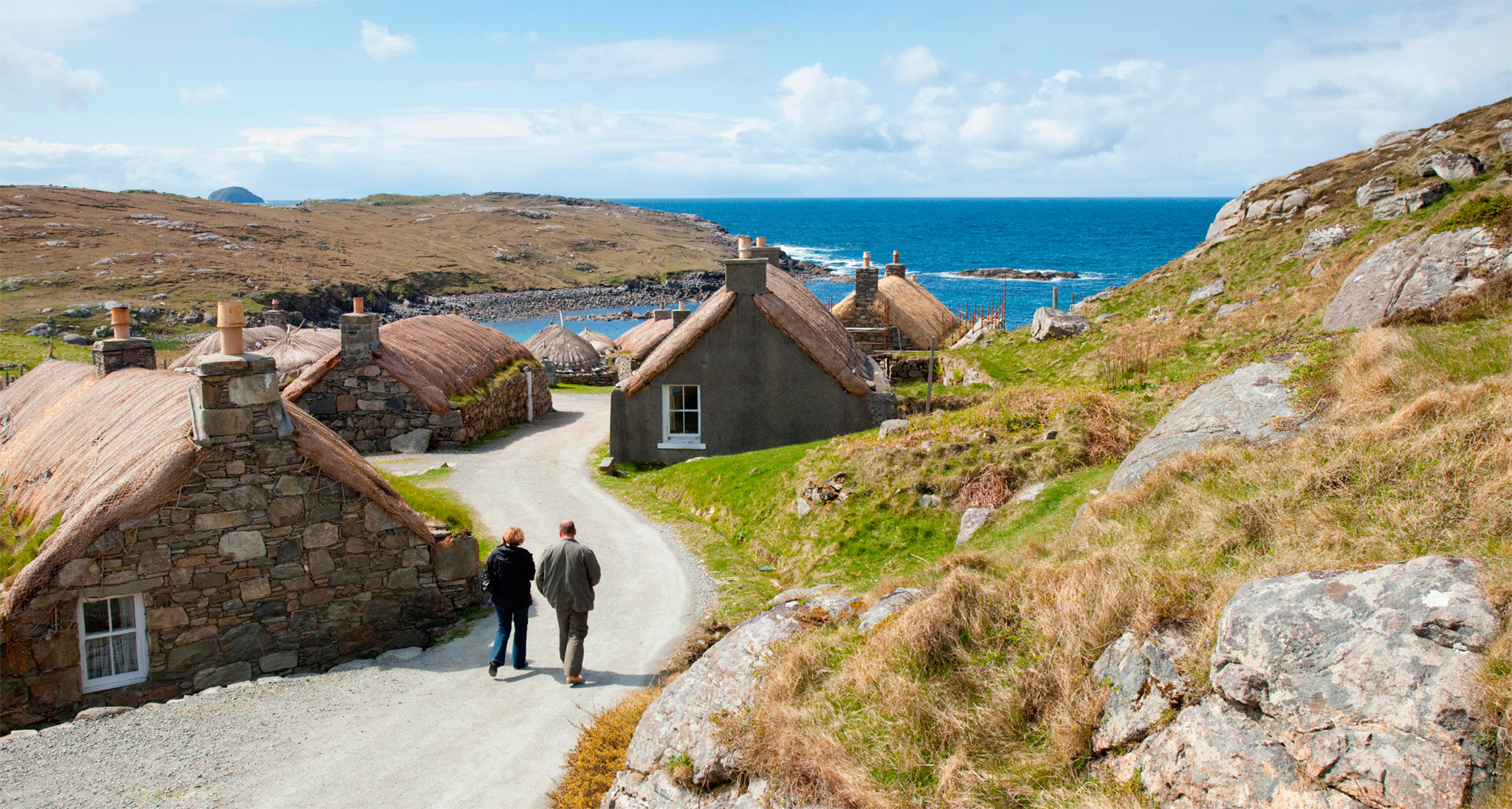
t The quaint village of Gearrannan Blackhouse, Carloway, Lewis
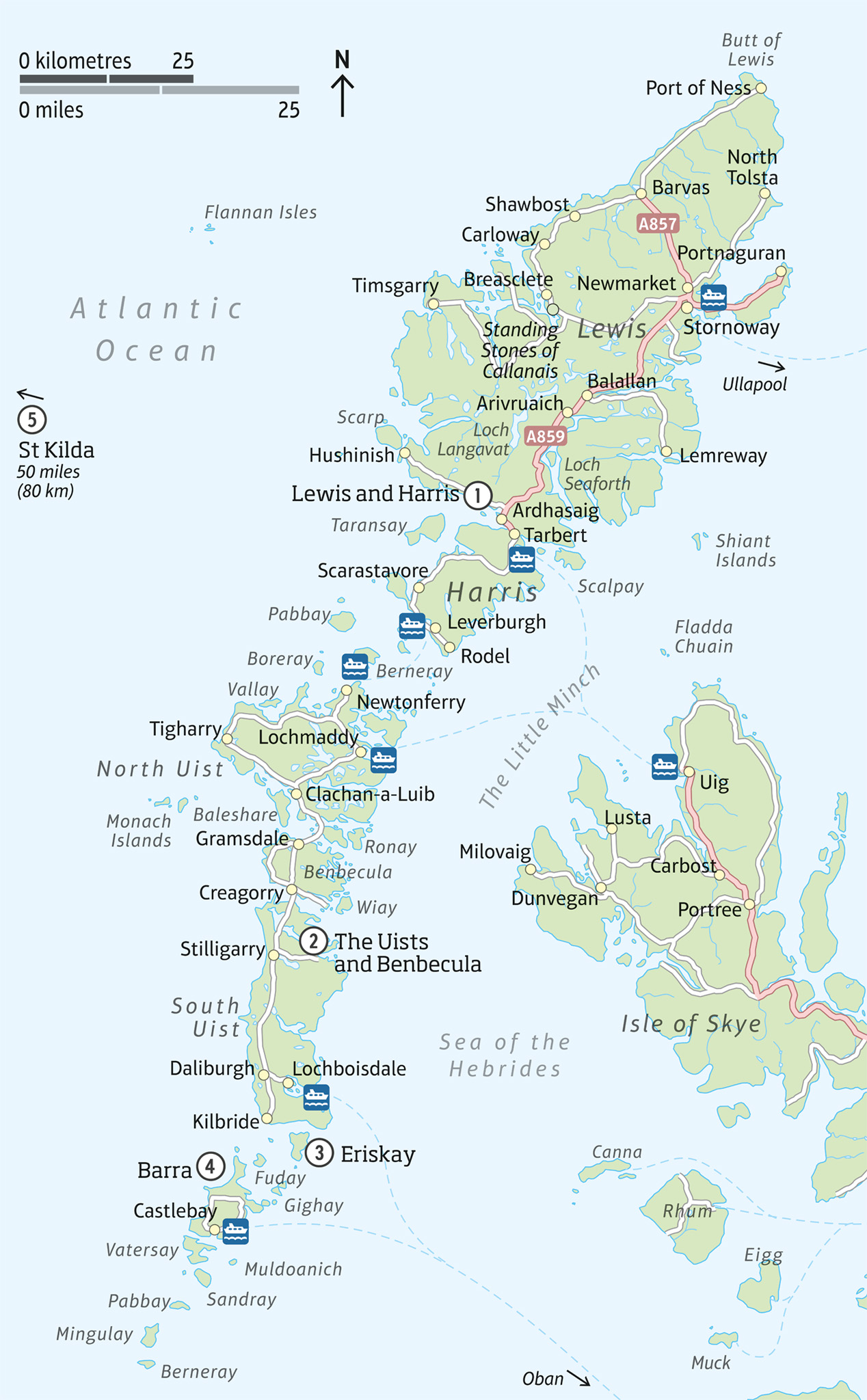
Forming the largest landmass of the Western Isles, Lewis and Harris are a single island, though Gaelic dialects differ between the two areas. The administrative centre of Stornoway is a bustling harbour town with colourful house fronts. The Museum nan Eilean offers a fascinating insight into the culture, language and traditions of the people of the Outer Hebrides. From here, the ancient Standing Stones of Callanais are only 26 km (16 miles) to the west. Just off the road on the way to Callanish are the cone-shaped ruins of Carloway Broch, a Pictish tower over 2,000 years old. The more recent past can be explored at The Blackhouse in Arnol – a showcase of rural crofting life as it was until 50 years ago.
South of the rolling peat moors of Lewis, a range of mountains marks the border with Harris, which is entered via the head of Loch Seaforth. The mountains of Harris are a paradise for hill walkers, offering views of the distant islands of St Kilda 80 km (50 miles) to the west.
The ferry port of Tarbert stands on a slim isthmus separating North and South Harris. The tourist office provides addresses for local weavers of the tough Harris Tweed. Some weavers still use indigenous plants to create the dyes. From Leverburgh a ferry sails to North Uist, linked by a causeway to Berneray.
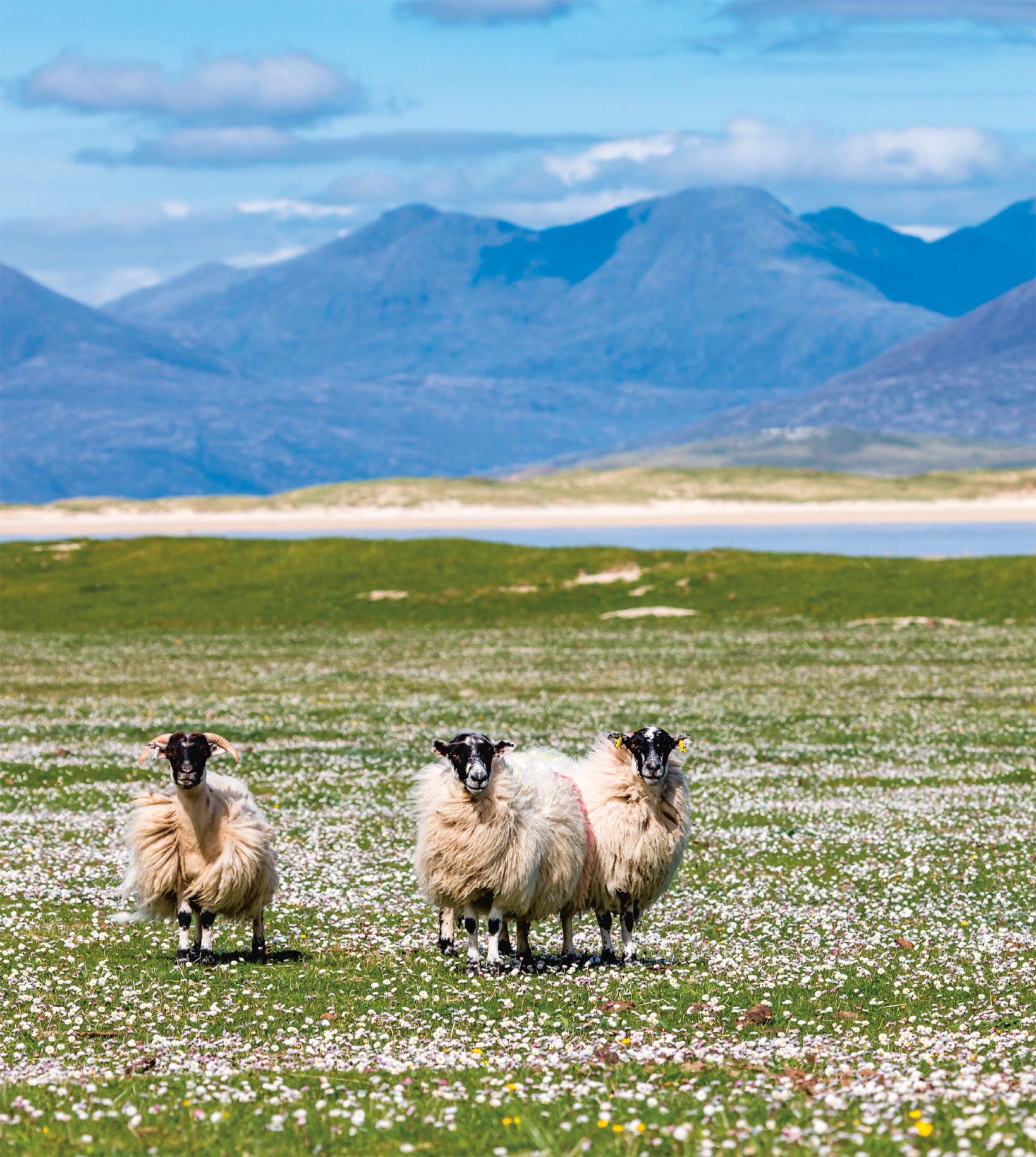
t Sheep in wild-flower meadows on rugged and remote Harris
Museum nan Eilean
" - = ⌂ Lews Castle grounds, Stornoway ∑ lews-castle.co.uk
The Blackhouse
' " ⌂ Arnol § (01851) 710 395 # Apr–Sep: Mon–Sat; Oct–Mar: Mon, Tue & Thu–Sat
∑ historicenvironment.scot
Experience The Highlands and Islands
|
EAT Crown Inn This cosy inn doubles as a lively bar-restaurant that hosts occasional live performances by local musicians. B2⌂ Castle St, Stornoway, Lewis ]]] Langass Lodge Locally caught seafood and produce from Langass’s own garden feature on the menu at this small restaurant with rooms. A3⌂Locheport, North Uist ]]] |
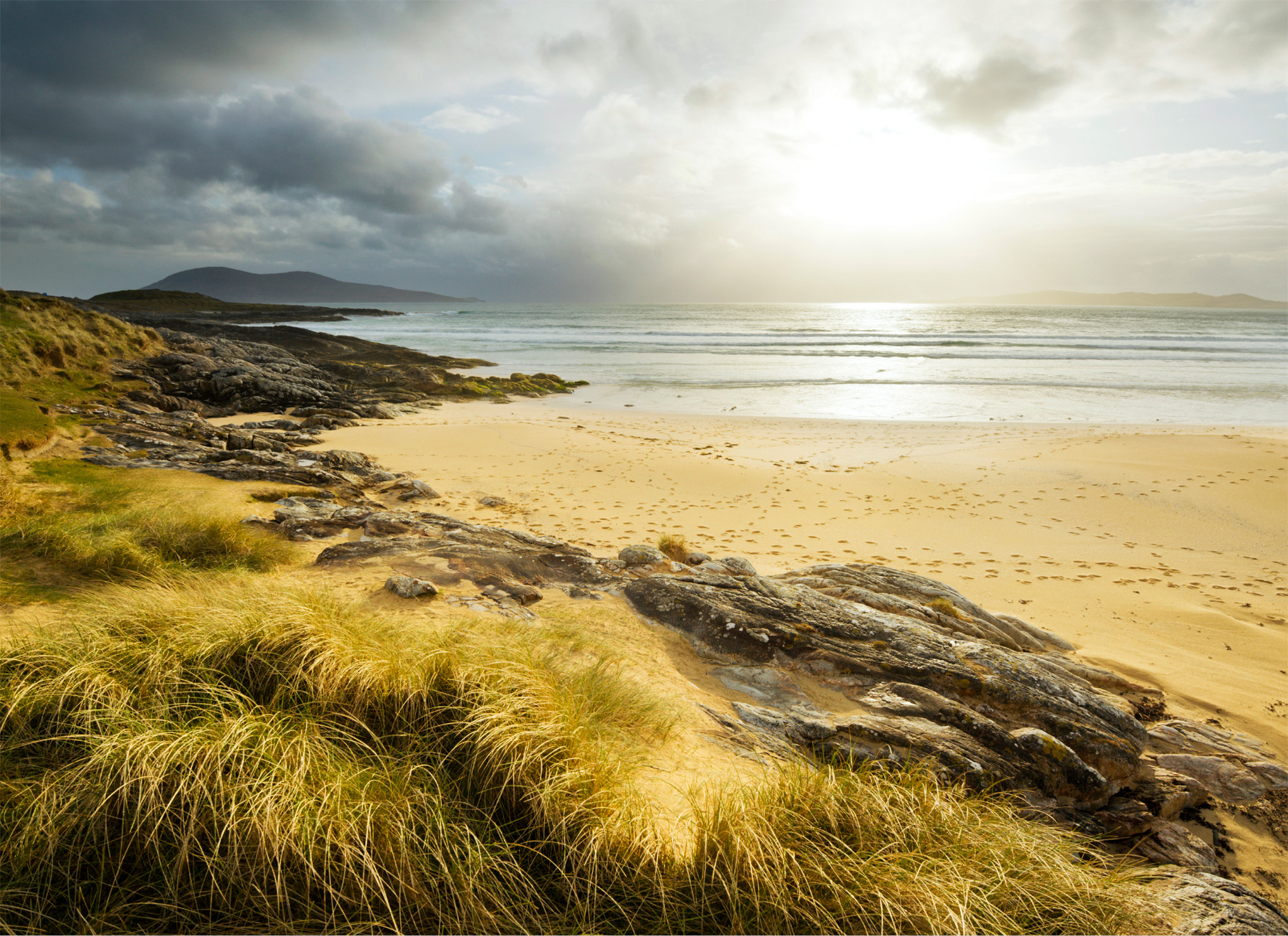
t Windswept Nisabost Beach, Harris
After the dramatic scenery of Harris, the lower-lying, largely waterlogged southern isles may seem an anticlimax, though they nurture secrets well worth discovering. Long, white, sandy beaches fringe the Atlantic coast, edged with one of Scotland’s natural treasures: the lime-rich soil known as machair. During the summer months, the soil is covered with wild flowers, the unique fragrance of which can be detected far out to sea.
From Lochmaddy, North Uist’s main village, the A867 crosses 5 km (3 miles) of causeway to Benbecula, the isle from which the brave Flora MacDonald smuggled Bonnie Prince Charlie to Skye. Benbecula is a flat island covered by a mosaic of small lochs. Like its neighbours, it is known for good trout fishing. Here, and to the north, the Protestant religion holds sway, while Catholicism prevails in the southern islands. Benbecula’s chief source of employment is the Army Rocket Range, which has its headquarters in the main village of Bailivanich. Another causeway leads to South Uist, which has golden beaches that are renowned as a National Scenic Area.
One of the smallest and most enchanting of the Western Isles, Eriskay epitomizes their peace and beauty. The island is best known for the wrecking of the SS Politician in 1941, which inspired the book and film Whisky Galore. A bottle from its cargo and other relics can be seen in Eriskay’s only bar. It was at the beautiful beach of Coilleag A’Phrionnsa (Prince’s beach) that Bonnie Prince Charlie first set foot on Scotland at the start of his 1745 campaign. As a result, a rare convolvulus flower that grows here has become associated with him.
The dramatic way to arrive on the pretty island of Barra is by plane – the airstrip is a beach and the timetable depends on the tide. The island has a central core of hills and circular road, with beaches on the western coast.
The view over Castlebay from the Madonna and Child statue on top of Heaval hill is particularly fine. The romantic Kisimul Castle, set on a tiny island, is the fifteenth seat of the Clan MacNeil. It is currently being restored. Other attractions are the Barra Heritage Centre and a golf course.
Kisimul Castle
" § (01871) 810313
∑ historicenvironment.scot
Barra Heritage Centre
§ (01871) 810413 # May–Sep: Mon–Sat ∑ barraheritage.com
These “Islands on the Edge of the World” were the most isolated habitation in Scotland until the ageing population requested to be evacuated in 1930. The largest gannetry in the world (40,000 pairs) is now found here. There are three islands and three sea stacks of awesome beauty, each with sheer, soaring cliffs rising as high as 425 m (1,400 ft). Such is the islands’ isolation that separate subspecies of mouse and wren have evolved here.
Tours are run by Westernedge Charters and Island Cruising. Volunteers can occasionally pay to join summer work parties on the islands, organised by the National Trust for Scotland, owners of the St Kilda World Heritage Site.
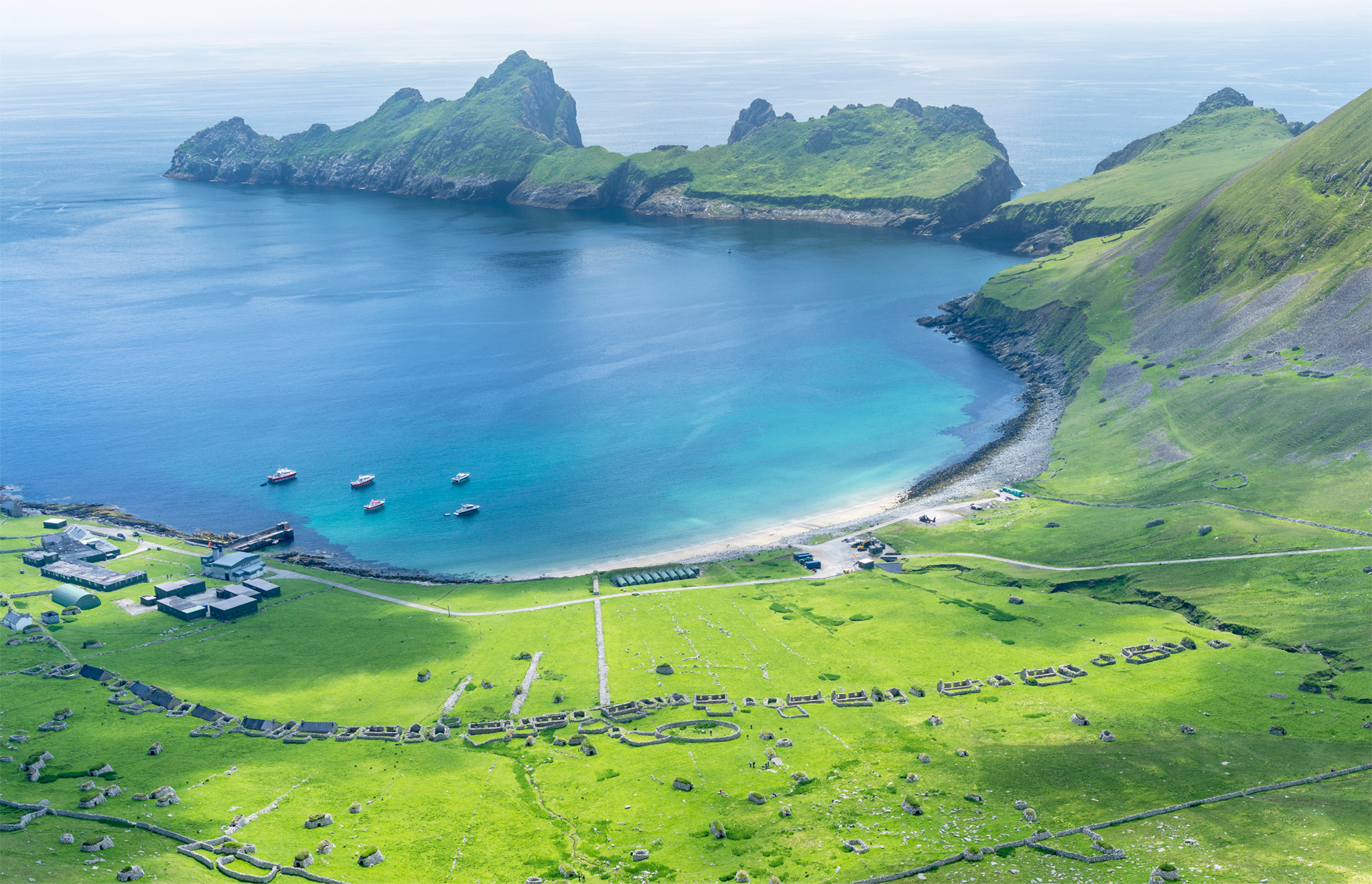
t Village bay and abandoned settlement of the Island of Hirta, St Kilda
Island Cruising
" ' ⌂ 1 Erista, Uig, Lewis # May–Sep ∑ island-cruising.com
Westernedge Charters
" ' ⌂ Berneray, North Uist # May–Sep ∑ westernedge.co.uk
St Kilda World Heritage Site
« ∑ kilda.org.uk
Crofting
Crofts are small parcels of agricultural land. They originated in the early 1800s when landlords decided to lease out poor-quality land on the coast in an effort to clear the people from more fertile areas. Crofters became dependent on wages from either fishing or collecting kelp, which was used to make commercial alkali. When these sources of income diminished, they endured extreme hardship through famine, high rents and lack of security. In 1886 an Act was passed to allow crofting families the right to inherit (but not own) the land. Today there are 17,000 registered crofts, almost all in the Highlands and islands. Most crofters raise sheep, but recent trends include tree planting and providing habitats for rare birds.