Table of Contents for
DK Eyewitness Travel Guide Scotland
 DK Eyewitness Travel Guide Scotland
Published by
DK Eyewitness Travel, 2019
DK Eyewitness Travel Guide Scotland
Published by
DK Eyewitness Travel, 2019
- COVER
- Half Title
- CONTENTS
- DISCOVER SCOTLAND
- Welcome to Scotland
- Reasons to Love Scotland
- Explore Scotland
- Discover Itineraries
- Scotland Itineraries
- 7 Days On the North Coast 500
- Scotland for Outdoor Adventures
- Scotland for Wildlife Encounters
- Scotland for Spectacular Castles
- Scotland for Bookworms
- Scotland for Art Lovers
- Scotland for Music Lovers
- Scotland for Foodies
- Scottish Spirit
- Scotland for Families
- Scotland for Beachgoers
- Scotland on Screen
- A Year in Scotland
- A Brief History
- EXPERIENCE SCOTLAND
- Edinburgh
- Area Map - Edinburgh
- 2 Days
- Edinburgh’s Summer Festivals
- Quiet Escapes Edinburgh’s
- Edinburgh Castle
- The Royal Mile
- Calton Hill
- National Museum of Scotland
- Scottish National Gallery
- Experience More
- A Short Walk - New Town
- A Long Walk - Water of Leith Walkway
- Southern Scotland
- Area Map - Southern Scotland
- Culzean Castle and Country Park
- Abbotsford
- Experience More
- Glasgow
- Area Map - Glasgow
- 2 Days in Glasgow
- Glasgow’s Industrial Heritage
- Basilica di San Marco
- Kelvingrove Art Gallery and Museum
- Experience More
- Central and Northeast Scotland
- Area Map - Central and Northeast Scotland
- The Veneto and Friuli
- Scone Palace
- Loch Lomond and the Trossachs National Park
- Stirling Castle
- Experience More
- The Highlands and Islands
- Area Map - The Highlands and Islands
- Highland Traditions and Culture
- Remote Island Getaways
- Ben Nevis
- Cairngorms National Park
- The Great Glen
- Isle of Skye
- Orkney Islands
- Shetland Islands
- Outer Hebrides
- Experience More
- A Driving Tour - Road to the Isles
- NEED TO KNOW
- Before You Go
- Getting Around
- Practical Information
- Scottish Vocabulary
- ACKNOWLEDGEMENTS AND IMPRINTS
- Copyright
- Navigational Contents
SCOTTISH
SPIRIT
No special occasion is complete without a dram of the drink that is the pure essence of Scotland. Although global brands have industrialized whisky-making, their dominance is being challenged by artisan distilleries that produce exciting new malts using age-old skills. Meanwhile, new distillers are creating gins and other spirits such as rum, vodka and absinthe.
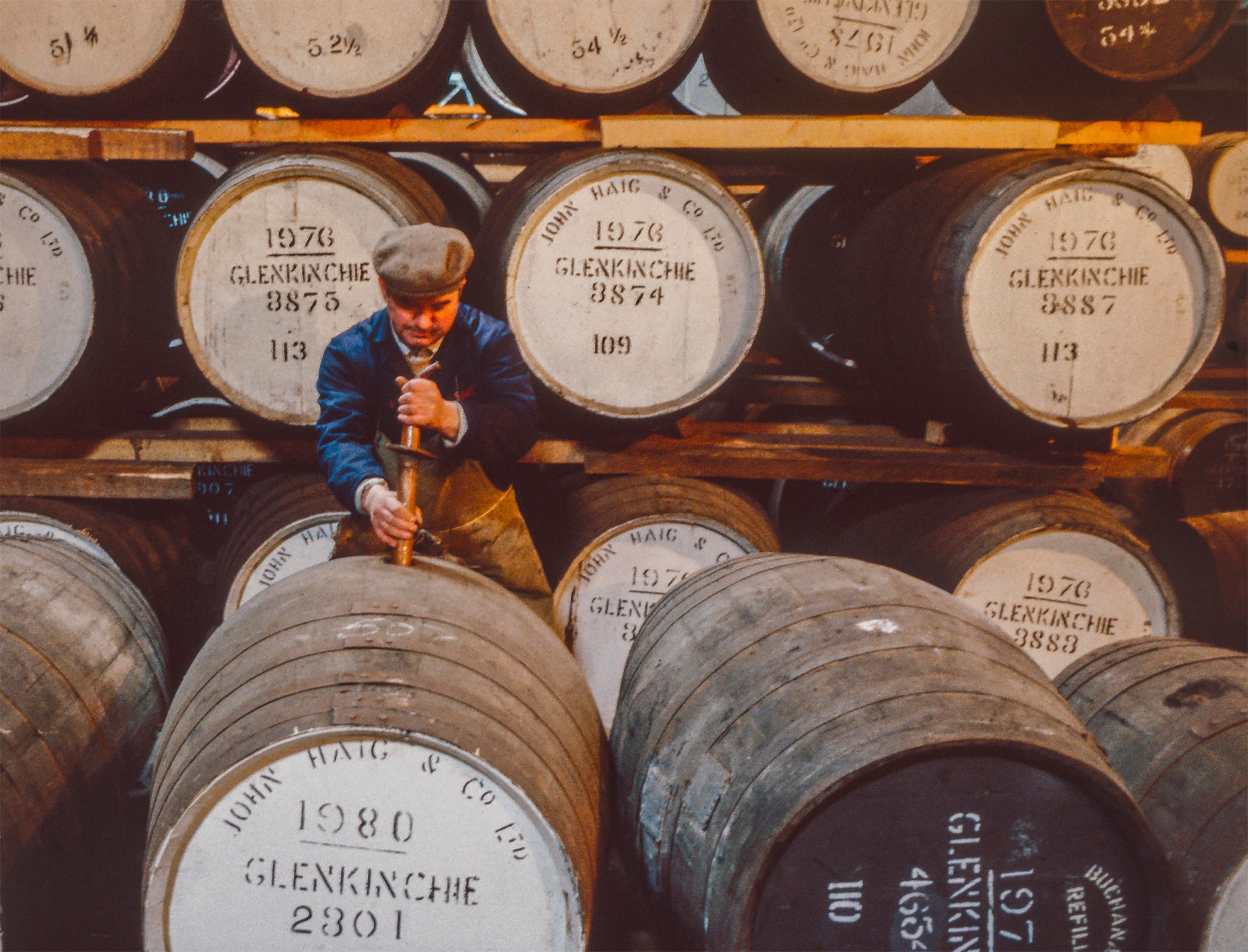
t Casks at the Glenkinchie distillery, a long-standing whisky producer
Lowland Whiskies
Lowland whiskies tend to be smooth and their palate gentle. Until recently lowland distilleries were few and far between, but new ones are cropping up, many producing spirits that replicate the light, grassy style of the region.
What to try: Glenkinchie is made near Edinburgh, while Auchentoshan is triple-distilled in Clydebank. Bladnoch, in the small town of Wigtown, is Scotland’s most southerly distillery.
Speyside Malts
Many of Scotland’s famous malt whiskies come from Speyside, where distillers claim there is a perfect balance of climate, terrain and water from Highland springs.
What to try: Glenlivet and Glenfiddich, matured in Bourbon casks to give them notes of light vanilla and orchard fruits, or sherry-matured, Macallan, the “Rolls Royce of single malts”, has notes of dried fruits and sweet spices. Don’t miss a visit to the Macallan distillery as part of The Malt Whisky Trail® in Speyside.
Highland Malts
Due to the Highlands’ vast and diverse terrain, its single malts can vary considerably. Some are rich and full-bodied, others sweet and fruity.
What to try: Glenmorangie, Scotland’s biggest-selling single malt, is light and flowery taste, while Edradour makes a minty, creamy whisky.
New Make Spirits and Gins
Gin has become Scotland’s trendy tipple of choice alongside “new make” spirits that side-step the ageing process of traditional whisky production.
What to try: Rascally Liquor at Annandale Distillery or go on a “gin jolley” at Pickering’s in Edinburgh’s Summerhall.
Island Malts
The malt whiskies of the Hebrides are redolent of heather and peat smoke, while some claim to detect a hint of seaweed and iodine in some island malts. For many they are an acquired taste.
What to try: Islay malts like Laphroaig, Lagavulin and Bowmore, Tobermory from Mull and Talisker from Skye.
DISCOVER Scotland Your Way
How Whisky is Made
Whisky is traditionally made by toasting freshly sprouting barley grains, then fermenting the malted barley to create a “wash” from which the raw alcohol that becomes whisky is distilled. To add complex flavours, it is usually aged for 5, 10, or 12 years or longer in oak casks that have held sherry, whisky or other wines. Malt whisky may be made only with spirit distilled from malted barley, while blends can combine different types of whisky.
Did You Know?
Whisky stored in casks evaporates at a rate of around 2% per year. This is called the “angels’ share”.