Table of Contents for
DK Eyewitness Travel Guide Scotland
 DK Eyewitness Travel Guide Scotland
Published by
DK Eyewitness Travel, 2019
DK Eyewitness Travel Guide Scotland
Published by
DK Eyewitness Travel, 2019
- COVER
- Half Title
- CONTENTS
- DISCOVER SCOTLAND
- Welcome to Scotland
- Reasons to Love Scotland
- Explore Scotland
- Discover Itineraries
- Scotland Itineraries
- 7 Days On the North Coast 500
- Scotland for Outdoor Adventures
- Scotland for Wildlife Encounters
- Scotland for Spectacular Castles
- Scotland for Bookworms
- Scotland for Art Lovers
- Scotland for Music Lovers
- Scotland for Foodies
- Scottish Spirit
- Scotland for Families
- Scotland for Beachgoers
- Scotland on Screen
- A Year in Scotland
- A Brief History
- EXPERIENCE SCOTLAND
- Edinburgh
- Area Map - Edinburgh
- 2 Days
- Edinburgh’s Summer Festivals
- Quiet Escapes Edinburgh’s
- Edinburgh Castle
- The Royal Mile
- Calton Hill
- National Museum of Scotland
- Scottish National Gallery
- Experience More
- A Short Walk - New Town
- A Long Walk - Water of Leith Walkway
- Southern Scotland
- Area Map - Southern Scotland
- Culzean Castle and Country Park
- Abbotsford
- Experience More
- Glasgow
- Area Map - Glasgow
- 2 Days in Glasgow
- Glasgow’s Industrial Heritage
- Basilica di San Marco
- Kelvingrove Art Gallery and Museum
- Experience More
- Central and Northeast Scotland
- Area Map - Central and Northeast Scotland
- The Veneto and Friuli
- Scone Palace
- Loch Lomond and the Trossachs National Park
- Stirling Castle
- Experience More
- The Highlands and Islands
- Area Map - The Highlands and Islands
- Highland Traditions and Culture
- Remote Island Getaways
- Ben Nevis
- Cairngorms National Park
- The Great Glen
- Isle of Skye
- Orkney Islands
- Shetland Islands
- Outer Hebrides
- Experience More
- A Driving Tour - Road to the Isles
- NEED TO KNOW
- Before You Go
- Getting Around
- Practical Information
- Scottish Vocabulary
- ACKNOWLEDGEMENTS AND IMPRINTS
- Copyright
- Navigational Contents
F1, F2 ⌂ Shetland g ~ From Aberdeen and Stromness, Orkney n Lerwick; www.shetland.org
With the North Sea to the east, and the Atlantic Ocean ravishing its western shores, this windswept archipelago is where Scotland meets Scandinavia, and the sense of transition here tangible. Shetland’s rugged coastline, oceanic climate and fascinating geology will delight all who venture to this most northerly enclave.
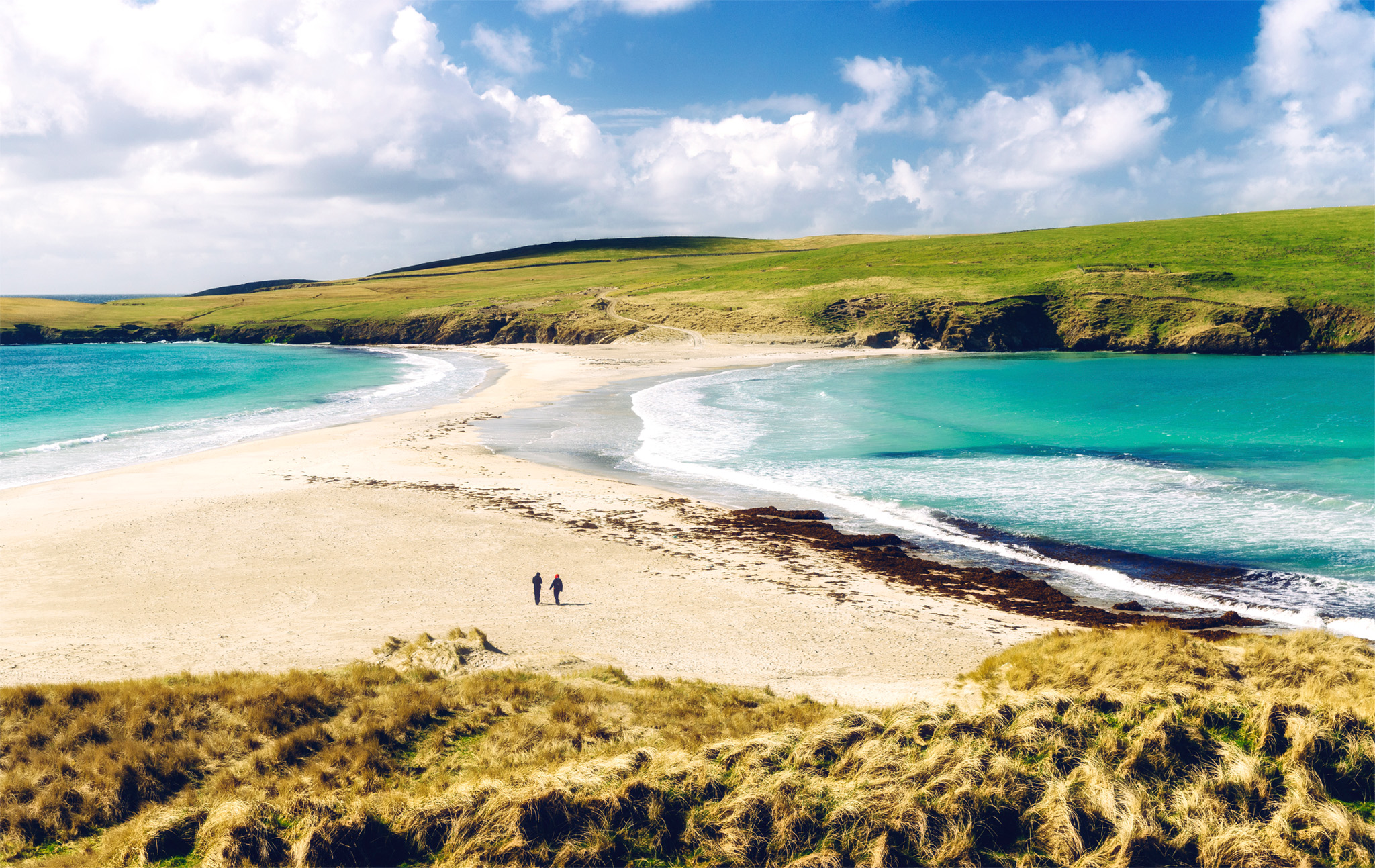
t St Ninian’s Isle, separated from Mainland by a thin isthmus of white sand
More than 100 rugged, cliff-hemmed islands form Scotland’s most northerly domain. Nowhere in Shetland is further than 5 km (3 miles) from the sea, and fishing and salmon farming are mainstays of the economy, boosted in recent decades by North Sea oil. Severe storms are common in winter, but in summer, the sun may shine for as long as 19 hours, and a twilight known as the “simmer dim” persists throughout the night.
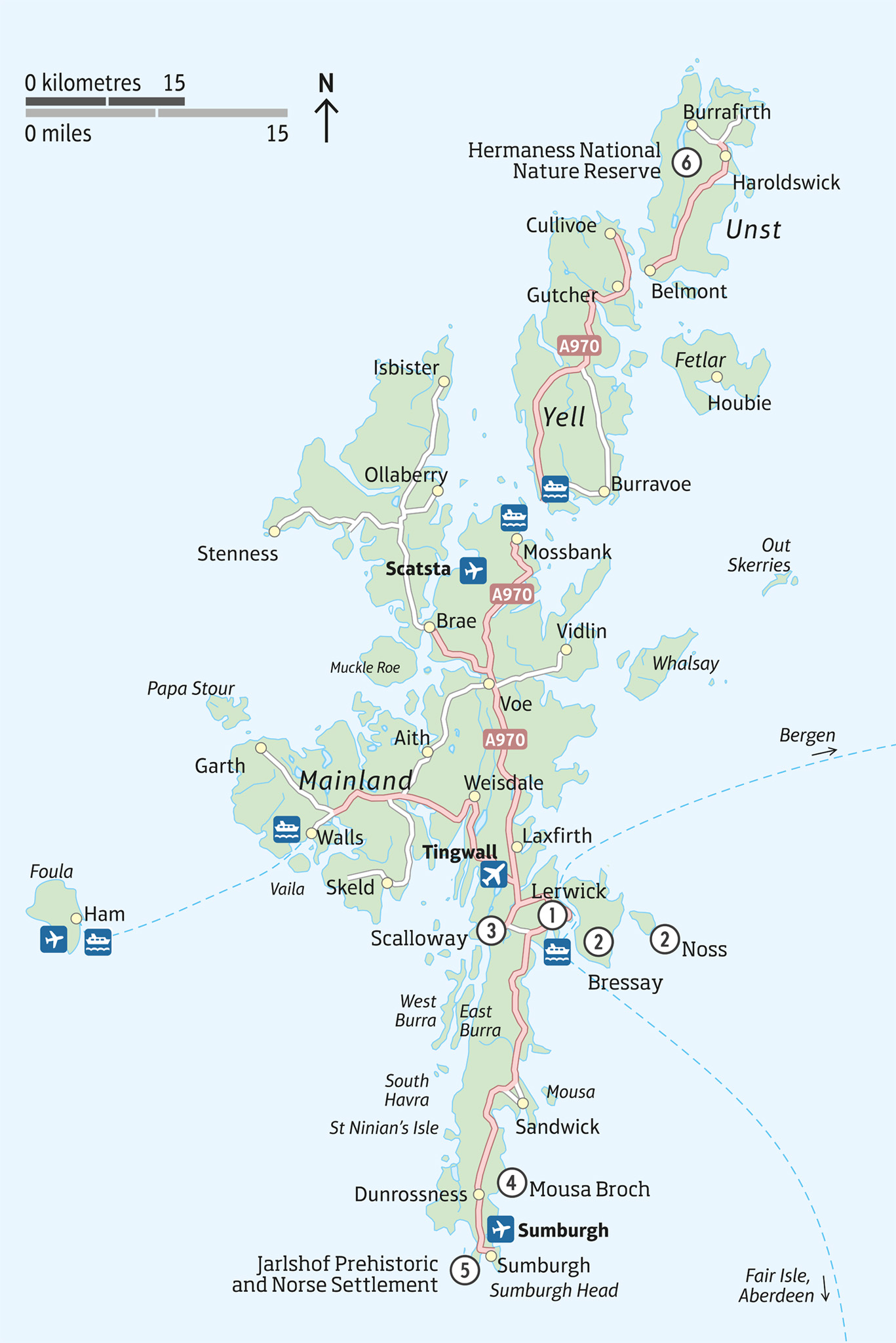
Mainland is home to Shetland’s main town, Lerwick, and the quiet port of Scalloway. North of Lerwick, Shetland rises to its highest point at Ronas Hill (454 m/1,475 ft) amid tracts of bleak, empty moorland. The west coast has spectacular natural scenery, notably the red granite cliffs and blow-holes at Esha Ness, from where you can see the wave-gnawed stacks of The Drongs and a huge rock arch called Dore Holm.
The northern isles of Yell, Fetlar and Unst have regular, though weather-dependent, boat connections to Mainland. Beyond the lighthouse of Muckle Flugga is Out Stack, Britain’s most northerly point.
West of Mainland, Foula has dramatic sea cliffs, while Fair Isle, midway between Orkney and Shetland, is owned by the National Trust for Scotland. There are regular internal flights to Fair Isle, Foula and Papa Stour, as well as inter-island ferries. Most routes depart from Tingwall, on Central Mainland.
Experience The Highlands and Islands
n Double-tap image to read the labels
Fair Isle knitwear
Fair Isle sweaters have been knitted by hand from hand-spun wool by the island’s womenfolk for more than 200 years. Each garment takes up to 100 hours to create and is a unique work of art, using traditional patterns in muted shades of grey, blue, brown and yellow, reflecting the tones of the Shetland Isles’ flora, fauna and natural landscapes. Skills are passed on from mothers to daughters, and learning them takes up to four years. Prices are high and would-be buyers may have to wait several years for their garment to be completed.
Did You Know?
The last inhabitants of the Island of Mousa, the Smith family, left the island in 1853.
Shetland’s chief town is a pretty place of grey stone buildings and narrow, flag-stoned lanes. First established by Dutch fishermen in the 1600s, it grew to become wealthy from the whaling trade. The increase in North Sea oil traffic has made the harbour area very busy. At the heart of the town is Commercial Street, its northern end guarded by Fort Charlotte, which affords fine views from its battlements. At the Shetland Museum and Archive, on Hay’s Dock, you can admire a fine collection of historic boats, archaeological finds and Shetland textiles tracing the islands’ unique and fascinating history.
On Lerwick’s outskirts lie the Clickminin Broch, a prehistoric fort dating from around 700 BC, and the 18th-century Böd of Gremista, birthplace of Arthur Anderson, co-founder of the P&O shipping company, which now houses a textile museum.
Shetland Museum and Archive
= - # Daily ∑ shetlandmuseumandarchives.org.uk
Böd of Gremista
" # May–Sep: Tue–Sat
∑ shetlandtextilemuseum.com
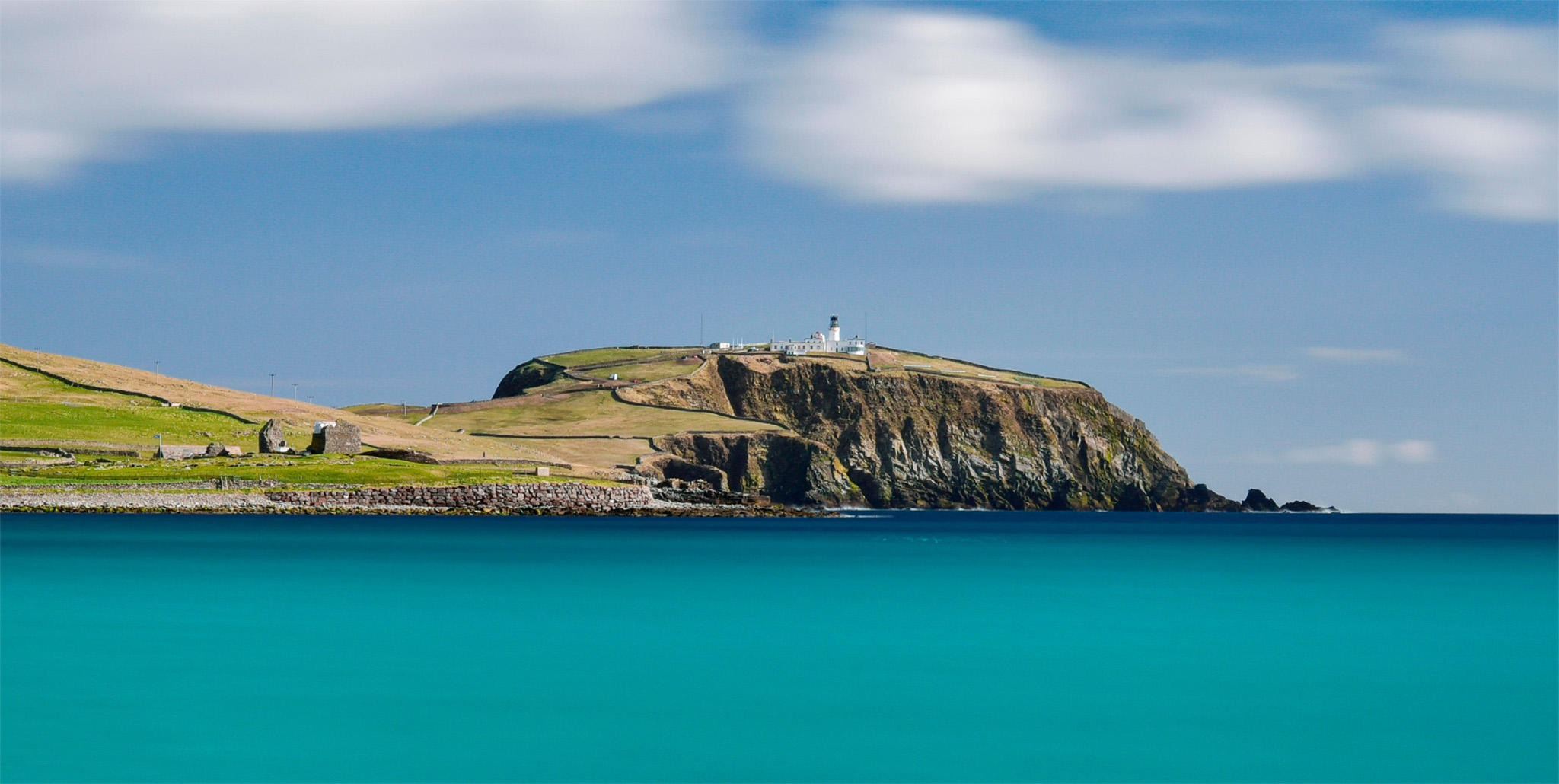
t Clifftop lighthouse at Sumburgh Head on the southern tip of Mainland
Sheltering Lerwick from the winter gales is Bressay, an island with fine walks and views. The Bressay ferry departs from Lerwick every hour, weather-dependent, and boats run a regular service from Lerwick to Noss, off Bressay’s east coast. Noss National Nature Reserve is home to thousands of breeding seabirds, including gannets and great skuas (or bonxies), while both islands are outstandingly beautiful and abundant in bird and mammal life. The Bressay Heritage Centre holds seasonal exhibitions on the island’s culture, history and natural heritage, and is open to the public part time from May to September.
Noss National Nature Reserve
" § (01595) 693345 # May–Aug: Tue, Wed, Fri–Sun
Bressay Heritage Centre
# May–Sep: 10am–4pm Tue, Wed, Fri & Sat; 11am–5pm Sun
∑ shetlandheritageassociation.com

great View
Sumburgh Head
For dramatic clifftop vistas and a spectacular sea view, the cliffs and lighthouse atop Sumburgh Head, at the very southern tip of the South Mainland, are well worth a visit. Keep your eyes peeled when looking out to sea; you may spot a white-sided dolphin, harbour porpoise or minke whale. Closer to shore, grey seals bask and play on the rocks below.
West of Lerwick is the quiet fishing port of Scalloway, Shetland’s second town and the islands’ former capital. Scalloway Castle is a fortified tower dating from 1600, while the Scalloway Museum contains an exhibition on the “Shetland Bus”, a wartime resistance operation that used fishing boats to bring refugees from German-occupied Norway. North of Scalloway, near Weisdale, the fertile region of Tingwall is a well-known angling centre. Connected by bridges to Central Mainland’s west coast are the islands of Burra and Trondra, with lovely beaches and walks.
Scalloway Museum
⌂ Castle St# Times vary, check website
∑ scallowaymuseum.org
The ornate Mousa Broch, on an easterly islet reached by a summer ferry from Sandwick, is the best example of this type of ancient fortified tower in Britain. These drystone roundhouses, which are unique to Scotland, consist of two concentric walls, between which is a narrow passage containing a stone stairway to the top. Thought to have been constructed in around 300 BC, Mousa is the tallest of all the remaining brochs in Scotland. Its 13-m- (42-ft-) tall towering walls are clearly visible from the main road, and make ideal nestboxes for a colony of storm petrels.
Experience The Highlands and Islands
Shetland’s Birdlife
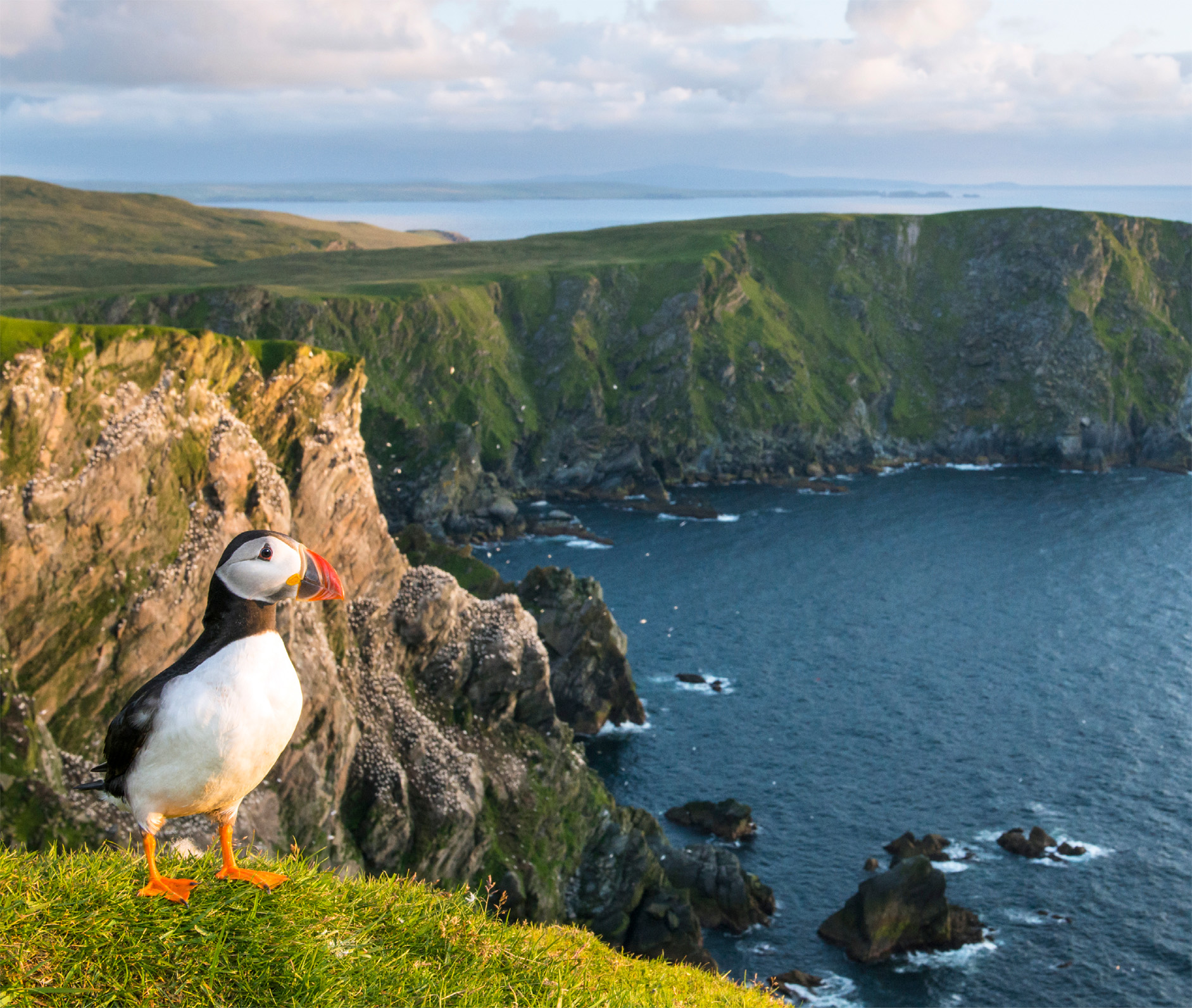
Millions of migrant and local birds can be admired on these islands. Over 20 species of seabirds regularly breed here, and over 340 different species have been recorded passing through Fair Isle, one of the world’s great staging posts. Inaccessible cliffs provide excellent security at vulnerable nesting times for huge colonies of gannets, guillemots, puffins, kittiwakes, fulmars and razorbills. Species found here but in very few other UK locations include great skuas and storm petrels.
Jarlshof, in the far south, spans over 3,000 years of occupation from Neolithic to Viking times. Preserved under layers of sand and grit for thousands of years, this ancient site was discovered in the 1890s thanks to powerful storms that ravished the land to reveal ancient treasures hidden underneath the ground. Explore ancient Bronze Age dwellings, Iron Age wheelhouses and Viking longhouses and outbuildings, and evidence of the island’s Norse occupation, all set against the dramatic backdrop of the beautiful West Voe of Sumburgh.
Of all Shetland’s islands, Unst has the most varied scenery and the richest flora and fauna, plus an excellent visitor centre at the Hermaness National Nature Reserve, home to thousands of seabirds. Here visitors can learn about the local birdlife, and stroll along the clifftop paths and grassy moorland. Beyond the lighthouse of Muckle Flugga is Out Stack, Britain’s most northerly point.