
Almost all modern platforms, except a few embedded ones, utilize the same security principle --the division of execution environments by security levels and privileges; in this case, this means the ability to access certain resources. On Intel-based platforms, there are four security levels known as protection rings. These rings are numbered 0 through 3, where the greater the number, the less privileged the ring. Obviously, the code running at a less privileged level cannot access memory with a higher privilege level directly. We will shortly see how data is transferred between different privilege levels.
The following figure illustrates the concept of protection rings:
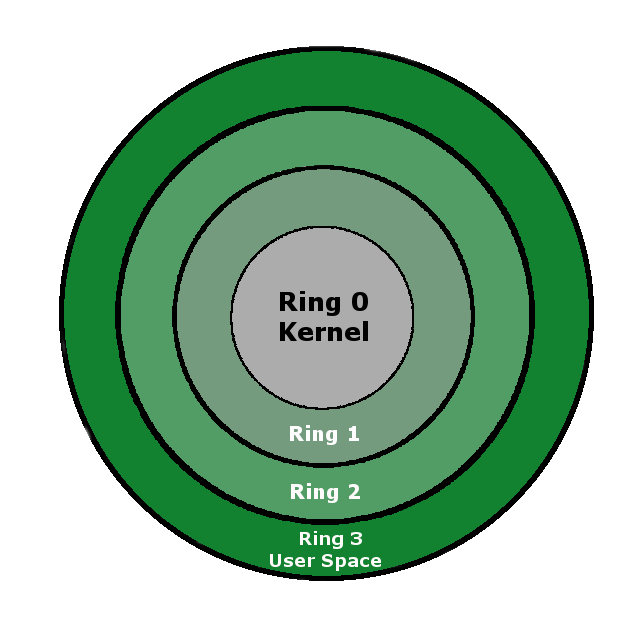
Here's a description of the different privileges of protection rings:
- Ring 0 is the most privileged level where all instructions are available and all hardware is accessible. This is the grey area where the kernel resides, accompanied by kernel space drivers.
- Ring 1 and Ring 2 are intended to serve as the driver execution environment, but are hardly used at all.
- Ring 3 is the user space. It is the privilege level regular software is granted, and it is the only privilege level we are interested in. Although getting deeper may be very interesting, it would not be practical for the purpose of this book, as all our code requires privilege level 3 only.