Table of Contents for
Drupal 8 Module Development

Version ebook / Retour

Cover image for bash Cookbook, 2nd Edition Drupal 8 Module Development by Daniel Sipos Published by Packt Publishing, 2017
  1. Drupal 8 Module Development
  2. Title Page
  3. Copyright
  4. Drupal 8 Module Development
  5. Credits
  6. About the Author
  7. About the Reviewers
  8. www.PacktPub.com
  9. Why subscribe?
  10. Customer Feedback
  11. Table of Contents
  12. Preface
  13. What this book covers
  14. What you need for this book
  15. Who this book is for
  16. Conventions
  17. Reader feedback
  18. Customer support
  19. Downloading the example code
  20. Downloading the color images of this book 
  21. Errata
  22. Piracy
  23. Questions
  24. Developing for Drupal 8
  25. Introducing Drupal (for developers)
  26. Developing for Drupal 8
  27. Technologies that drive Drupal
  28. PHP
  29. Databases and MySQL
  30. The web server
  31. HTML, CSS, and JavaScript
  32. Drupal architecture
  33. Drupal core, modules, and themes
  34. Hooks, plugins, and events
  35. Services and the dependency injection container
  36. From request to response
  37. Drupal's major subsystems
  38. Routing
  39. Entities
  40. Fields
  41. Menus
  42. Views
  43. Forms
  44. Configuration
  45. Plugins
  46. The theme system
  47. Caching
  48. Other subsystems
  49. Tools for developing in Drupal
  50. Version control
  51. Composer
  52. The API site and coding standards
  53. The developer (Devel) module
  54. Drush (the Drupal shell)
  55. Drupal Console
  56. Developer settings
  57. Summary
  58. Creating Your First Module
  59. Creating a module
  60. Your first hook implementation
  61. Route and controller
  62. The route
  63. Route variables
  64. Namespaces
  65. The Controller
  66. Services
  67. What is a service?
  68. The HelloWorldSalutation service
  69. Tagged services
  70. Using services in Drupal 8
  71. Injecting the service into our Controller
  72. The form
  73. Altering forms
  74. Custom submit handlers
  75. Rendering forms
  76. Service dependencies
  77. Blocks
  78. Our first block plugin
  79. Block configuration
  80. Working with links
  81. The URL
  82. The link
  83. Which way to link?
  84. Event Dispatcher and redirects
  85. Redirecting from a Controller
  86. Redirecting from a subscriber
  87. Dispatching events
  88. Summary
  89. Logging and Mailing
  90. Logging
  91. The Drupal 8 logging theory
  92. Our own logger channel
  93. Our own logger
  94. Logging for Hello World
  95. Logging summary
  96. Mail API
  97. The theory of the Mail API
  98. Implementing hook_mail()
  99. Sending emails
  100. Altering someone else's emails
  101. Custom mail plugins
  102. The mail plugin
  103. Using mail plugins
  104. Tokens
  105. The Token API
  106. Using tokens
  107. Defining new tokens
  108. Token summary
  109. Summary
  110. Theming
  111. Business logic versus presentation logic
  112. Twig
  113. Theme hooks
  114. Theme hook suggestions
  115. Render arrays
  116. The structure of a render array
  117. #type
  118. #theme
  119. #markup
  120. The render pipeline
  121. Assets and libraries
  122. Libraries
  123. Attaching libraries
  124. Common theme hooks
  125. Lists
  126. Links
  127. Tables
  128. Attributes
  129. Theming our Hello World module
  130. Summary
  131. Menus and Menu Links
  132. The menu system
  133. Menus
  134. Menu links
  135. Multiple types of menu links
  136. Local tasks
  137. Local actions
  138. Contextual links
  139. MenuLink trees
  140. Menu link tree manipulators
  141. Menu active trail
  142. Rendering menus
  143. Working with menu links
  144. Defining menu links
  145. Working with menu links
  146. Defining local tasks
  147. Defining local actions
  148. Defining contextual links
  149. Summary
  150. Data Modeling and Storage
  151. Different types of data storage
  152. State API
  153. Tempstore
  154. PrivateTempStore
  155. A note about anonymous users
  156. SharedTempStore
  157. Tempstore conclusion
  158. UserData
  159. Configuration
  160. Introduction
  161. What is configuration used for?
  162. Managing configuration
  163. Different types of configuration
  164. Configuration storage
  165. Schema
  166. Overrides
  167. Global overrides
  168. Module overrides
  169. Language overrides
  170. Priority
  171. Interacting with simple configuration
  172. Entities
  173. Content versus configuration entity types
  174. Entity type plugins
  175. Identifiers
  176. Bundles
  177. Database tables
  178. Entity keys
  179. Links
  180. Entity translation
  181. Entity revisions
  182. Configuration export
  183. Handlers
  184. Fields
  185. Configuration entity fields
  186. Content entity fields
  187. Base fields
  188. Configurable fields
  189. Field storage
  190. Entity types summary
  191. TypedData
  192. Why?
  193. What?
  194. The low-level API
  195. DataType plugins
  196. Data definitions
  197. Content entities
  198. TypedData summary
  199. Interacting with the Entity API
  200. Querying and loading entities
  201. Building queries
  202. Loading entities
  203. Reading entities
  204. Manipulating entities
  205. Creating entities
  206. Rendering content entities
  207. Pseudo-fields
  208. Content entity validation
  209. Validation summary
  210. Summary
  211. Your Own Custom Entity and Plugin Types
  212. Custom content entity type
  213. Custom plugin type
  214. Custom configuration entity type
  215. The Importer plugin
  216. Content entity bundles
  217. Drush command
  218. Summary
  219. The Database API
  220. The Schema API
  221. Running queries
  222. Select queries
  223. Handling the result
  224. More complex select queries
  225. Range queries
  226. Pagers
  227. Insert queries
  228. Update queries
  229. Delete queries
  230. Transactions
  231. Query alters
  232. Update hooks
  233. Summary
  234. Custom Fields
  235. Field type
  236. Field widget
  237. Field formatter
  238. Field settings
  239. Using as a base field
  240. Summary
  241. Access Control
  242. Introduction to the Drupal access system
  243. Roles and permissions under the hood
  244. Defining permissions
  245. Checking the user credentials
  246. Route access
  247. Custom route access
  248. Static approach
  249. Service approach
  250. Programmatically checking access on routes
  251. Bonus - dynamic route options for access control
  252. CSRF protection on routes
  253. Altering routes
  254. Entity access
  255. Injecting services into Entity handlers
  256. Entity access hooks
  257. Field access
  258. Entity access in routes
  259. Node access grants
  260. Block access
  261. Summary
  262. Caching
  263. Introduction
  264. Cacheability metadata
  265. Cache tags
  266. Cache contexts
  267. Max-age
  268. Using the cache metadata
  269. Caching in block plugins
  270. Caching access results
  271. Placeholders and lazy building
  272. Lazy builders
  273. Using the Cache API
  274. Creating our own cache bin
  275. Summary
  276. JavaScript and the Ajax API
  277. JavaScript in Drupal
  278. Drupal behaviors
  279. Our library
  280. The JavaScript
  281. Drupal settings
  282. Ajax API
  283. Ajax links
  284. Ajax in forms
  285. States (Form) system
  286. Summary
  287. Internationalization and Languages
  288. Introduction
  289. Language
  290. Content Translation
  291. Configuration Translation
  292. Interface Translation
  293. Internationalization
  294. Content entities and the Translation API
  295. Summary
  296. Batches, Queues, and Cron
  297. Batch powered update hooks
  298. Batch operations
  299. Creating the batch
  300. Batch operations
  301. Cron
  302. Queues
  303. Introduction to the Queue API
  304. Cron based queue
  305. Processing a queue programmatically
  306. Lock API
  307. Summary
  308. Views
  309. Entities in Views
  310. Exposing custom data to Views
  311. Views data
  312. Views fields
  313. Views relationships
  314. Views sorts and filters
  315. Views arguments
  316. Altering Views data
  317. Custom Views field
  318. Field configuration
  319. Custom Views filter
  320. Custom Views argument
  321. Views theming
  322. Views hooks
  323. Summary
  324. Working with Files and Images
  325. The filesystem
  326. Stream wrappers
  327. Managed versus unmanaged files
  328. Using the File and Image fields
  329. Working with managed files
  330. Attaching managed files to entities
  331. Helpful functions for dealing with managed files
  332. Managed file uploads
  333. Managed file form element
  334. Entity CRUD hooks
  335. Managed file usage service
  336. Processing the CSV file
  337. Our own stream wrapper
  338. Working with unmanaged files
  339. Private file system
  340. Images
  341. Image toolkits
  342. Image styles
  343. Rendering images
  344. Summary
  345. Automated Testing
  346. Testing methodologies in Drupal 8
  347. PHPUnit
  348. Registering tests
  349. Unit tests
  350. Mocked dependencies
  351. Kernel tests
  352. TeamCleaner test
  353. CsvImporter test
  354. Functional tests
  355. Configuration for functional tests
  356. Hello World page test
  357. Hello World form test
  358. Functional JavaScript tests
  359. Time test
  360. CsvImporter test
  361. Summary
  362. Drupal 8 Security
  363. Cross-Site Scripting (XSS)
  364. Sanitization methods in Drupal 8
  365. Double escaping
  366. SQL Injection
  367. Cross-Site Request Forgery (CSRF)
  368. Summary

Internationalization

The idea behind internationalization is to ensure that everything that gets output on the site can be translated into the enabled languages through a common mechanism--in this case, using the Interface Translation module. This refers to content, visible configuration values, and the strings and texts that come out of modules and themes. But there are many different ways this can happen, so let's see how in each of these cases we would ensure that our information can be translated.

A principle rule when writing Drupal modules or themes is to always use English as the code language. This is to ensure consistency and keep open the possibility that other developers will work on the same codebase, which may not speak a particular language. This is also the case for text used to be displayed in the UI. It should not be the responsibility of the code to output the translated text, but rather to always keep it consistent, that is, in English.

Of course, this is dependent on it being done right, in order to allow it to be translated via interface translation. There are multiple ways this can be ensured, depending on the circumstances.

The most common scenario we need to be aware of is when we have to print out to the user, in a PHP, string of text. Drupal 7 developers should already be familiar with the t() function through which these strings are run. This function still exists and should be used whenever we are not inside a class context:

return t('The quick brown fox');

However, when we are inside a class, we should check if any of the parents are using the StringTranslationTrait. If not, we should use it in our class and then we'll be able to do this instead:

return $this->t('The quick brown fox');

Even better still, we should inject the TranslationManager service into our class because the preceding mentioned trait makes use of it.

None of the examples given before should be new to us, as we've been using these throughout the code we've been writing in this book. But what actually happens behind the scenes?

The t() and StringTranslationTrait::t() functions both create and return an instance of TranslatableMarkup (essentially delegating to its constructor), which upon rendering (being cast to a string), will return the formatted and translated string. The responsibility of the actual translation is delegated to the TranslationManager service. This process has two parts. Static analyzers pick up on these text strings and add them to the database in the list of strings that need to be localized. These can then be translated by users via the user interface. Second, at runtime, the strings get formatted and the translated version is shown, depending on the current language context. Because of the first part, we should never do something like this:

return $this->t($my_text);

The reason is that static analyzers can no longer pick up on the strings that need to be translated. Moreover, if the text is coming from user input, it can lead to XSS attacks if not properly sanitized before.

That being said, we can still have dynamic, that is, formatted, text output using this method, and we've seen this in action as well:

$count = 5;
return $this->t('The quick brown fox jumped @count times', ['@count' => $count]);

In this case, we have a dynamic variable (which can be part of user input), which will be used to replace the placeholder @count from the text. Drupal takes care of sanitizing the variable before outputting the string to the user. Alternatively, we can also use the % prefix to define a placeholder we want Drupal to wrap with <em class="placeholder">. The cool thing is that, when performing translations, users can shift the placeholder in the sentence to accommodate language specificity.

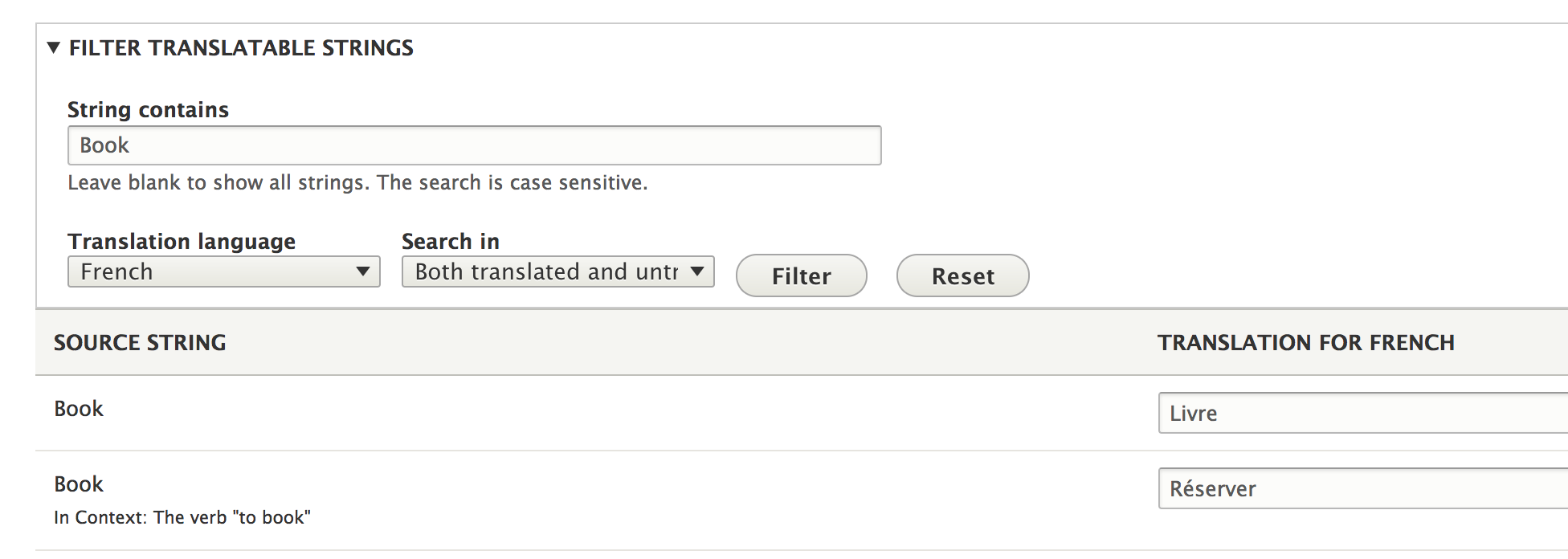
One of the intended consequences of the static analyzer picking out and storing the strings that need to be translated is that, by default, each individual string is only translated once. This is good in many cases but also poses some problems when the same English string has different meanings (which map to different translations in other languages). To counter this issue, we can specify a context to the string that needs to be translated so that we can identify which meaning we actually want to translate. This is where the third parameter of the t() function (and method) we saw in the previous paragraphs comes into play.

For example, let's consider the word Book, which is translated by default in its meaning as a noun. But we may have a submit button on a form that has the value Book, which clearly has a different meaning as a call to action. So in the latter case, we could do it like this:

t('Book', [], ['context' => 'The verb "to book"']);

Now in the interface translation, we will have both versions available.
Another helpful tip is that we can also account for plurals in the string translations. The StringTranslationTrait::formatPlural() helps with this by creating a PluralTranslatableMarkup object similar to the TranslatableMarkup, but with some extra parameters to account for differences when it comes to plurals. This comes in very handy in our preceding example with the brown fox jumping a number of times, because if the fox jumps only once, the resulting string would not be grammatically correct anymore. So instead, we can do the following:

$count = 5;
return $this->formatPlural($count, 'The quick brown fox jumped 1 time', 'The quick brown fox jumped @count times')];

The first parameter is the actual count (the differentiator between singular and plural). The second and third parameters are the singular and plural versions respectively. You'll also notice that since we specified the count already, we don't have to specify it again in the arguments array. It's important to note that the placeholder name inside the string needs to be @count if we want the renderer to understand its purpose.

The string translation techniques we discussed so far also work in other places--not just in PHP code. For example, in JavaScript we would do something like this:

Drupal.t('The quick brown fox jumped @count times', {'@count': 5});
Drupal.formatPlural(5, 'The quick brown fox jumped 1 time', 'The quick brown fox jumped @count times');

So, based on this knowledge, I encourage you to go back and fix our incorrect use of the string output in JavaScript in the previous chapter.

In Twig, we'd have something like this (for simple translations):

{{ 'Hello World.'|trans }}
{{ 'Hello World.'|t }}

Both of the above lines do the same thing. To handle plurals (and placeholders), we can use the {% trans %} block:

{% set count = 5 %}
{% trans %}
  The quick brown fox jumped 1 time.
{% plural count %}
  The quick brown fox jumped {{ count }} times.
{% endtrans %}

Finally, the string context is also possible like so:

{% trans with {'context': 'The verb "to book"'} %}
  Book
{% endtrans %}

In annotations, we have the @Translation() wrapper, as we've seen already a few times when creating plugins or defining entity types.

Finally, in YAML files, some of the strings are translatable by default (so we don't have to do anything):

  • Module names and descriptions in .info.yml files
  • The _title (together with the optional _title_context) key values under the defaults section of .routing.yml files
  • The title (together with the optional title_context) key values in .links.action.yml, .links.task.yml and .links.contextual.yml files

Dates are also potentially problematic when it comes to localization, as different locales show dates differently. Luckily, Drupal provides the DateFormatter service, which handles this for us. For example:

\Drupal::service('date.formatter')->format(time(), 'medium');

The first parameter of this formatter is the UNIX timestamp of the date we want to format. The second parameter indicates the format to use (either one of the existing formats or custom). Drupal comes with a few predefined date formats, but site builders can define others as well as, which can be used here. However, if the format is custom, the third parameter is a a PHP date format string suitable for input to date(). The fourth parameter is a time zone identifier we want to format the date in, and the final parameter can be used to specify the language to localize to directly (regardless of the current language of the site).