This book has just skimmed the surface of the capabilities of the Propeller microcontroller.
As always, the best way to learn is by doing, so pick a problem of interest and have at it. The next best way to learn is to study somebody else’s code. You can download a number of Spin and PASM projects at the Object Exchange (
http://obex.parallax.com
).
There are a number of programs already written in Spin, and there is a large knowledge base available to help with learning it and fixing problems. However, Spin is relatively slow. Furthermore, Parallax is encouraging new users to learn to use C to program the Propeller and encouraging existing users to migrate. There is a huge knowledge base of information on “standard” C, but the Propeller-specific parts of C are still in development. Finally, PASM is by far the fastest way to run your code (particularly for bit-twiddling), but Cog-C mode is nearly as fast (see Table 17-1).
Table 17-1
Comparison of Compression Speeds
Language | Number of Counts to Compress 128 Samples |
|---|---|
Spin code | 1.5 million counts |
C code (LMM only) | 150,000 counts |
Cog-C mode | 42,000 counts |
Mixed-mode C and PASM | 23,000 counts |
PASM code
| 22,000 counts |
The ideal combination may well be C with Cog-C modules and injected inline assembly code for particular tasks. This is also, unsurprisingly, somewhat complex. I hope that you can use the examples in this book to do your own projects. Good luck with your journey (Figure 17-1)!
Our motto might be “Render unto C that which is C’s and unto PASM to twiddle bits!”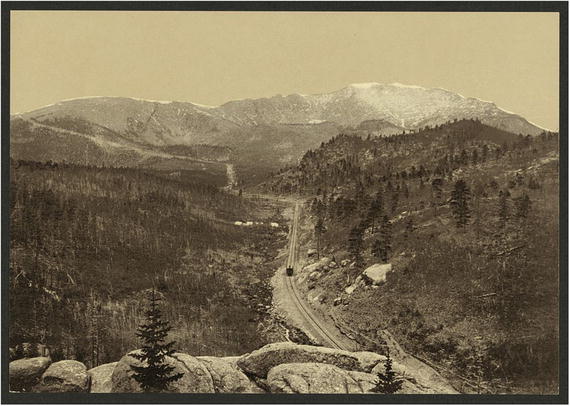
Figure 17-1
Crossing the timber line, Pike’s Peak Railway, some time between 1898 and 1905. Detroit Photographic Company, public domain. https://goo.gl/dzvSXN.