Table of Contents for
Unsolved Murders
 Unsolved Murders
Published by
DK Publishing, 2019
Unsolved Murders
Published by
DK Publishing, 2019
- Unsolved Murders: True Crime Cases Uncovered
- COVER
- TITLE PAGE
- CONTENTS
- HOW TO USE THIS EBOOK
- THE SHROUDED HOUSE: THE VILLISCA AX MURDERS, 1912
- A HOLLYWOOD WHODUNIT: WILLIAM DESMOND TAYLOR, 1922
- THE BODIES IN THE BARN: THE HINTERKAIFECK MURDERS, 1922
- THE IMPOSSIBLE MURDER: THE WILLIAM WALLACE CASE, 1931
- DEEP WATERS: THE SHARK ARM CASE, 1935
- PANIC IN THE CITY: THE CLEVELAND TORSO KILLER, 1935-38
- SCANDAL IN SHANGRI-LA: THE HAPPY VALLEY MURDER, 1941
- THE SKELETON IN THE WOOD: WHO PUT BELLA IN THE WYCH ELM?, 1943
- DEATH OF A DREAMER: THE BLACK DAHLIA, 1947
- DID SAM DO IT?: THE MURDER OF MARILYN SHEPPARD, 1954
- THE LAST BIKE RIDE: THE MURDER OF LYNNE HARPER, 1959
- CAMPSITE OF HORRORS: THE LAKE BODOM MURDERS, 1960
- KILLING FOR FUN: THE ZODIAC KILLER, 1968-69
- STRANGER DANGER: THE OAKLAND COUNTY CHILD KILLER, 1976-77
- DEATH AT THE DRUGSTORE: THE TYLENOL MURDERS, 1982
- A CHRISTMAS NIGHTMARE: THE MURDER OF JONBENéT RAMSEY, 1996
- DRIVE-BY SHOOTINGS: TUPAC SHAKUR AND BIGGIE SMALLS, 1996-97
- SHOT IN BROAD DAYLIGHT: THE MURDER OF JILL DANDO, 1999
- STAIRCASE OF DEATH: THE MURDER OF KATHLEEN PETERSON, 2001
- THE BODIES IN THE MARSHLAND: THE LONG ISLAND SERIAL KILLER, 2003-10
- REFERENCES
- COPYRIGHT
- Unsolved Murders: True Crime Cases Uncovered
THE MURDER OF JILL DANDO, 1999
SHOT IN BROAD DAYLIGHT
The brutal murder of television presenter Jill Dando, killed on the doorstep of her London home, was not only headline news because of her celebrity; it truly shocked Britain.
Jill Dando was a hugely popular BBC TV presenter throughout the 1990s. Her charming personality and warm presence lit up such programs as Breakfast News, the Six O’Clock News, and the travel series Holiday. However, Jill was best known as one of the principal anchors of the prime-time investigative show Crimewatch. Each week, Jill would present the key facts of a recent, unsolved UK crime and invite viewers to help police by contacting a special phone number. Crimewatch was partly responsible for bringing a number of criminals to justice. Just 37 years old, Jill was in the prime of her life and career, and soon to be married to gynaecologist Alan Farthing.
Alan lived in Bedford Close in the affluent district of Chiswick, West London. Jill was in the process of selling her two-story home at 29, Gowan Avenue in nearby Fulham so that she could move in with her fiancé. Her own home was up for sale, but she still needed to stop off there to pick up mail and check her fax machine.
On the morning of April 26, 1999, Jill Dando set off to make just such a visit. On the way, she went into a BP gas station store, bought a new fax machine cartridge and paper, and two fillets of Dover sole. Her image was captured on security cameras at the gas station, and there was no evidence that she was being followed. Jill was scheduled to read the BBC Six O’Clock News the following day. In a tragic twist of fate, her own murder would be the lead story.
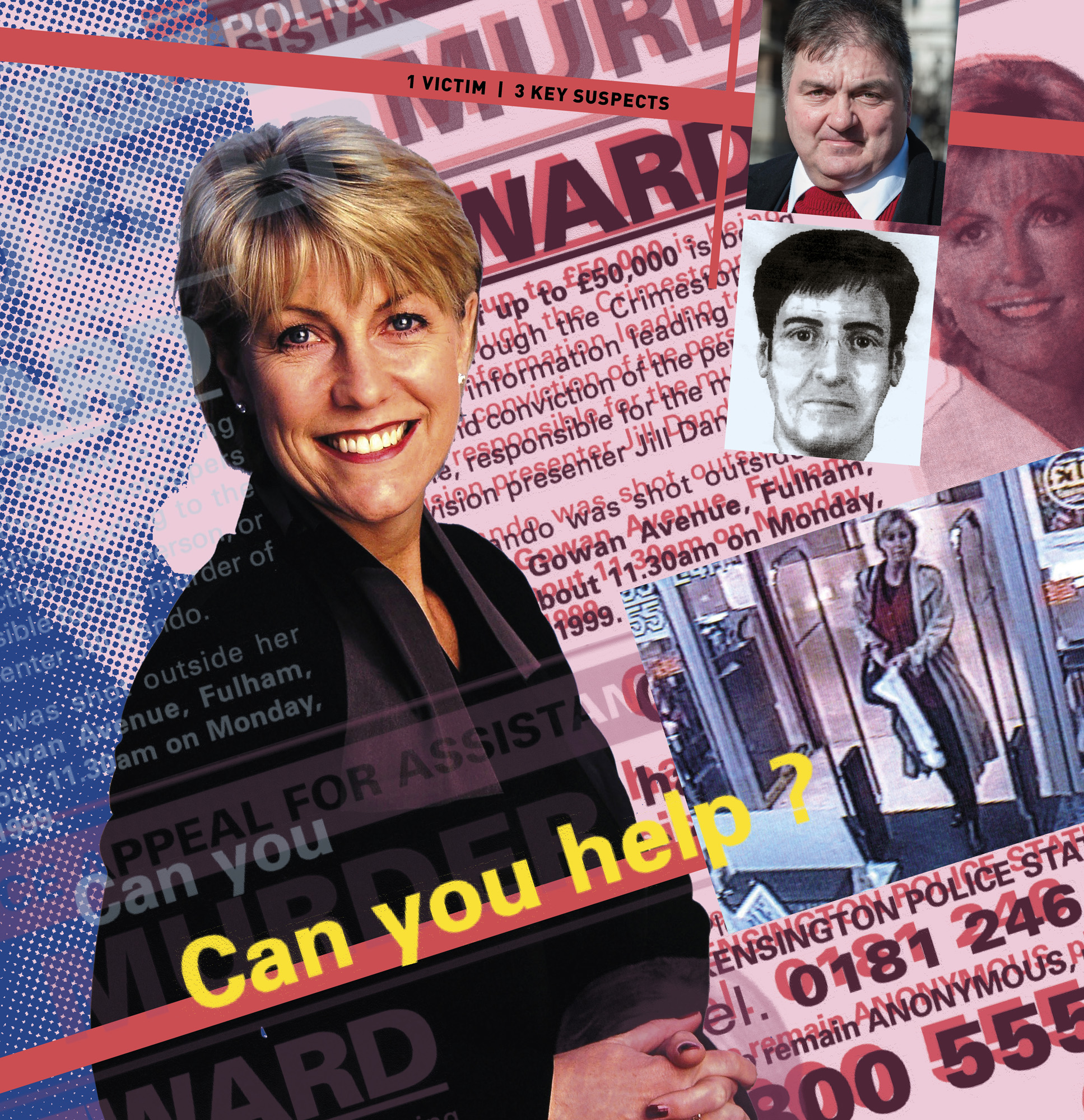
Clockwise from top: Barry George, who was acquitted in 2008 of the murder of Jill Dando; a 1999 police E-fit of a man they wished to interview in connection with the crime; a CCTV image of Jill shopping shortly before her death; TV presenter Jill Dando as the British public knew her.
FINAL MOMENTS
At approximately 11:30 a.m., Jill arrived at her front door. She was carrying a shopping bag in one hand and her house keys in the other. Before she had a chance to open the door, she was seized, pushed to the ground, and shot once in the head.
Jill’s neighbor, Richard Hughes, later told police that around the time of the attack, he heard her let out a “very distinctive scream” adding that she sounded “quite surprised.”1 Moments later, he spotted a clean-shaven, well-dressed man with dark hair running down the street. He estimated that the man was in his late 30s or early 40s and was about 5 feet 11 inches (1.8 meters) tall. Unaware that anything was awry, Hughes continued with his day.
Fifteen minutes later, a woman passing by discovered Jill lying on the ground outside her home in a pool of blood, her head resting against her front door. She was rushed to Charing Cross Hospital, but was pronounced dead on arrival.
The autopsy revealed that the gun had been pressed hard against Jill’s head when it was fired. The impression of the weapon’s barrel and sight was clearly visible. A single 9 mm bullet had entered just behind the top of her left ear and exited above the right ear, embedding itself in the front door. The gun had not been fitted with a silencer but, because it was fired while forced against Jill’s head, the noise of the shot would have been greatly reduced. Damage to the lower part of the door indicated that the victim had been in a crouched position when the fatal shot was fired—presumably forced to the ground by her killer. A bruise on Jill’s forearm could have been caused by her assailant.
Police investigators, some of whom had worked alongside Jill on Crimewatch, now had the grim task of trying to identify and catch her killer. Speculation immediately focused on the motive for the murder. As an investigative journalist and presenter, Jill had come into contact with a number of unsavory characters over the course of her career. Could she have been targeted by a professional hitman? Was someone seeking revenge? One theory was that she had been murdered by a Yugoslavian or Serbian assassin after making a TV appeal for Kosovo-Albanian refugees, who had been driven from their homes by militias backing Serbian leader Slobodan Milosevic. Another theory was that she had been targeted by a criminal she had helped to expose on an episode of Crimewatch. The fact that the killer knew to place the gun directly against her head to minimize noise and blood spatter indicated that he or she could have been a professional.
Another early line of inquiry examined the possibility that Jill had been murdered by an obsessive stalker—an occupational hazard for those in the limelight. “It could either be a stalker or a hitman. However, there are many theories to be explored and nothing will be left untouched,” announced Detective Chief Inspector Hamish Campbell, who was leading the investigation.2
May 25, 2000 / Police arrest local man Barry George for the murder of Jill Dando.
Massive media coverage meant that the police were under great pressure to find the killer. Nevertheless, their inquiries proved fruitless until, more than a year later, came the announcement the press and public had waited for: Barry George, 39, described as a “local weirdo” with an obsession for Freddie Mercury of the rock band Queen3, was charged with Jill Dando’s murder.
George had come to the attention of the police when he called them shortly after Jill’s death to report that he had seen a truck acting suspiciously near her home on the day of the murder. Police discovered that George, who was unemployed, had a history of stalking women and also convictions for sexual assault. He was put under surveillance as police collected evidence against him.
After his arrest, much was made of George’s local reputation as a “loner” and an “oddball.” He certainly had obsessive aspects to his personality; he had an unusual interest in celebrities and frequently adopted their names. In the years leading up to his arrest, he had called himself Steve Majors, after stuntman Lee Majors, who played Col. Steve Austin in the TV action series The Six Million Dollar Man, as well as Barry Bulsara (Freddie Mercury’s real surname). George also fabricated stories about his past, claiming to have been a roadie for Michael Jackson and to have served in the British Army’s elite SAS corps. Those who knew him said that he was obsessed with his health and could frequently be seen jogging or biking in the neighborhood. Shortly before his trial, George—who had an IQ of just 75, placing him in the lowest 5 percent of the population—was diagnosed with Asperger’s syndrome.
JUST A FAN?
During Barry George’s trial, the prosecution stressed the fact that when his apartment in nearby Crookham Road was searched, they discovered 54 newspaper clippings dating back to 1990 about Jill. However, Barry’s lawyer, Michael Mansfield QC, pointed out that George also had a number of newspaper clippings concerning other celebrities. In fact, the articles about Jill represented only 8 percent of the clippings found in his apartment. “There would be no way of telling from the 670 newspapers [found there] whether he was more interested in Manchester United than Jill Dando, would there?”5 he said, in response to the prosecution’s claim that George was an obsessive fan. “The fundamental flaw in this argument is that there is no evidence, none at all, that, prior to Jill Dando’s murder, this defendant had any exaggerated, special, or particular interest in her,” Mansfield observed.6 He emphasized that when Barry’s apartment was searched, no personal photographs or videos of Jill were found and neither were any autographs. If George was obsessed with Jill, as the prosecution claimed, then he would surely have gone to her house—which was just a short distance from his own—to take photographs of her or at least attempt to ask her for her autograph.
A witness at the trial claimed to have seen George outside Dando’s house several hours before the murder; however, the only piece of concrete evidence that could conceivably tie George to the crime was a tiny trace of a substance, reported to be firearm residue, found in the pocket of his jacket. A polyester fiber found on Jill Dando’s coat could have come from George’s pants, but the fiber was too common and too small for forensics expert Geoffrey Roe to be sure.
Mansfield went on to claim that the murder could have been a Serbian death squad reprisal for the RAF’s bombing of a Belgrade TV station. He also produced an official report that stated that a Serbian warlord had put the BBC director general, Sir John Birt, on a hit list. He suggested to the court that the target may have changed to Jill Dando after security was allegedly stepped up to protect Birt.
July 2, 2001 / Barry George is found guilty and sentenced to life in prison.
Despite the flimsy and highly circumstantial evidence against him, Barry George was found guilty. An appeal against the conviction was turned down the following year. Doggedly protesting his innocence, George took the case to the Criminal Cases Review Commission. Forensic science experts now questioned whether the particle found in George’s jacket was firearm residue after all. They decided that “it was, in fact, no more likely that the particle had come from a gun fired by George than that it had come from some other source.” A retrial was scheduled, and the firearm evidence—so crucial to George’s original conviction—was dismissed by the judge.
August 1, 2008 / Barry George is acquitted of Jill Dando’s murder after serving seven years in prison.
Following Barry George’s acquittal, there was widespread criticism in the media that the police had focused all their attention on trying to prove George’s guilt and devoted insufficient time to investigating other potential suspects. According to reports released in 2015, over 100 possible suspects in the murder were never successfully traced by police. These documents showed that some of these individuals included members of the Serbian secret service and of the IRA, as well as a notorious British gangster based in Spain. Furthermore, 11 men spotted on Jill’s street that afternoon were never identified. “I find it disturbing there were a hundred suspects who were never followed up. To put Barry George in the frame, they had to exclude everyone else,” said Michael Mansfield.
“THIS WAS A PROFESSIONAL HIT.”
After this information came to light, Alice Beers, a BBC colleague of Jill Dando and a former presenter of the Watchdog consumer advice program came forward to report that Jill had received threatening letters just weeks before she was killed. She said that both she and Jill had received letters from somebody threatening to kidnap and rape them. She expected the police to contact her about the letters, but no call ever came. “If no stone was left unturned… then I would have been called,” she said.7
COPYCAT KILLING
Was Jill Dando’s murderer an obsessive fan, a vengeful gangster, or a Serbian hitman? In 2009, the BBC revealed that shortly after Jill’s murder, an anonymous caller claiming to have killed Jill Dando had also threatened the head of BBC news at the time, Tony Hall.
In 2012, the Serbian angle seemed to become more plausible when the Daily Mail newspaper reported that a Serbian woman, Branka Prpa, claimed that her TV presenter husband, Slavko Curuvija, a critic of Slobodan Milosovic, had been murdered in a similar fashion.8
Despite intense media coverage in the press and on television, and a hefty reward for information leading to a conviction, Jill Dando’s killer has never been brought to justice.
JILL DANDO’S LAST DAY
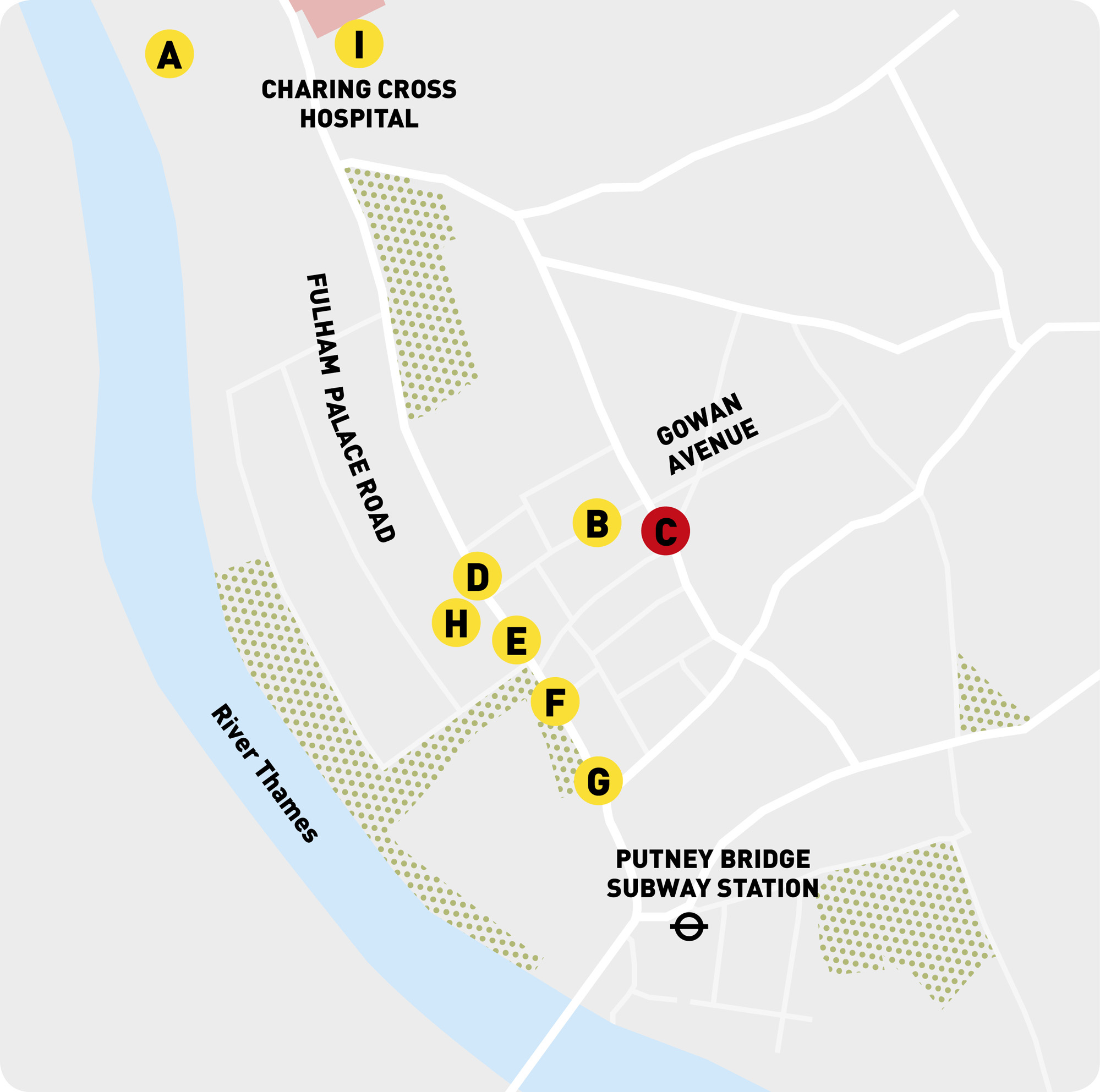
 10:00 a.m. Jill leaves fiancé’s home
 10:30 a.m. Cleaner sees man outside Jill’s house
 11:30 a.m. Jill is shot near to her front door
 Witnesses see man running away
 Man runs across Fulham Palace Rd.
 Witnesses see man crouched near Bishops Park, talking on a cellphone
 11:45 a.m. Man resembling E-fit image takes bus from Fulham Palace Rd. to Putney Bridge subway station
 11:52 a.m. Metallic blue Range Rover speeds south down Fulham Palace Rd.
 1:03 p.m. Jill dies in hospital
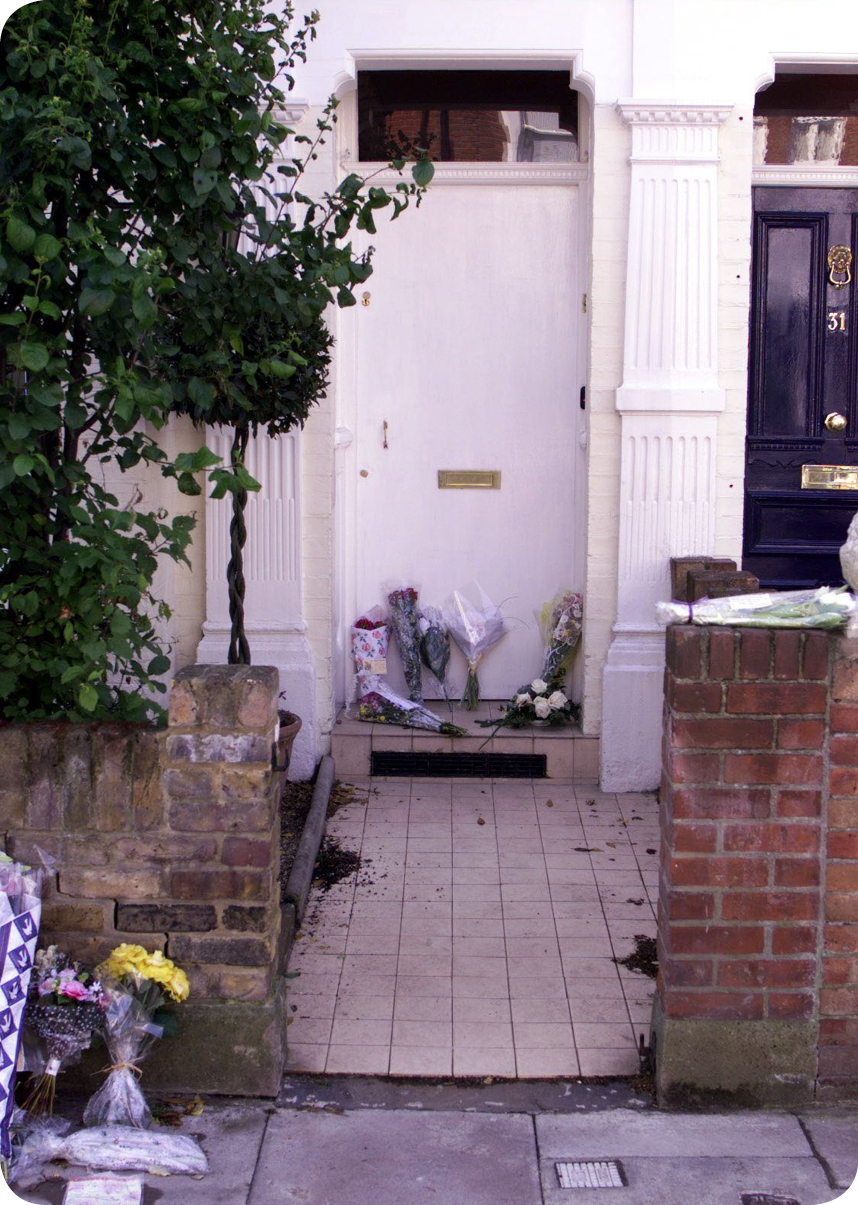
Jill Dando’s front door, the scene of her murder.