Table of Contents for
Unsolved Murders
 Unsolved Murders
Published by
DK Publishing, 2019
Unsolved Murders
Published by
DK Publishing, 2019
- Unsolved Murders: True Crime Cases Uncovered
- COVER
- TITLE PAGE
- CONTENTS
- HOW TO USE THIS EBOOK
- THE SHROUDED HOUSE: THE VILLISCA AX MURDERS, 1912
- A HOLLYWOOD WHODUNIT: WILLIAM DESMOND TAYLOR, 1922
- THE BODIES IN THE BARN: THE HINTERKAIFECK MURDERS, 1922
- THE IMPOSSIBLE MURDER: THE WILLIAM WALLACE CASE, 1931
- DEEP WATERS: THE SHARK ARM CASE, 1935
- PANIC IN THE CITY: THE CLEVELAND TORSO KILLER, 1935-38
- SCANDAL IN SHANGRI-LA: THE HAPPY VALLEY MURDER, 1941
- THE SKELETON IN THE WOOD: WHO PUT BELLA IN THE WYCH ELM?, 1943
- DEATH OF A DREAMER: THE BLACK DAHLIA, 1947
- DID SAM DO IT?: THE MURDER OF MARILYN SHEPPARD, 1954
- THE LAST BIKE RIDE: THE MURDER OF LYNNE HARPER, 1959
- CAMPSITE OF HORRORS: THE LAKE BODOM MURDERS, 1960
- KILLING FOR FUN: THE ZODIAC KILLER, 1968-69
- STRANGER DANGER: THE OAKLAND COUNTY CHILD KILLER, 1976-77
- DEATH AT THE DRUGSTORE: THE TYLENOL MURDERS, 1982
- A CHRISTMAS NIGHTMARE: THE MURDER OF JONBENéT RAMSEY, 1996
- DRIVE-BY SHOOTINGS: TUPAC SHAKUR AND BIGGIE SMALLS, 1996-97
- SHOT IN BROAD DAYLIGHT: THE MURDER OF JILL DANDO, 1999
- STAIRCASE OF DEATH: THE MURDER OF KATHLEEN PETERSON, 2001
- THE BODIES IN THE MARSHLAND: THE LONG ISLAND SERIAL KILLER, 2003-10
- REFERENCES
- COPYRIGHT
- Unsolved Murders: True Crime Cases Uncovered
THE HAPPY VALLEY MURDER, 1941
SCANDAL IN SHANGRI-LA
While most Britons were suffering the perils and privations of World War II, far away in Africa, a few wealthy aristocrats were living the high life. Until murder shattered their exotic idyll…
The murder of Josslyn Hay, 22nd Earl of Erroll, Baron of Kilmarnock and High Constable of Scotland, scandalized wartime Britain by exposing the decadent habits of a group of wealthy expatriates in colonial Kenya. Speculation was also rife as to the murderer’s possible motive. Was it a crime of passion prompted by Hay’s notorious womanizing, or could his death have been a political assassination provoked by his fascist connections?
Hay was part of a small group of privileged white Britons sitting out the war by living a life of hedonism and luxury in Kenya. The group was known as the Happy Valley set, and the White Highlands of Kenya was their playground. The Happy Valley set became infamous for their debauched lifestyles; their sexual promiscuity, excessive drinking and drug use, and continuous partying shocked the small community of settlers who were striving to create farmland from the African bush.
WILD PARTIES
Hay first arrived in Kenya in 1924 with his wife, Lady Idina Sackville, with whom he had eloped while she was still married to her first husband. Hay barely pretended to be faithful, but Idina reportedly did not mind the numerous love affairs her husband was having behind her back. “Idina was only happy… if all her guests had swapped partners, wives or husbands by nightfall,” wrote James Fox in his celebrated book on the Happy Valley case, White Mischief.1 In fact, the couple’s dinner parties at their ranch house, Clouds, were the talk of the area. A regular event at these gaudy soirées was the “sheet game,” in which nude men lined up behind a sheet. The female guests then attempted to identify them just by their lower regions.
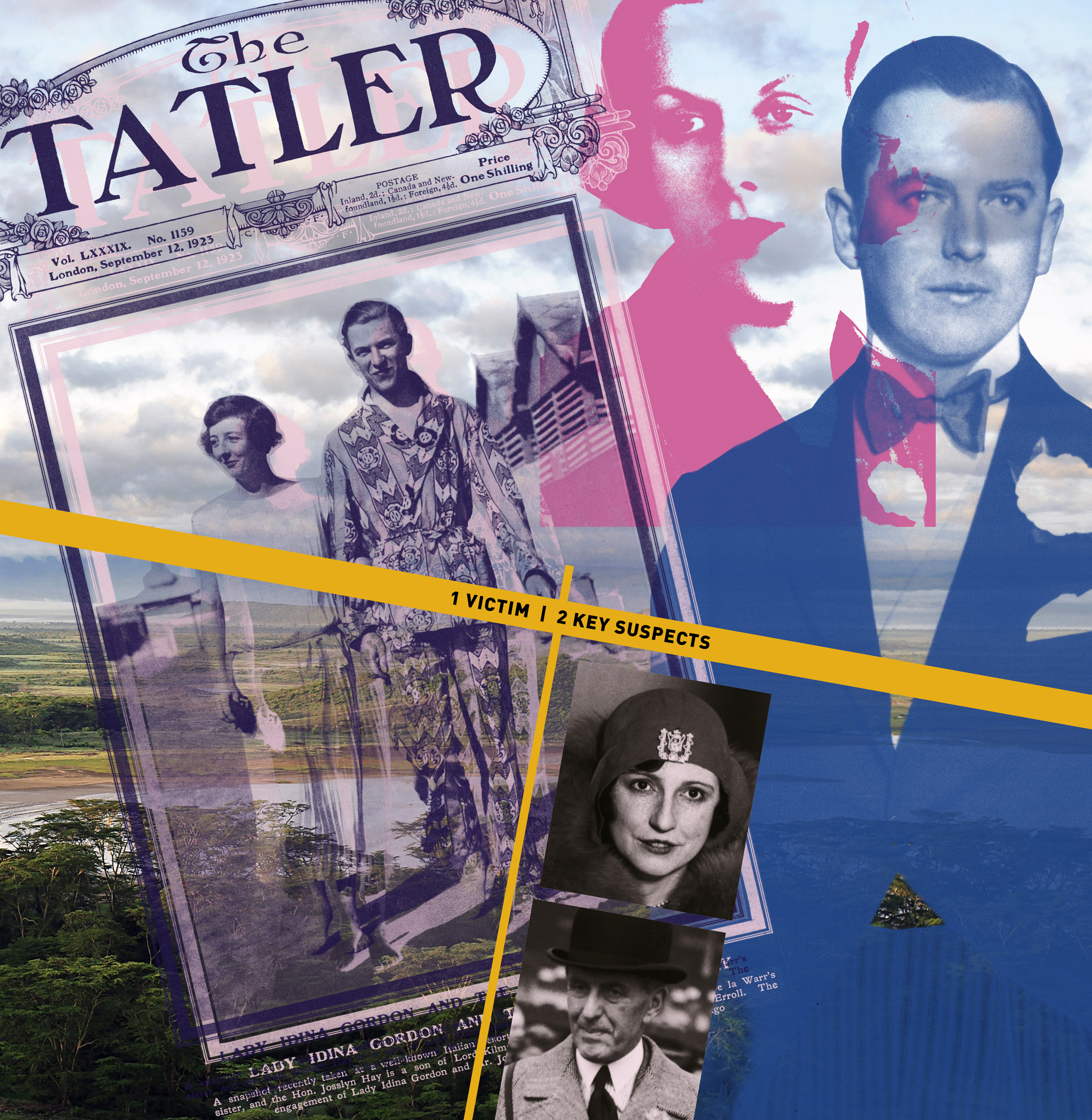
Main image: The region of Kenya that was known as Happy Valley
Clockwise from left: Lady Idina Gordon and her fiancé the Hon. Josslyn Hay, later Earl of Erroll, in 1923; Diana Caldwell; Hay in evening dress; Molly Ramsay-Hill on the day of her wedding to Hay; prime suspect Sir Jock Delves Broughton.
In 1928, the couple divorced amid fights over financial issues. Hay moved in with Edith Maude “Molly” Ramsay-Hill, a married woman some years Hay’s senior. When Ramsay-Hill’s husband was made privy to the affair, he confronted the couple and chased Hay with a rhino whip. Molly was soon divorced, and she and Hay wed in 1930.
After leaving her husband, Molly bankrolled both her and her younger husband. They lived in Oserian, a flashy, Moroccan-style home on the shores of Lake Naivasha, Kenya. Hay’s chiseled looks, arrogant air, and quick wit made him irresistibly attractive to the clique of bored, upper-class settlers’ wives. A serial philanderer and gambler, his speciality was seducing rich married women. Meanwhile, Molly Ramsay-Hill so immersed herself in the alcohol and drug-fueled “Happy Valley” lifestyle that she died of overindulgence in 1939.
INSTANT ATTRACTION
The following year, Hay encountered Lady Diana Delves Broughton, a voluptuous 26-year-old with deep blue eyes and wispy blonde locks. Many women in the Happy Valley set envied her beauty and instant sex appeal. Lady Diana had recently married the much older Sir Jock Delves Broughton, 11th Baronet DL and the largest landowner in Kenya. Recently divorced, Sir Jock had decided to take his young wife to Kenya to escape his mounting debts, as well as to get away from wartime Britain.
The attraction between the rakish aristocrat Hay and Lady Diana was instant. They soon embarked upon a passionate and highly visible affair, which Sir Jock was said to be very nonchalant about. When he and Diana married, they had reportedly made a pact that they would “set each other free” should either one of them fall in love with somebody else. Sir Jock later claimed that he took a “philosophical” view of his beautiful young wife’s affair with his friend and resolved to step back.2
As if to demonstrate that he bore the couple no ill will, on January 23, 1941, Sir Jock invited Lady Diana and Hay to a dinner party at the exclusive Muthaiga Club—a frequent haunt of the Happy Valley set—along with several other friends. During this lavish event, Sir Jock, though drinking heavily, played the perfect part of a graceful loser. He even toasted the new couple with champagne and wished them “every happiness.”3 Within hours, Hay would be dead.
COVERED TRACKS
As the dinner party reached its drunken conclusion, Hay and Lady Diana decided to continue celebrating and went out dancing. At around 2:15 a.m., Hay dropped off Lady Diana at the home she shared with Sir Jock and climbed back into his Buick to drive the short distance to his own house. Scarcely an hour later, two dairy workers discovered his body. His car’s headlights were still blazing.
January 24, 1941 / Hay is found shot dead in his car at the Karen Road junction on the Nairobi-Ngong road.
Hay’s body was in a kneeling position in the front passenger footwell; a bullet had entered his head just behind the right ear. Powder marks on the side of his face indicated that he had been shot at close range. In the car, police found a cigarette butt soaked in blood. In what remains arguably one of the most bungled police inspections in criminal history, Hay’s body was removed before being carefully examined, and police trampled all over another set of tire tracks that could have had a bearing on the case. Hay’s Buick was even given a thorough wash before the decision was made to dust it for fingerprints.
The murder of Josslyn Hay, the 22nd Earl of Erroll, marked open season on his reputation, and stories of his hedonistic lifestyle flashed across British newspapers alongside news of the nightly raids by German bombers. He quickly became a symbol of debauched aristocracy and, eager for distraction from the Blitz, the nation reveled in his downfall. Before long, his affair with Lady Diana became common knowledge, and Sir Jock was named the prime suspect in the murder. He was duly arrested on March 10 and charged with Hay’s murder. Sir Jock denied any involvement in the crime, citing the fact that he had invited Hay and Lady Diana to his dinner party the evening before the murder as evidence that he was not jealous or angry about the breakdown of his marriage.
May 26, 1941 / The trial of Sir Jock Delves Broughton for the murder of Josslyn Hay, 22nd Earl of Erroll, begins.
During the subsequent trial, Lady Carberry, a close friend of the Broughtons, testified that, despite his protestations, Sir Jock appeared unhappy during the dinner party. He told her that he planned to give his wife his estate or make her an allowance. He also announced that he had been “extraordinarily lonely” during his short marriage.4 Lady Carberry added that, after the death of Hay, on one occasion she and Sir Jock had lunch, during which he broke down and wept.
THE CASE COLLAPSES
So far, the evidence against Sir Jock was little more than supposition. The prosecution claimed that the bloodstained cigarette butt found in Hay’s car constituted evidence that Sir Jock was the murderer, on the slender basis that Hay did not smoke, but Sir Jock was known to smoke two brands of cigarettes.
Searching for hard facts, the prosecution pinned its hopes on showing that the single bullet that killed Hay came from a .32 Colt found in Sir Jock’s home. When a ballistics expert testified that the bullet that killed Hay could not have come from a Colt—any Colt—the absence of a murder weapon destroyed the prosecution’s case. After just three hours deliberation, Sir Jock was acquitted. A contributing factor to this verdict may have been the fact that the foreman of the jury was Sir Jock’s barber.
Far from being welcomed back after his ordeal, Sir Jock was shunned by his former Happy Valley friends. Lady Diana, apparently recovering quickly from the shock of Hay’s murder, immediately left Sir Jock for Gilbert Colvile, a millionaire cattle rancher who lived nearby. Nursing a back injury, Sir Jock returned home to England alone and stayed in the Adelphi Hotel in Liverpool.
December 5, 1942 / Sir Jock Delves Broughton commits suicide with a morphine overdose.
To many observers, Sir Jock’s suicide was tantamount to an admission of guilt. A month after Sir Jock’s death, Lady Diana married the eminently respectable Gilbert Colvile.
In her 2003 book Elspeth Huxley: a Biography, C. S. Nicholls, an authority on colonial Kenya, named Sir Jock as the murderer. By her account, Sir Jock lay in wait for Hay when he drove Lady Diana home. He got in Hay’s car, shot him, and then drove to the crossroads. For a large sum of money, Sir Jock had arranged for an acquaintance, Dr. Athan Philip, to meet him there and drive him back to his house.
POLITICAL MOTIVES
The theory that Hay may have been killed by a jealous husband was one thing, but when Sir Jock was acquitted, speculation arose that there could have been a political motive for the murder. Could Hay have been assassinated by a British agent because he was a fascist sympathizer, suspected of collaborating with the Germans? Hay had actually joined the British Union of Fascists for a year in 1934; there were even rumors that he was involved in a renegade group that included the Duke of Windsor and Rudolf Hess.5 An investigation by The Sunday Times speculated that Hay had abused his position as second-in-command of the Kenyan armed forces by selling secrets to Mussolini’s forces in Italian East Africa. It was well known that British military plans had been leaked to the Italian army headquarters in Addis Ababa. Could Hay have been responsible? Giving more weight to this theory, several close associates of Lady Diana alleged that Hay was lined up to become the Governor of Kenya in the event of a successful Italian invasion.
A LOVER’S REVENGE
Other commentators have suggested the possibility that a scorned lover did the deed. There are even some who believed that Hay was killed by Lady Diana when he refused to marry her. However, as their passionate romance was still in its first flush, and she was apparently at home in bed at the time of his death, this was thought unlikely.
In 2010, a fresh suspect was brought to light when Paul Spicer began researching the American heiress Countess Alice de Janzé, who had been a close friend of his mother and a leading member of the Happy Valley set.
In his book, The Temptress: The Scandalous Life of Alice, Countess de Janzé, Spicer related that Alice de Janzé had an on-off relationship with Hay over the course of several years. Coincidentally, she had experience with a gun, having shot her lover, the English nobleman and playboy Raymund de Trafford, and then herself at a Paris railroad station in 1927. Both fortunately survived, and Alice de Janzé was dubbed “the fastest gun in the Gare du Nord.”
THE FEMME FATALE
Alice de Janzé only received a six-month suspended sentence for shooting Raymund de Trafford and herself. The French court viewed the crime leniently as a “crime of passion.” Spicer claimed that de Janzé had an issue with rejection and suggested that, incensed by Hay’s budding relationship with the much younger Lady Diana Broughton, she could have arranged to meet Hay at the crossroads and shot him. “She had the motive and she certainly had the nerve. She would not fear carrying out that act. She was consumed with jealousy.” Soon after the murder, Alice de Janzé visited the mortuary where Hay’s body lay and kissed him on the lips, reportedly exclaiming, “Now you are mine forever.”
“SHE HAD SHOT A MAN BEFORE.”
Alice de Janzé had dabbled in the occult and may have hoped to be reunited with her former lover in some form of afterlife. In any event, she never got over his death and committed suicide in September 1941. Spicer claimed that she left a note for the police in which she confessed to the murder. However, the contents of this letter have never been revealed.6
The glare of publicity surrounding the murder of Hay marked the beginning of the end for Kenya’s colonial expat elite, but the question of who pulled the fateful trigger that dark night, and why, continues to cast its lurid, glamorous spell.
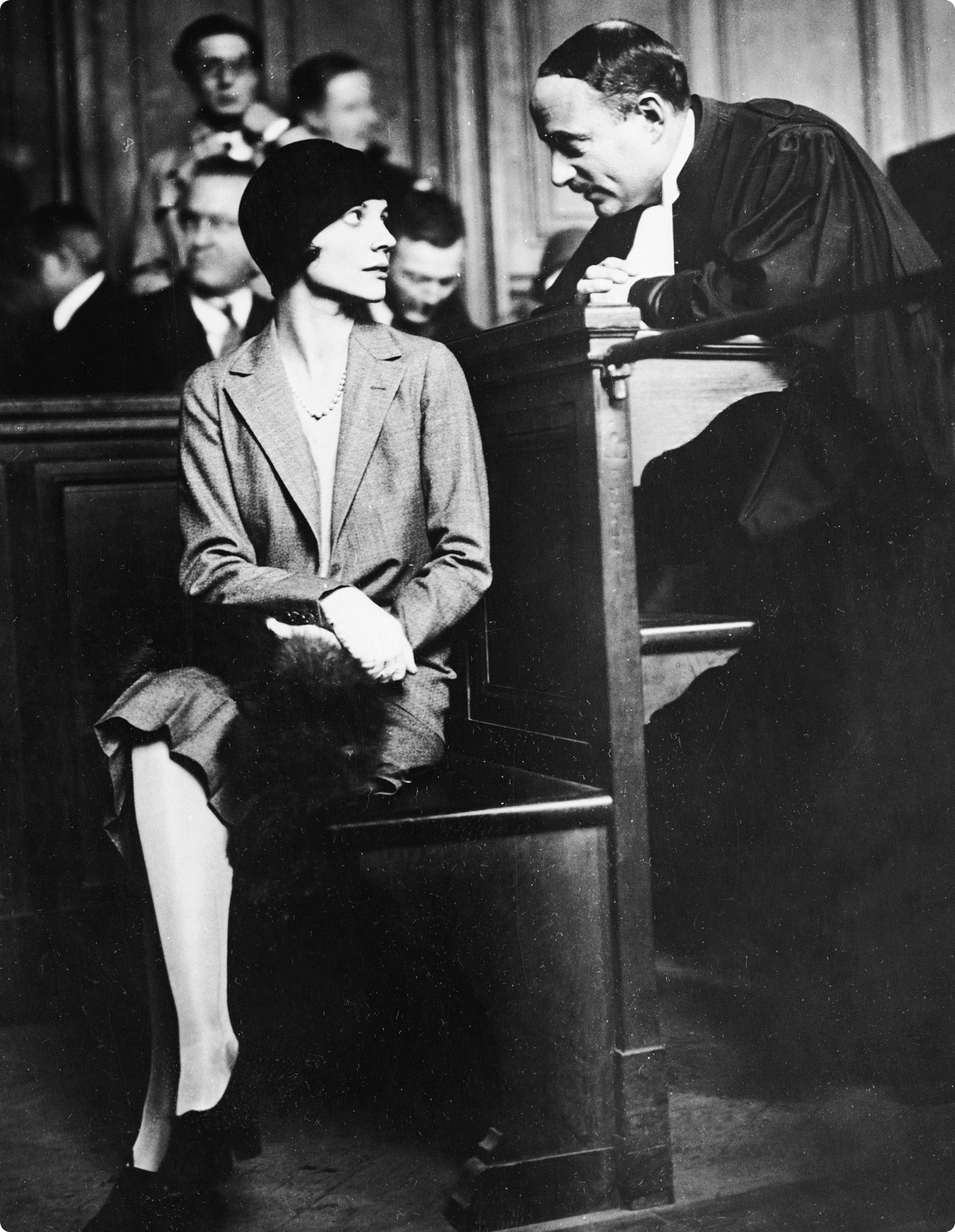
The tempestuous American heiress Countess Alice de Janzé confers with her barrister during her trial for shooting her lover and herself at the Gare du Nord, Paris,1927.