Table of Contents for
Unsolved Murders
 Unsolved Murders
Published by
DK Publishing, 2019
Unsolved Murders
Published by
DK Publishing, 2019
- Unsolved Murders: True Crime Cases Uncovered
- COVER
- TITLE PAGE
- CONTENTS
- HOW TO USE THIS EBOOK
- THE SHROUDED HOUSE: THE VILLISCA AX MURDERS, 1912
- A HOLLYWOOD WHODUNIT: WILLIAM DESMOND TAYLOR, 1922
- THE BODIES IN THE BARN: THE HINTERKAIFECK MURDERS, 1922
- THE IMPOSSIBLE MURDER: THE WILLIAM WALLACE CASE, 1931
- DEEP WATERS: THE SHARK ARM CASE, 1935
- PANIC IN THE CITY: THE CLEVELAND TORSO KILLER, 1935-38
- SCANDAL IN SHANGRI-LA: THE HAPPY VALLEY MURDER, 1941
- THE SKELETON IN THE WOOD: WHO PUT BELLA IN THE WYCH ELM?, 1943
- DEATH OF A DREAMER: THE BLACK DAHLIA, 1947
- DID SAM DO IT?: THE MURDER OF MARILYN SHEPPARD, 1954
- THE LAST BIKE RIDE: THE MURDER OF LYNNE HARPER, 1959
- CAMPSITE OF HORRORS: THE LAKE BODOM MURDERS, 1960
- KILLING FOR FUN: THE ZODIAC KILLER, 1968-69
- STRANGER DANGER: THE OAKLAND COUNTY CHILD KILLER, 1976-77
- DEATH AT THE DRUGSTORE: THE TYLENOL MURDERS, 1982
- A CHRISTMAS NIGHTMARE: THE MURDER OF JONBENéT RAMSEY, 1996
- DRIVE-BY SHOOTINGS: TUPAC SHAKUR AND BIGGIE SMALLS, 1996-97
- SHOT IN BROAD DAYLIGHT: THE MURDER OF JILL DANDO, 1999
- STAIRCASE OF DEATH: THE MURDER OF KATHLEEN PETERSON, 2001
- THE BODIES IN THE MARSHLAND: THE LONG ISLAND SERIAL KILLER, 2003-10
- REFERENCES
- COPYRIGHT
- Unsolved Murders: True Crime Cases Uncovered
THE WILLIAM WALLACE CASE, 1931
THE IMPOSSIBLE MURDER
Was this history-making case a “perfect crime” meticulously orchestrated by a ruthless mastermind? Or was the prime suspect just another innocent victim?
The murder of Julia Wallace, bludgeoned to death in the parlor of her marital home in Liverpool, England on January 20, 1931 is widely regarded as one of the most baffling of all unsolved crimes. This classic “locked-room” murder mystery has fascinated crime writers such as Raymond Chandler and Dorothy L. Sayers, inspired the P. D. James novel The Skull Beneath the Skin, and also been the subject of a television drama, investigative documentaries, and numerous true crime books and articles in the press. The case also made British legal history: It was the first time that a murder conviction was overturned on appeal following a review of the evidence.
THE HAPPY COUPLE
William Herbert Wallace and his wife, Julia, lived in a small, three-bedroom terrace on Wolverton Street in the poor district of Anfield, Liverpool. They had been married for 17 years. William had traveled widely as a young man, visiting both India and China. He was forced home by illness and met Julia a couple of years after his return to Britain. William was now an insurance agent with the Prudential Assurance Company, while Julia was an amateur painter and pianist. In fact, both Julia and William were musically gifted, with William being an adept violin player. The couple would often play and sing duets together. Julia was exceptionally intelligent, having studied philosophy and dabbled in chemistry. According to William, their marriage was harmonious, and friends and neighbors would testify that there was nothing to indicate otherwise.
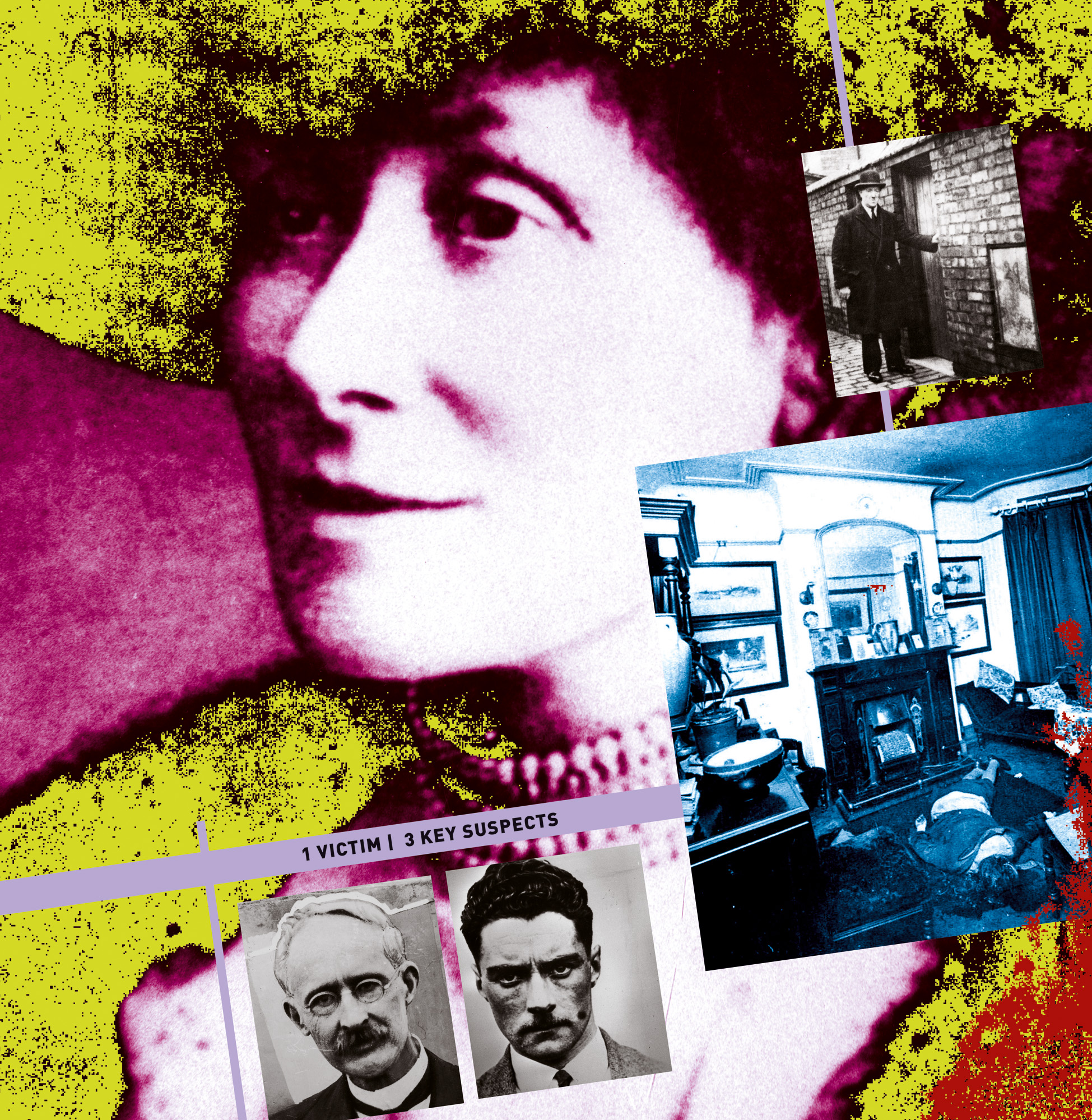
Main image: Julia Wallace c.1900.
Clockwise from top: Detective-sergeant Harry Bailey at the back door that would not—and then would—open; Julia Wallace’s body in the parlor at 29 Wolverton Street; Richard Gordon Parry in a 1934 police mug shot; prime suspect William Wallace.
MYSTERY CLIENT
On the evening of Monday, January 19, 1931, 52-year-old William Wallace arrived at the Liverpool Central Chess Club for a game. He was handed a message by club captain Samuel Beattie, who had taken a telephone call for Wallace. The caller had identified himself as “R. M. Qualtrough” and requested that Wallace should come to “25 Menlove Gardens East” the following evening at 7:30 p.m. to discuss an insurance deal. “I want to see him particularly,” said the voice at the end of the line.1 The caller said that he couldn’t call back because it was his daughter’s 21st birthday and he was therefore particularly busy. William took the note and placed it in his pocket, telling Beattie that he didn’t know anybody by the name of “R. M. Qualtrough,” but would visit him tomorrow nevertheless. Times were tough in Depression-era Britain and Wallace foresaw the possibility of some much-needed money.
The following evening, Wallace finished his day’s work at the Prudential Assurance Company and returned home, where Julia had dinner waiting. When the couple finished eating, Wallace told her that he had a meeting with a man who could hopefully bring him more insurance business. As Wallace put on his coat, he added that he would be home as soon as possible.
7:06 p.m. / William Wallace boards the tram at Lodge Lane in order to keep his appointment with R. M. Qualtrough.
Wallace set off for 25 Menlove Gardens East; he hadn’t heard of the address before but knew the general area. During his tram journey, he chatted to the tram inspector, mentioning where he was going. Wallace got off the tram at what he assumed was the appropriate stop and went looking for the address. He found Menlove Gardens North, South, and West, but no Menlove Gardens East. He then asked several people, including a couple of police officers on beat duty if they knew the street. They all gave the same answer: Menlove Gardens East did not exist.
His patience exhausted, Wallace gave up this infuriating wild goose chase and made his way back home, pondering who “R.M. Qualtrough” could be and why he had seen fit to send him to a non-existent address on a cold, dark winter’s evening.
THE BODY IN THE PARLOR
Wallace arrived home—only to discover that he was unable to open either his front or back door. Both appeared to be locked from the inside. His next-door neighbors, John and Florence Johnston, saw him looking worried and asked him if he needed any help. He told them that he had been out for several hours and could not get into his home. However, while Mr. and Mrs. Johnston were present, he walked around to the back once again and this time, the door opened. “It opens now,” he murmured to his neighbors. As he entered the house, a ghastly scene met his eyes. Julia was lying in front of the gas fire in the parlor. She had been bludgeoned to death with a heavy object, hit with such force that her skull had been cracked open. “They’ve finished her, look at her brains…” William commented, with a surprising lack of apparent emotion, to Mr. and Mrs. Johnston, who were standing behind him in the doorway.
Police soon arrived to assess the scene and make a search of the house and surrounding area. They noted that there was no sign of breaking and entering, leading them to believe that Julia herself must have admitted the killer into the house. A small sum of money had been stolen from an insurance money cashbox in the house but the police deduced that this was a ploy to give the impression that the murder was the result of a robbery gone wrong. The handling of the investigation left much to be desired; while examining the crime scene, officers wandered all over the house, and smudged fingerprints that could have belonged to the killer. Moreover, the pathologist neglected to take the temperature of Julia’s body and therefore an accurate time of death was never determined.
THE GUILTY HUSBAND?
What is known is that the murder was frenzied and brutal. Blood was splattered across the room, indicating that the killer would most likely have blood on his own clothes. In addition, a check of the house’s sinks and drains revealed that they had not been used, indicating that the killer left without washing any blood from his clothing or body.
Although there was no direct evidence against him, police soon began to question whether William had killed his wife and engineered the phony meeting with the mysterious “R. M. Qualtrough” to deflect suspicion from himself. They took the fact that William had asked various people for directions as a ploy to establish an alibi for the murder. It transpired that the phone call from “R.M. Qualtrough” had come from a telephone booth just 400 yards (366 meters) from the Wallace household. However, Samuel Beattie, who had taken the phone call at the Liverpool Central Chess Club, was adamant that the voice on the other end of the line was not William’s.
Investigators also questioned why William had claimed that the back door of his home was jammed but, as soon as other witnesses were present, miraculously opened. Investigators found a raincoat beneath Julia’s body. William didn’t have a spot of blood on the suit he was wearing, so police speculated that he could have worn the raincoat over his naked body as he carried out the murder to shield himself from blood spatter.
While investigators were building a case against William, the balance of evidence was beginning to tilt in his favor. Numerous witnesses placed William on the tram at around 7:06 p.m. that evening, while others claimed to have seen Julia alive at approximately 6:45 p.m. This time frame implied that William would only have had about 20 minutes to murder his wife, clean himself up, dispose of the murder weapon, hide the money that was missing from the cashbox, and catch the tram.
February 2, 1933 / William Herbert Wallace is arrested and charged with the murder of Julia Wallace.
William stood trial at Liverpool Assizes. “Few more brutal murders can ever have been committed—this elderly, lonely woman literally hacked to death for apparently no reason at all,” declared the prosecuting counsel, Edward Hemmerde K.C. During the trial, William seemed detached and monotone, if not cold, while detailing the events around the horrible murder of a loved one. He took the stand and failed to impress the jury. Why? As an observer of the trial, crime writer F. Tennyson Jesse wrote: “The jury did not like the man, or his manner which could have been either stoicism or callousness. They did not understand his lack of expression… and they knew it hid something. It could have hidden sorrow or guilt and they made their choice.”
All the evidence against William was highly circumstantial and no motive was put forward. Nevertheless, after just an hour of deliberation by the jury, William Herbert Wallace was found guilty of his wife’s murder and sentenced to die on the gallows.
“PEOPLE OF UNPLEASING PERSONALITY SHOULD BE ADVISED NEVER TO GO INTO THE WITNESS BOX.”
One month later, Wallace became the first man in Britain to have a conviction for murder dismissed on the grounds that it was not supported by the evidence. Wallace was a free man, but was still met with general suspicion. He moved to a bungalow on the River Mersey where, just two years later, he died. Some said that stress and a broken heart contributed to his sudden demise. He went to the grave protesting his innocence. Wallace was buried beside his wife.
ALTERNATIVE SUSPECTS
So if William Herbert Wallace was not responsible for his wife’s murder, then who killed her? In 1984, true crime writer Roger Wilkes speculated in his book Wallace: The Final Verdict that the real murderer of Julia Wallace was Richard Gordon Parry, a former work colleague of Wallace. Another former colleague told police that Wallace had reported Parry for wrongdoing, which led to Parry being fired. In his book, Wilkes claims that Parry wanted revenge on Wallace, so he lured Wallace from his home with the phone call and committed the murder while Wallace was out searching for the non-existent address. While researching the case, Wilkes found a new witness; a retired mechanic named John Parkes, who claimed that on the night of Julia Wallace’s murder, he had hosed down a car for Parry. While cleaning the car’s interior, he came across a bloodstained glove, which Parry quickly snatched away.3
John Gannon’s book The Killing of Julia Wallace named another suspect in the murder: Joseph Caleb Marsden. Gannon theorized that Wallace knew that he did not have long to live and decided that he did not want to spend his final years with his hated wife. According to Gannon, Wallace hired Parry to make the bogus phone call in order to provide Wallace with an iron-clad alibi for the time of the murder.
However, Gannon contended that neither Wallace nor Parry committed the murder, but Marsden. Gannon asserted that Marsden was about to marry into a wealthy family, but Wallace had discovered that he was having a sexual relationship with Julia. This gave Wallace the opportunity to blackmail Marsden into killing his wife for him. During the initial investigation, however, Marsden’s name cropped up as nothing more than an acquaintance of both Wallace and his wife.4
AN UNSOLVABLE PUZZLE
Since 1931, the so-called “perfect murder” of Julia Wallace has been investigated and reinvestigated numerous times. Nevertheless, experts still have contradicting opinions on William Herbert Wallace’s guilt. Many wild rumors circulated, from William having an affair with Julia’s sister to Julia being overinsured and killed by William for the money. One of the most imaginative theories in the case is that William was a secret disciple of occultist Aleister Crowley with a drug addiction, who had numerous affairs behind his wife’s back. However, no evidence has ever substantiated any of these speculations.
The murder of Julia Wallace continues to defy explanation. The crime novelist Raymond Chandler fittingly referred to the case as “the nonpareil of all murder mysteries… the impossible murder, because Wallace couldn’t have done it and neither could anyone else.”
THE MOVEMENTS OF WILLIAM WALLACE
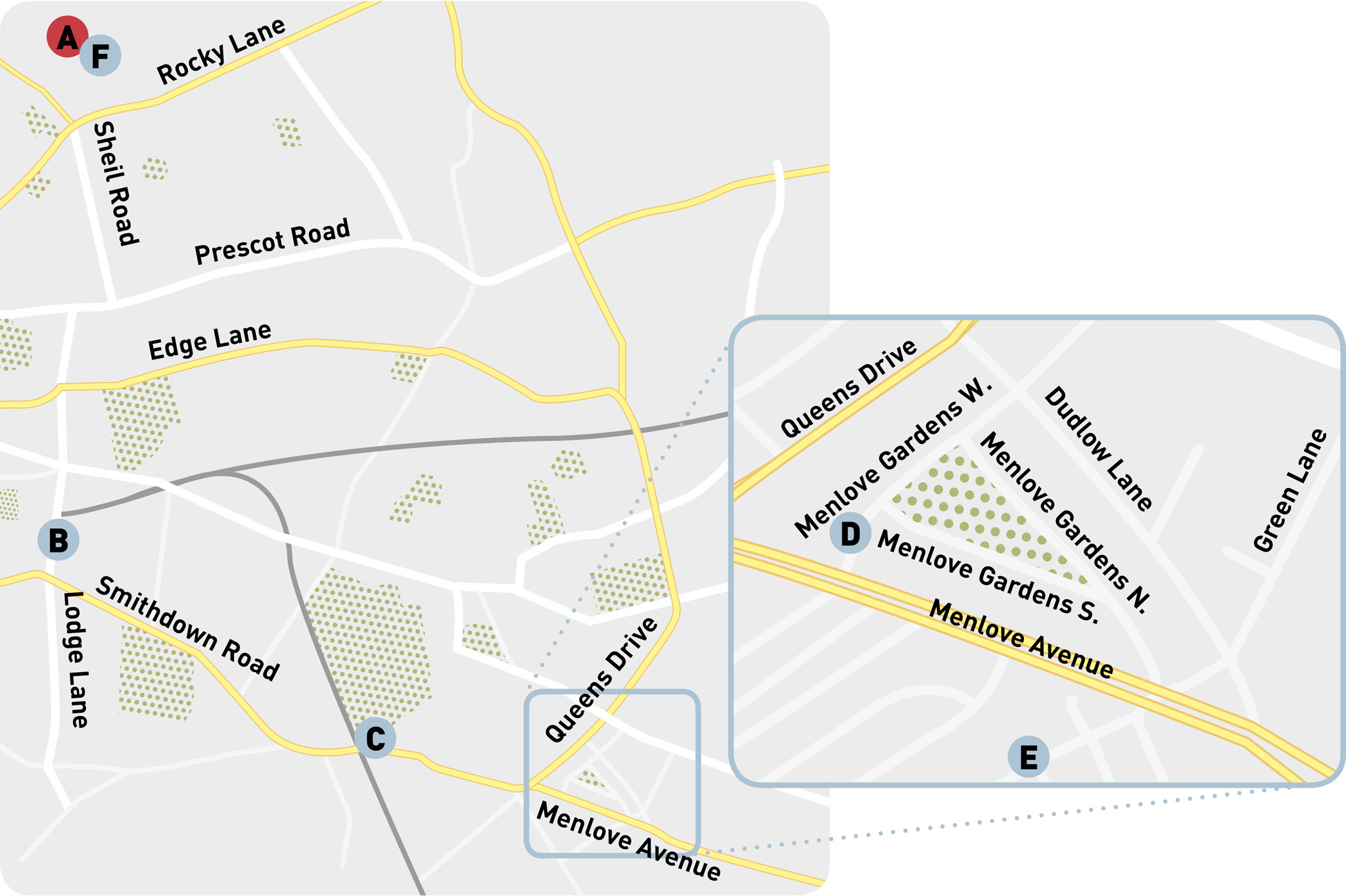
 Wallace leaves his house
 7:06 p.m. Wallace boards tram
 7:15 p.m. Wallace transfers to 5A tram car
 Katie Mather tells Wallace she does not know a Qualtrough
 7:45 p.m. Wallace asks a policeman the time
 8:45 p.m. Neighbors see Wallace standing outside his home