Table of Contents for
Unsolved Murders
 Unsolved Murders
Published by
DK Publishing, 2019
Unsolved Murders
Published by
DK Publishing, 2019
- Unsolved Murders: True Crime Cases Uncovered
- COVER
- TITLE PAGE
- CONTENTS
- HOW TO USE THIS EBOOK
- THE SHROUDED HOUSE: THE VILLISCA AX MURDERS, 1912
- A HOLLYWOOD WHODUNIT: WILLIAM DESMOND TAYLOR, 1922
- THE BODIES IN THE BARN: THE HINTERKAIFECK MURDERS, 1922
- THE IMPOSSIBLE MURDER: THE WILLIAM WALLACE CASE, 1931
- DEEP WATERS: THE SHARK ARM CASE, 1935
- PANIC IN THE CITY: THE CLEVELAND TORSO KILLER, 1935-38
- SCANDAL IN SHANGRI-LA: THE HAPPY VALLEY MURDER, 1941
- THE SKELETON IN THE WOOD: WHO PUT BELLA IN THE WYCH ELM?, 1943
- DEATH OF A DREAMER: THE BLACK DAHLIA, 1947
- DID SAM DO IT?: THE MURDER OF MARILYN SHEPPARD, 1954
- THE LAST BIKE RIDE: THE MURDER OF LYNNE HARPER, 1959
- CAMPSITE OF HORRORS: THE LAKE BODOM MURDERS, 1960
- KILLING FOR FUN: THE ZODIAC KILLER, 1968-69
- STRANGER DANGER: THE OAKLAND COUNTY CHILD KILLER, 1976-77
- DEATH AT THE DRUGSTORE: THE TYLENOL MURDERS, 1982
- A CHRISTMAS NIGHTMARE: THE MURDER OF JONBENéT RAMSEY, 1996
- DRIVE-BY SHOOTINGS: TUPAC SHAKUR AND BIGGIE SMALLS, 1996-97
- SHOT IN BROAD DAYLIGHT: THE MURDER OF JILL DANDO, 1999
- STAIRCASE OF DEATH: THE MURDER OF KATHLEEN PETERSON, 2001
- THE BODIES IN THE MARSHLAND: THE LONG ISLAND SERIAL KILLER, 2003-10
- REFERENCES
- COPYRIGHT
- Unsolved Murders: True Crime Cases Uncovered
THE LAKE BODOM MURDERS, 1960
CAMPSITE OF HORRORS
This seemingly motiveless attack on four sleeping teenagers in a famous Finnish beauty spot has passed into the darkest annals of unexplained crime.
Finland’s beautiful Lake Bodom is situated near the southern city of Espoo. Between June and August the sun does not set, temperatures soar, and Finns of all ages flock to the lake to celebrate the arrival of summer and the passing of the long, freezing winter. It was in this carefree spirit that, on June 4, 1960, four teenagers pitched their tent on the lake’s tranquil shore.
Maila Irmeli Björklund and Anja Tuulikki Mäki, both 15, and their boyfriends, Seppo Antero Boisman and Nils Wilhelm Gustafsson, both 18, had planned an evening of fishing and camping. After riding their motorcycles to Lake Bodom from their hometown of Vantaa, the teenagers chose a spot shaded by birch trees along the idyllic Finnish bay. They spent the evening chatting, swimming, and fishing, completely oblivious to the horrors that would soon unfold at their campsite. Between 4:00 a.m. and 6:00 a.m., the sleeping teenagers were brutally attacked. They were bludgeoned with a heavy object, possibly a large rock, and slashed and stabbed with a knife. The murder weapons would never be found.
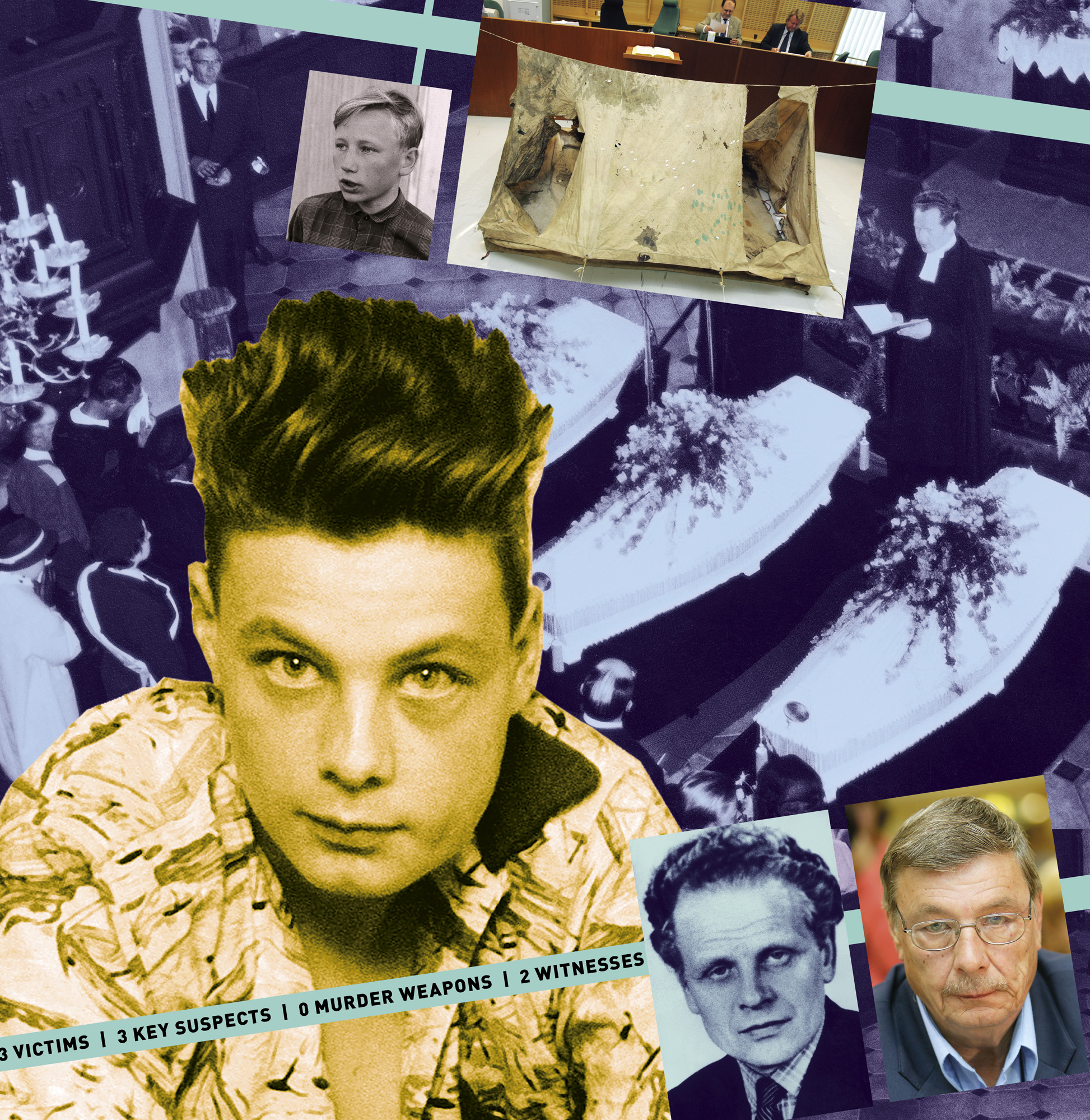
Main image: The funeral of the three Lake Bodom murder victims.
Clockwise from top: One of the boys who might have seen the killer; the ripped and stained tent, one of the main exhibits at Nils Gustafsson’s 2005 trial; Gustafsson, who was acquitted of all charges; suspect Hans Assmann; young Nils, sole survivor, in 1960.
The following morning, a local carpenter named Risto Sirén stumbled across the grim scene while out for a swim with his son. Miraculously, Nils was unconscious but still clinging to life. He was the sole survivor of the brutal attack, but was not without injuries. He suffered from concussion, fractures to the jaw, bruises on his face, and stab wounds. When he came to, he stated that he had no recollection of the attack, owing to shock. “My last memory is of when we went to bed and wished each other good night. After that, I don’t remember if it was Wednesday or Thursday when I woke up,” he stated.1 Of all of the victims, Nils’ girlfriend, Maila, sustained the most vicious injuries. She was discovered lying on top of the tent with her underwear removed, and she had suffered significantly more stab wounds than the others. A cluster of wounds had been inflicted postmortem, the majority on her neck.
MYSTERY ATTACKER
An investigation of the crime scene revealed that the killer had not entered the tent but had attacked the teenagers from outside of it as they slept. The tent had at least 25 slashes. Several items belonging to the teenagers appeared to have been stolen, including a wallet and items of clothing, including Nils’ shoes. Strangely, the keys to the victims’ motorcycles had been taken, but not the bikes themselves. Approximately ½ mile (800 meters) from the crime scene, several of these items were found, including Nils’ shoes, which were partially hidden. In front of the mangled tent was a set of bloody footprints that matched Nils’ discarded shoes, implying that the killer had fled the scene while wearing them.
Two boys who had been birdwatching near the crime scene came forward to tell police that they had seen a blond-haired man walking away from the collapsed tent at approximately 6:00 a.m. These young eyewitnesses would later undergo hypnosis in the hope that they could provide more information. While they couldn’t give further details, their story remained the same, and a composite sketch of this unidentified man was drawn by a police sketch artist. After making a full recovery from his injuries, Nils would also undergo hypnosis. During his session, he recollected a vision of a figure coming toward him, clad in black and with glaring red eyes.
11 a.m., June 5, 1960 / The bodies are discovered.
THE KIOSK VENDOR
Over time, several individuals became suspects in the gruesome triple murder. One of the most plausible among the locals was Karl Valdemar Gyllström, a kiosk vendor at Lake Bodom. Karl was known for his particularly aggressive behavior toward campers. On occasion, he would slash the ropes of tents so that they would collapse on the sleeping occupant. Ulf Johansson, the author of Legend of Bodom, recalled how he was once the victim of Karl’s anger; when he was a teenager, Karl had thrown rocks at him as he biked past.
“ME AND ALL THE OTHER NORTHERNERS, WE ALWAYS KNEW WHO THE MURDERER WAS.”
Many locals had found it extremely suspicious that, following the murders, Karl filled in a well on his property. Because the murder weapons had never been discovered, there were those who suspected that they had been interred in the well. In 1969, Karl drowned in Lake Bodom. He had never been fully investigated as a suspect in the murders; his wife had provided a seemingly iron-clad alibi for him, claiming that he was in bed asleep. However, shortly before his wife passed away, she confessed that this alibi was false and claimed that he had threated to kill her and their children if she refused to provide a cover story for him.
THE MAN WITH BLOND HAIR
Another prime suspect throughout the investigation was an alleged KGB spy named Hans Assmann, who once claimed he had served as a guard at Auschwitz. The day after the murders, Hans checked himself into the Helsinki Surgical Hospital, where his appearance was said to be extremely disheveled. Nurses recollected that he had black fingernails and his clothing was stained with a red substance. The doctors who saw him that afternoon were adamant that the red stains on his clothes were blood. Moreover, Hans was said to have acted in a very suspicious manner at the hospital, giving a false name, telling contradicting stories about how he had injured himself, and feigning unconsciousness.
After the description of the blond-haired suspect spotted by the young birdwatchers was released to the media, Hans chopped off his own blond locks. In addition, his clothing was said to match that worn by the elusive blond-haired man. Perhaps most chillingly, a man who looked strikingly similar to Hans was photographed at the funeral of the victims. It isn’t unheard of for killers to make an appearance at their victims’ funerals, perhaps out of morbid curiosity or with the intention of taunting investigators. Some murderers derive sadistic pleasure from knowing something that nobody else does. Despite all this powerful, admittedly circumstantial, evidence, Hans was never brought in for questioning.
Several books have been written about Hans Assman and he has been linked to several other unsolved murders, including that of 17-year-old Auli Kyllikki Saari. In 2003, Dr. Jorma Palo, who had been training at the Helsinki Surgical Hospital when Hans came in for treatment, published a book in which he named Hans as the killer.3 Allegedly while on his deathbed, Hans confessed to the murders; however, this claim cannot be verified.
LOOK AT THE DNA
The case eventually went cold, but because Finland has no statute of limitations for murder, it was reopened in 2004. Sole-survivor Nils Gustafsson, now married with two grown-up children, was arrested on suspicion of having committed the murders. Investigators claimed that the broken jaw he had sustained during the attack was the result of a fight with Seppo, his best friend. They now believed that Nils had killed the trio and arranged the crime scene, inflicting the knife wounds and blunt force trauma on himself to give the impression of a frenzied attack by an unknown killer.
August 4, 2005 / 45 years after the murders were committed, the trial of Nils Gustafsson begins.
Investigators announced that they had discovered a key piece of evidence that allegedly tied Nils to the murders: DNA testing had been carried out on Nils’ discarded shoes that revealed traces of the victims’ blood. During Nils’ trial, his defense argued that the new DNA evidence didn’t prove that Nils was guilty of the murders. They contended that the killer could have easily stolen and worn Nils’ shoes, along with several other items of clothing that were taken. The prosecution refuted these arguments, stating that Nils had committed the murders and then discarded his shoes in an attempt to conceal his guilt.
The defense used DNA evidence of their own to strengthen their case by presenting a pillowcase that had been found inside the teenagers’ tent. On it, they found sperm that didn’t match either Nils or Seppo. They argued that this was evidence that somebody else had carried out the attack on the victims in a sexual frenzy. The fact that Nils’ own blood was found on the inside of the tent—indicating that he, too, had been inside the tent during the frenzied attack—further strengthened their case.
VICTIM OR KILLER?
Both the defense and the prosecution produced experts who gave conflicting statements with regard to the injuries that Nils had suffered on that fateful night. Neurology specialist Olli Tenovuo claimed it was very plausible that Nils had suffered memory loss following the attack. The prosecution called in the respected physician Eero Hirvensalo, who told the court that he believed Nils’ injuries were consistent with being punched with a fist, as opposed to being bludgeoned with a heavy object. “These jaw fractures are low-energy injuries that did not require great violence,” he claimed.4 The prosecution argued that such injuries were not serious enough to cause memory loss.
Ultimately, the court agreed with the defense, accepting that the boys’ eyewitness testimony of a blond-haired man departing the scene was credible. It ruled that an unknown assailant had probably attacked the four teenagers as they slept in their tent, and rejected the prosecution’s scenario that a fight between Nils and Seppo had triggered the murders. The court deduced that it was very unlikely that Nils could have inflicted his wounds on himself.
“HE WAS VERY BADLY INJURED AND COULD NOT HAVE DONE WHAT HE IS BEING CHARGED WITH.”
Furthermore, the court questioned how Nils could have disposed of the murder weapons in such a short time frame. Nils was duly acquitted of all charges, and was awarded €44,900 ($52,500 in US dollars) compensation for the suffering his arrest and trial had caused him.
DEEP WATERS
The Lake Bodom Murders have haunted Finland for decades, inspiring books, conspiracy theories, movies—even a death metal band named Children of Bodom. The mystery surrounding the identity of the killer or killers, as well as the killer’s motive, has elevated the case to quasi-mythical status. Three generations of children have grown up being told not to stay out late for fear of the Bodom murderer. As long as the killer is unidentified, that fear shall remain.
LAKE BODOM CRIME SCENE
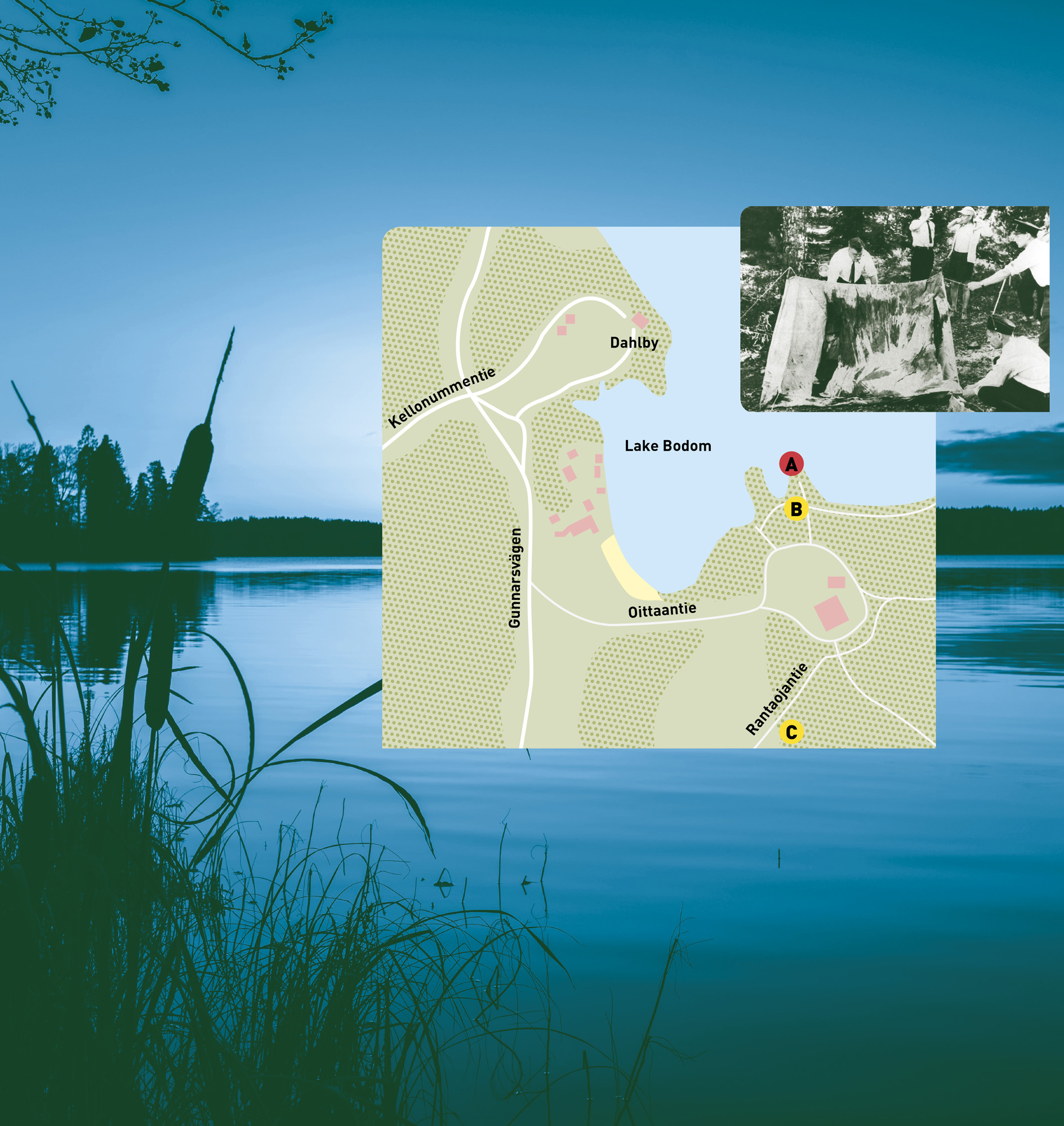
 Campsite where the slashed tent and victims are found
 Birdwatching boys see blond-haired man walking away from tent at about 6:00 a.m.
 Location where Nils Gustafsson’s shoes are found