Table of Contents for
Understanding Compression
 Understanding Compression
Published by
O'Reilly Media, Inc., 2016
Understanding Compression
Published by
O'Reilly Media, Inc., 2016
- Cover
- nav
- Understanding Compression
- Understanding Compression
- section
- Foreword
- Preface
- 1. Let’s Not Be Boring
- 2. Do Not Skip This Chapter
- 3. Breaking Entropy
- 4. Variable-Length Codes
- 5. Statistical Encoding
- 6. Adaptive Statistical Encoding
- 7. Dictionary Transforms
- 8. Contextual Data Transforms
- 9. Data Modeling
- 10. Switching Gears
- 11. Evaluating Compression
- 12. Compressing Image Data Types
- 13. Serialized Data
- 14. Lossy Data Compression
- 15. Making the World a Little Smaller
- Glossary of Compression Words
- Index
- About the Authors
- Colophon
Colophon
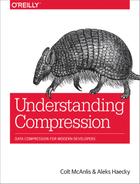
The animal on the cover of Understanding Compression is a Brazilian three-banded armadillo (Tolypeutes tricinctus).
This armadillo is indigenous to Brazil, as its name suggests. They live primarily in open savannahs and dry woodlands, preferring habitats with tall, woody grasses, scattered bushes, and gnarled trees. They are generally nocturnal, but have been known to forage during the day. They eat mainly ants and termites, which they find while shuffling along with their nose to the ground; they can smell prey through 20 cm of soil. Three-banded armadillos are great diggers, but they prefer to rest under bushes rather than in burrows. They do not rely on digging burrows for defense either, but instead roll into a ball and lock their armor. It is one of two species of armadillo that can roll into a ball.
Armadillos are usually solitary animals, but the three-banded armadillo occasionally travels in small families of up to three members. Mating season is October to January, with a brief courtship before mating. The gestation period lasts 120 days, resulting in a single, blind offspring. Newborn armadillo armor is soft, but its claws are fully developed and it can walk and roll into a ball within hours of birth. The Brazilian three-banded armadillo has undergone a 30% decrease in population in the last decade. Its only natural predators are adult pumas and jaguars, but its main threat is the destruction of its habitat to make room for livestock.
Many of the animals on O’Reilly covers are endangered; all of them are important to the world. To learn more about how you can help, go to animals.oreilly.com.
The cover image is from Beeton’s Dictionary. The cover fonts are URW Typewriter and Guardian Sans. The text font is Adobe Minion Pro; the heading font is Adobe Myriad Condensed; and the code font is Dalton Maag’s Ubuntu Mono.