Table of Contents for
The Adobe Photoshop Lightroom Classic CC Book, Second Edition
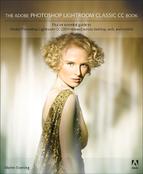 The Adobe Photoshop Lightroom Classic CC Book, Second Edition
Published by
Adobe Press, 2019
The Adobe Photoshop Lightroom Classic CC Book, Second Edition
Published by
Adobe Press, 2019
- Contents
- Cover Page
- Title Page
- Copyright Page
- Dedications
- Introduction
- Contents
- 1 Introducing Adobe Photoshop Lightroom
- 2 Importing photos
- 3 The Library module
- 4 Develop module image editing
- The Tone Curve Panel
- Easing the Workflow
- 5 The art of black and white
- 6 Sharpening and noise reduction
- 7 Exporting from Lightroom
- 8 Printing
- 9 Presenting your work
- 10 Managing your photos in Lightroom
- 11 Lightroom CC/mobile
- 12 Lightroom preferences and settings
- Index
Introduction
Work on the Adobe® Photoshop® Lightroom® program began toward the end of 2003 when a small group of Adobe people, headed by Mark Hamburg, met up at photographer Jeff Schewe’s studio in Chicago to discuss a new approach to raw image editing and image management. What would it take to meet the specific needs of those photographers who were now starting to shoot digitally? More specifically, what would be the best way to help photographers manage their ever-growing libraries of images? It was shortly after this that I was invited to join an early group of alpha testers and help work out what sort of program Lightroom should become. As we began to discuss our different digital photography workflows, it became increasingly obvious why we all needed a better way to manage and process our digital photos. Lightroom underwent some pretty major changes in those early stages as the team tried out different workflow ideas, until eventually we ended up with the Lightroom program you see now.
The Adobe Photoshop Lightroom Classic CC Book is intended to be the ultimate reference guide to Lightroom and designed to help you get the maximum benefit out of the program. In writing this book, I have had in mind both amateur and professional photographers and have aimed to provide what I believe is the most detailed book available on this subject. I also wanted to make sure space was given to explaining the background to some of the features. The feedback I have had for previous editions of this book has been encouraging. Newbies to Lightroom have found it easy to access and understand all the basics, while advanced professional users appreciate the background detail that’s provided. I have to confess, when I first started work on this project, I never imagined the book would end up being over 760 pages long. Mark Hamburg once joked that he must have failed in his mission to make Lightroom “unreasonably simple” if you needed a book as thick as mine in order to understand it!
So many changes have taken place since version 1.0 was released. As a result, not only has the book ended up being bigger, but I have also had to rewrite almost everything that was in the original edition. As always, I suggest you approach the book by reading it in chapter order, starting with Chapter 1: Introducing Adobe Photoshop Lightroom. This chapter explains some of the fundamental principles behind Lightroom and in particular, the rationale behind the new naming which has resulted in Lightroom desktop now becoming known as Lightroom Classic CC.
The Lightroom catalog is a major feature of the program, which is why I have devoted more than 200 pages of the book to providing in-depth advice on how to work with the Library module, including how to import photos and manage your photos through the use of keywords and metadata. Even more space is devoted to image processing and how to make use of all the Develop module controls. Here you will find some great picture examples, which show how Lightroom can help you unleash your creativity.
This edition of the book has a companion website: thelightroombook.com. It contains additional resource material in the form of Lightroom movie tutorials, templates, and PDF downloads. I know a lot of readers like having access to the images that appear in the book. Therefore, I have created a downloadable Lightroom catalog that contains nearly all the photos that appear here. Full instructions on how to install the catalog once you have downloaded it are available on the website.
Downloadable Content:

Overall, I am still as excited about Lightroom as I was at the beginning of the program’s development, and I hope the book provides the inspiration and insights to help you get the most out of the program, too.
Martin Evening, December 2018
Lightroom Book Updates
Adobe has been known to release interim updates for the Lightroom program in which new features are added. To keep readers updated, I aim to keep the book website updated, adding PDFs or movies whenever significant new features are added. So when this happens, do remember to check the book website. I also have a Facebook page where readers can keep up to date: facebook.com/MartinEveningPhotoshopAndPhotography.
Acknowledgments
I would like to thank Pamela Pfiffner, for prompting me to get started on this project and for her advice and help during the planning stage of this book series. For this particular edition, my editor, Laura Norman, has done a wonderful job making sure everything has come together smoothly. Other members of the publishing team included senior production editor Tracey Croom; copyeditor Linda Laflamme; proofreader Patricia J. Pane; indexer James Minkin; and additional compositing and corrections by David Van Ness. I would also like to thank Charlene Charles-Will for the original cover design, as well as the Adobe Press marketing team.
Lightroom is really the brainchild of Mark Hamburg, without whom none of this would have happened. Since the inception of Lightroom, I have been helped a lot by the various Lightroom engineers and other members of the team. It is all thanks to them that I have managed to gather the background technical knowledge required to write this book. In particular, I would like to thank Thomas Knoll, Eric Chan, Max Wendt, and Joshua Bury (who work on the Camera Raw engineering). I would also like to thank Benjamin Warde, product managers Sharad Mangalick and Tom Hogarty, plus product evangelist Julieanne Kost, for the support and help they have given me over the years. I would especially like to thank Ian Lyons, who tech edited the book. Thank you, Ian, for clarifying all the many technical points and providing additional insights. Thanks also go to Sean McCormack, who provided me with valuable feedback and assistance.
A number of photographic shoots have been carried out specifically for this book. I would like to thank the models, Jagna Szaykowska at Profile models, Lucy Edwards and Veronica at M&P, and Kelly from Nevs; Camilla Pascucci for makeup; Terry Calvert, James Pearce, and Nadia Foster for hair; Harriet Cotterill for the clothes styling; Neil Soni and the late Stuart Weston for the use of their studios; and Harry Dutton and Rob Cadman for assisting me. Also a big thank you to Jeff Schewe and George Jardine for documenting the shoots with stills and video.
It has been an interesting experience to see a new program emerge from scratch and has been a pleasure to share the development process in the company of a great group of Lightroom experts and fellow authors, who were all willing to share their knowledge about the program with one another. You will notice that this book is dedicated to the memory of Bruce Fraser, who sadly passed away in December 2006. Bruce was one of the original core group of Lightroom experts who helped shape the program. The Lightroom capture and output sharpening features are both based on Bruce’s original work on Photoshop sharpening techniques. Bruce was a true genius and is deeply missed by all those who knew and worked with him.
A book like this would be rather boring to read through without having some decent photographs to illustrate it with. For supplementing my own photography, I would, therefore, like to thank Sean McCormack, Eric Richmond, and Jeff Schewe, all of whom are individually credited throughout this book. And lastly, I would like to thank my wife Camilla and daughter Angelica for yet again being so understanding and patient while I was glued to the computer!