Table of Contents for
Linux Network Administrator's Guide, Second Edition
 Linux Network Administrator's Guide, Second Edition
Published by
O'Reilly Media, Inc., 2000
Linux Network Administrator's Guide, Second Edition
Published by
O'Reilly Media, Inc., 2000
- Cover
- Linux Network Administrator’s Guide, 2nd Edition
- Preface
- Sources of Information
- File System Standards
- Standard Linux Base
- About This Book
- The Official Printed Version
- Overview
- Conventions Used in This Book
- Submitting Changes
- Acknowledgments
- 1. Introduction to Networking
- TCP/IP Networks
- UUCP Networks
- Linux Networking
- Maintaining Your System
- 2. Issues of TCP/IP Networking
- IP Addresses
- Address Resolution
- IP Routing
- The Internet Control Message Protocol
- Resolving Host Names
- 3. Configuring the Networking Hardware
- A Tour of Linux Network Devices
- Ethernet Installation
- The PLIP Driver
- The PPP and SLIP Drivers
- Other Network Types
- 4. Configuring the Serial Hardware
- Introduction to Serial Devices
- Accessing Serial Devices
- Serial Hardware
- Using the Configuration Utilities
- Serial Devices and the login: Prompt
- 5. Configuring TCP/IP Networking
- Installing the Binaries
- Setting the Hostname
- Assigning IP Addresses
- Creating Subnets
- Writing hosts and networks Files
- Interface Configuration for IP
- All About ifconfig
- The netstat Command
- Checking the ARP Tables
- 6. Name Service and Resolver Configuration
- How DNS Works
- Running named
- 7. Serial Line IP
- SLIP Operation
- Dealing with Private IP Networks
- Using dip
- Running in Server Mode
- 8. The Point-to-Point Protocol
- Running pppd
- Using Options Files
- Using chat to Automate Dialing
- IP Configuration Options
- Link Control Options
- General Security Considerations
- Authentication with PPP
- Debugging Your PPP Setup
- More Advanced PPP Configurations
- 9. TCP/IP Firewall
- What Is a Firewall?
- What Is IP Filtering?
- Setting Up Linux for Firewalling
- Three Ways We Can Do Filtering
- Original IP Firewall (2.0 Kernels)
- IP Firewall Chains (2.2 Kernels)
- Netfilter and IP Tables (2.4 Kernels)
- TOS Bit Manipulation
- Testing a Firewall Configuration
- A Sample Firewall Configuration
- 10. IP Accounting
- Configuring IP Accounting
- Using IP Accounting Results
- Resetting the Counters
- Flushing the Ruleset
- Passive Collection of Accounting Data
- 11. IP Masquerade and Network Address Translation
- Configuring the Kernel for IP Masquerade
- Configuring IP Masquerade
- Handling Name Server Lookups
- More About Network Address Translation
- 12. Important Network Features
- The tcpd Access Control Facility
- The Services and Protocols Files
- Remote Procedure Call
- Configuring Remote Login and Execution
- 13. The Network Information System
- NIS Versus NIS+
- The Client Side of NIS
- Running an NIS Server
- NIS Server Security
- Setting Up an NIS Client with GNU libc
- Choosing the Right Maps
- Using the passwd and group Maps
- Using NIS with Shadow Support
- 14. The Network File System
- Mounting an NFS Volume
- The NFS Daemons
- The exports File
- Kernel-Based NFSv2 Server Support
- Kernel-Based NFSv3 Server Support
- 15. IPX and the NCP Filesystem
- IPX and Linux
- Configuring the Kernel for IPX and NCPFS
- Configuring IPX Interfaces
- Configuring an IPX Router
- Mounting a Remote NetWare Volume
- Exploring Some of the Other IPX Tools
- Printing to a NetWare Print Queue
- NetWare Server Emulation
- 16. Managing Taylor UUCP
- UUCP Configuration Files
- Controlling Access to UUCP Features
- Setting Up Your System for Dialing In
- UUCP Low-Level Protocols
- Troubleshooting
- Log Files and Debugging
- 17. Electronic Mail
- How Is Mail Delivered?
- Email Addresses
- How Does Mail Routing Work?
- Configuring elm
- 18. Sendmail
- Installing sendmail
- Overview of Configuration Files
- The sendmail.cf and sendmail.mc Files
- Generating the sendmail.cf File
- Interpreting and Writing Rewrite Rules
- Configuring sendmail Options
- Some Useful sendmail Configurations
- Testing Your Configuration
- Running sendmail
- Tips and Tricks
- 19. Getting Exim Up and Running
- If Your Mail Doesn’t Get Through
- Compiling Exim
- Mail Delivery Modes
- Miscellaneous config Options
- Message Routing and Delivery
- Protecting Against Mail Spam
- UUCP Setup
- 20. Netnews
- What Is Usenet, Anyway?
- How Does Usenet Handle News?
- 21. C News
- Installation
- The sys File
- The active File
- Article Batching
- Expiring News
- Miscellaneous Files
- Control Messages
- C News in an NFS Environment
- Maintenance Tools and Tasks
- 22. NNTP and the nntpd Daemon
- Installing the NNTP Server
- Restricting NNTP Access
- NNTP Authorization
- nntpd Interaction with C News
- 23. Internet News
- Newsreaders and INN
- Installing INN
- Configuring INN: the Basic Setup
- INN Configuration Files
- Running INN
- Managing INN: The ctlinnd Command
- 24. Newsreader Configuration
- trn Configuration
- nn Configuration
- A. Example Network: The Virtual Brewery
- B. Useful Cable Configurations
- A Serial NULL Modem Cable
- C. Linux Network Administrator’s Guide, Second Edition Copyright Information
- 1. Applicability and Definitions
- 2. Verbatim Copying
- 3. Copying in Quantity
- 4. Modifications
- 5. Combining Documents
- 6. Collections of Documents
- 7. Aggregation with Independent Works
- 8. Translation
- 9. Termination
- 10. Future Revisions of this License
- D. SAGE: The System Administrators Guild
- Index
- Colophon
One of the most popular software packages for Netnews is C News. It was designed for sites that carry news over UUCP links. This chapter will discuss the central concepts of C News, basic installation, and maintenance tasks.
C News stores its configuration files in
/etc/news, and most of its binaries are kept
below the /usr/lib/news/ directory. Articles are
kept below /var/spool/news. You should make sure
that virtually all files in these directories are owned by user
news or group news. Most problems arise from files being
inaccessible to C News. Use su to become the user
news before you touch anything
in the directory. The only exception is the
setnewsids command, which is used to set the real
user ID of some news programs. It must be owned by root and have the setuid bit set.
In this chapter, we describe all C News configuration files in detail and show you what you have to do to keep your site running.
Articles can be fed to C News in several ways. When a local user posts
an article, the newsreader usually hands it to the
inews command, which completes the header
information. News from remote sites, be it a single article or a whole
batch, is given to the rnews command, which stores
it in the /var/spool/news/in.coming directory,
from where it will be picked up at a later time by
newsrun. With any of these two techniques, however,
the article will eventually be handed to the
relaynews command.
For each article, the relaynews command first checks if the
article has already been seen at the local site by looking up the message ID
in the history file. Duplicate articles are dropped.
Then relaynews looks at the Newsgroups:
header line to find out if the local site requests articles from any of these
groups. If it does, and the newsgroup is listed in the
active file, relaynews tries to store
the article in the corresponding directory in the news spool area. If this
directory does not exist, it is created. The article’s message ID is then
logged to the history file. Otherwise,
relaynews drops the article.
Sometimes relaynews fails to store an incoming
article because a group to which it has been posted is not listed in
your active file. In this case, the article is moved to the junk
group.[124]
relaynews also checks for stale or misdated articles
and reject them. Incoming batches that fail for any other reason are moved
to /var/spool/news/in.coming/bad, and an error message
is logged.
After this, the article is relayed to all other sites that request news
from these groups, using the transport specified for each particular site. To
make sure an article isn’t sent to a site that has already seen it, each
destination site is checked against the article’s Path:
header field, which contains the list of sites the article has traversed so
far, written in the UUCP-style bang-path source-routing style described in
Chapter 17. If the destination site’s name does not
appear in this list, the article is sent to it.
C News is commonly used to relay news between UUCP sites, although it is also possible to use it in an NNTP environment. To deliver news to a remote UUCP site, either in single articles or whole batches, uux is used to execute the rnews command on the remote site and feed the article or batch to it on standard input. Refer to Chapter 16, for more information on UUCP.
Batching is the term used to describe sending large bundles of
individual articles all in one transmission. When batching is
enabled for a given site, C News does not send any incoming article
immediately; instead, it appends its path name to a file, usually called
out.going/site/togo. Periodically, a program is executed
from a crontab entry by the cron program,
which reads this file and bundles all of the listed articles into one or more
file, optionally compressing them and sending them to rnews
at the remote site.[125]
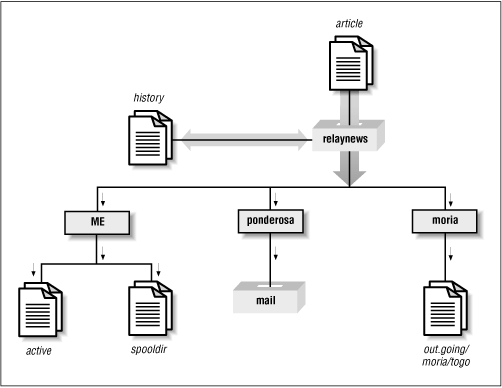
Figure 21.1 shows the news flow through
relaynews. Articles may be relayed to the local site
(denoted by ME), to a site named
ponderosa via email, and a site
named moria, for which batching is
enabled.
[124] There may be a difference
between the groups that exist at your site and those that your site
is willing to receive. For example, the subscription list might
specify comp.all, which
should send all newsgroups below the comp hierarchy, but at your site you
might not list several of the comp newsgroups in the
active file. Articles posted to those groups will
be moved to junk.
[125] Note that this should be the crontab of news; file permissions will not be mangled.