Table of Contents for
Seven Databases in Seven Weeks, 2nd Edition
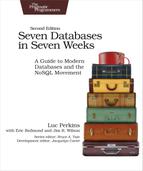 Seven Databases in Seven Weeks, 2nd Edition
Published by
Pragmatic Bookshelf, 2018
Seven Databases in Seven Weeks, 2nd Edition
Published by
Pragmatic Bookshelf, 2018
- Title Page
- Seven Databases in Seven Weeks, Second Edition
- Seven Databases in Seven Weeks, Second Edition
- Seven Databases in Seven Weeks, Second Edition
- Seven Databases in Seven Weeks, Second Edition
- Acknowledgments
- Preface
- Why a NoSQL Book
- Why Seven Databases
- What’s in This Book
- What This Book Is Not
- Code Examples and Conventions
- Credits
- Online Resources
- 1. Introduction
- It Starts with a Question
- The Genres
- Onward and Upward
- 2. PostgreSQL
- That’s Post-greS-Q-L
- Day 1: Relations, CRUD, and Joins
- Day 2: Advanced Queries, Code, and Rules
- Day 3: Full Text and Multidimensions
- Wrap-Up
- 3. HBase
- Introducing HBase
- Day 1: CRUD and Table Administration
- Day 2: Working with Big Data
- Day 3: Taking It to the Cloud
- Wrap-Up
- 4. MongoDB
- Hu(mongo)us
- Day 1: CRUD and Nesting
- Day 2: Indexing, Aggregating, Mapreduce
- Day 3: Replica Sets, Sharding, GeoSpatial, and GridFS
- Wrap-Up
- 5. CouchDB
- Relaxing on the Couch
- Day 1: CRUD, Fauxton, and cURL Redux
- Day 2: Creating and Querying Views
- Day 3: Advanced Views, Changes API, and Replicating Data
- Wrap-Up
- 6. Neo4J
- Neo4j Is Whiteboard Friendly
- Day 1: Graphs, Cypher, and CRUD
- Day 2: REST, Indexes, and Algorithms
- Day 3: Distributed High Availability
- Wrap-Up
- 7. DynamoDB
- DynamoDB: The “Big Easy” of NoSQL
- Day 1: Let’s Go Shopping!
- Day 2: Building a Streaming Data Pipeline
- Day 3: Building an “Internet of Things” System Around DynamoDB
- Wrap-Up
- 8. Redis
- Data Structure Server Store
- Day 1: CRUD and Datatypes
- Day 2: Advanced Usage, Distribution
- Day 3: Playing with Other Databases
- Wrap-Up
- 9. Wrapping Up
- Genres Redux
- Making a Choice
- Where Do We Go from Here?
- A1. Database Overview Tables
- A2. The CAP Theorem
- Eventual Consistency
- CAP in the Wild
- The Latency Trade-Off
- Bibliography
- Seven Databases in Seven Weeks, Second Edition
You May Be Interested In…
Select a cover for more information
Seven Web Frameworks in Seven Weeks
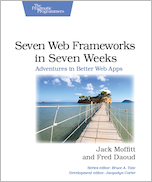
Whether you need a new tool or just inspiration, Seven Web Frameworks in Seven Weeks explores modern options, giving you a taste of each with ideas that will help you create better apps. You’ll see frameworks that leverage modern programming languages, employ unique architectures, live client-side instead of server-side, or embrace type systems. You’ll see everything from familiar Ruby and JavaScript to the more exotic Erlang, Haskell, and Clojure.
Jack Moffitt, Fred Daoud
(302 pages) ISBN: 9781937785635 $38
Seven Concurrency Models in Seven Weeks
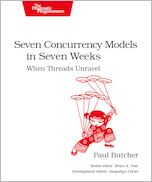
Your software needs to leverage multiple cores, handle thousands of users and terabytes of data, and continue working in the face of both hardware and software failure. Concurrency and parallelism are the keys, and Seven Concurrency Models in Seven Weeks equips you for this new world. See how emerging technologies such as actors and functional programming address issues with traditional threads and locks development. Learn how to exploit the parallelism in your computer’s GPU and leverage clusters of machines with MapReduce and Stream Processing. And do it all with the confidence that comes from using tools that help you write crystal clear, high-quality code.
Paul Butcher
(296 pages) ISBN: 9781937785659 $38
Adopting Elixir
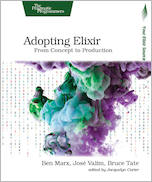
Adoption is more than programming. Elixir is an exciting new language, but to successfully get your application from start to finish, you’re going to need to know more than just the language. You need the case studies and strategies in this book. Learn the best practices for the whole life of your application, from design and team-building, to managing stakeholders, to deployment and monitoring. Go beyond the syntax and the tools to learn the techniques you need to develop your Elixir application from concept to production.
Ben Marx, José Valim, Bruce Tate
(242 pages) ISBN: 9781680502527 $42.95
Programming Elixir ≥ 1.6
This book is the introduction to Elixir for experienced programmers, completely updated for Elixir 1.6 and beyond. Explore functional programming without the academic overtones (tell me about monads just one more time). Create concurrent applications, but get them right without all the locking and consistency headaches. Meet Elixir, a modern, functional, concurrent language built on the rock-solid Erlang VM. Elixir’s pragmatic syntax and built-in support for metaprogramming will make you productive and keep you interested for the long haul. Maybe the time is right for the Next Big Thing. Maybe it’s Elixir.
Dave Thomas
(398 pages) ISBN: 9781680502992 $47.95
Programming Phoenix ≥ 1.4
Don’t accept the compromise between fast and beautiful: you can have it all. Phoenix creator Chris McCord, Elixir creator José Valim, and award-winning author Bruce Tate walk you through building an application that’s fast and reliable. At every step, you’ll learn from the Phoenix creators not just what to do, but why. Packed with insider insights and completely updated for Phoenix 1.4, this definitive guide will be your constant companion in your journey from Phoenix novice to expert, as you build the next generation of web applications.
Chris McCord, Bruce Tate and José Valim
(325 pages) ISBN: 9781680502268 $45.95
Programming Elm
Elm brings the safety and stability of functional programing to front-end development, making it one of the most popular new languages. Elm’s functional nature and static typing means that run-time errors are nearly impossible, and it compiles to JavaScript for easy web deployment. This book helps you take advantage of this new language in your web site development. Learn how the Elm Architecture will help you create fast applications. Discover how to integrate Elm with JavaScript so you can update legacy applications. See how Elm tooling makes deployment quicker and easier.
Jeremy Fairbank
(250 pages) ISBN: 9781680502855 $40.95
Design It!
Don’t engineer by coincidence—design it like you mean it! Grounded by fundamentals and filled with practical design methods, this is the perfect introduction to software architecture for programmers who are ready to grow their design skills. Ask the right stakeholders the right questions, explore design options, share your design decisions, and facilitate collaborative workshops that are fast, effective, and fun. Become a better programmer, leader, and designer. Use your new skills to lead your team in implementing software with the right capabilities—and develop awesome software!
Michael Keeling
(358 pages) ISBN: 9781680502091 $41.95
Release It! Second Edition
A single dramatic software failure can cost a company millions of dollars—but can be avoided with simple changes to design and architecture. This new edition of the best-selling industry standard shows you how to create systems that run longer, with fewer failures, and recover better when bad things happen. New coverage includes DevOps, microservices, and cloud-native architecture. Stability antipatterns have grown to include systemic problems in large-scale systems. This is a must-have pragmatic guide to engineering for production systems.
Michael Nygard
(376 pages) ISBN: 9781680502398 $47.95
Functional Programming in Java
Get ready to program in a whole new way. Functional Programming in Java will help you quickly get on top of the new, essential Java 8 language features and the functional style that will change and improve your code. This short, targeted book will help you make the paradigm shift from the old imperative way to a less error-prone, more elegant, and concise coding style that’s also a breeze to parallelize. You’ll explore the syntax and semantics of lambda expressions, method and constructor references, and functional interfaces. You’ll design and write applications better using the new standards in Java 8 and the JDK.
Venkat Subramaniam
(196 pages) ISBN: 9781937785468 $33
Programming Concurrency on the JVM
Stop dreading concurrency hassles and start reaping the pure power of modern multicore hardware. Learn how to avoid shared mutable state and how to write safe, elegant, explicit synchronization-free programs in Java or other JVM languages including Clojure, JRuby, Groovy, or Scala.
Venkat Subramaniam
(280 pages) ISBN: 9781934356760 $35
Data Science Essentials in Python
Go from messy, unstructured artifacts stored in SQL and NoSQL databases to a neat, well-organized dataset with this quick reference for the busy data scientist. Understand text mining, machine learning, and network analysis; process numeric data with the NumPy and Pandas modules; describe and analyze data using statistical and network-theoretical methods; and see actual examples of data analysis at work. This one-stop solution covers the essential data science you need in Python.
Dmitry Zinoviev
(224 pages) ISBN: 9781680501841 $29
Practical Programming, Third Edition
Classroom-tested by tens of thousands of students, this new edition of the best-selling intro to programming book is for anyone who wants to understand computer science. Learn about design, algorithms, testing, and debugging. Discover the fundamentals of programming with Python 3.6—a language that’s used in millions of devices. Write programs to solve real-world problems, and come away with everything you need to produce quality code. This edition has been updated to use the new language features in Python 3.6.
Paul Gries, Jennifer Campbell, Jason Montojo
(410 pages) ISBN: 9781680502688 $49.95