Table of Contents for
Seven Databases in Seven Weeks, 2nd Edition
 Seven Databases in Seven Weeks, 2nd Edition
Published by
Pragmatic Bookshelf, 2018
Seven Databases in Seven Weeks, 2nd Edition
Published by
Pragmatic Bookshelf, 2018
- Title Page
- Seven Databases in Seven Weeks, Second Edition
- Seven Databases in Seven Weeks, Second Edition
- Seven Databases in Seven Weeks, Second Edition
- Seven Databases in Seven Weeks, Second Edition
- Acknowledgments
- Preface
- Why a NoSQL Book
- Why Seven Databases
- What’s in This Book
- What This Book Is Not
- Code Examples and Conventions
- Credits
- Online Resources
- 1. Introduction
- It Starts with a Question
- The Genres
- Onward and Upward
- 2. PostgreSQL
- That’s Post-greS-Q-L
- Day 1: Relations, CRUD, and Joins
- Day 2: Advanced Queries, Code, and Rules
- Day 3: Full Text and Multidimensions
- Wrap-Up
- 3. HBase
- Introducing HBase
- Day 1: CRUD and Table Administration
- Day 2: Working with Big Data
- Day 3: Taking It to the Cloud
- Wrap-Up
- 4. MongoDB
- Hu(mongo)us
- Day 1: CRUD and Nesting
- Day 2: Indexing, Aggregating, Mapreduce
- Day 3: Replica Sets, Sharding, GeoSpatial, and GridFS
- Wrap-Up
- 5. CouchDB
- Relaxing on the Couch
- Day 1: CRUD, Fauxton, and cURL Redux
- Day 2: Creating and Querying Views
- Day 3: Advanced Views, Changes API, and Replicating Data
- Wrap-Up
- 6. Neo4J
- Neo4j Is Whiteboard Friendly
- Day 1: Graphs, Cypher, and CRUD
- Day 2: REST, Indexes, and Algorithms
- Day 3: Distributed High Availability
- Wrap-Up
- 7. DynamoDB
- DynamoDB: The “Big Easy” of NoSQL
- Day 1: Let’s Go Shopping!
- Day 2: Building a Streaming Data Pipeline
- Day 3: Building an “Internet of Things” System Around DynamoDB
- Wrap-Up
- 8. Redis
- Data Structure Server Store
- Day 1: CRUD and Datatypes
- Day 2: Advanced Usage, Distribution
- Day 3: Playing with Other Databases
- Wrap-Up
- 9. Wrapping Up
- Genres Redux
- Making a Choice
- Where Do We Go from Here?
- A1. Database Overview Tables
- A2. The CAP Theorem
- Eventual Consistency
- CAP in the Wild
- The Latency Trade-Off
- Bibliography
- Seven Databases in Seven Weeks, Second Edition
Wrap-Up
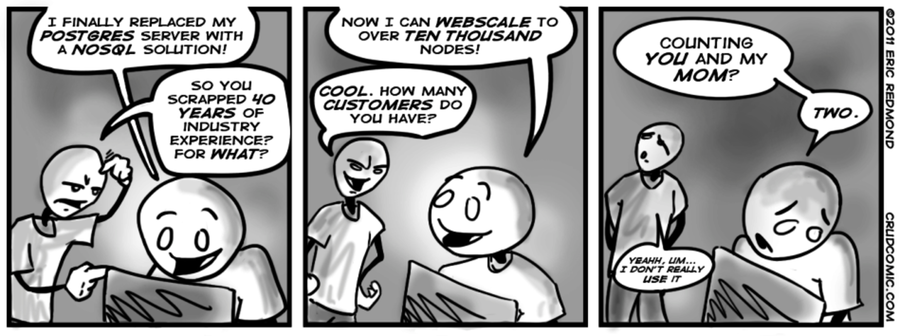
If you haven’t spent much time with relational databases, we highly recommend digging deeper into PostgreSQL, or another relational database, before deciding to scrap it for a newer variety. Relational databases have been the focus of intense academic research and industrial improvements for more than forty years, and PostgreSQL is one of the top open source relational databases to benefit from these advancements.
PostgreSQL’s Strengths
PostgreSQL’s strengths are as numerous as any relational model: years of research and production use across nearly every field of computing, flexible queryability, and very consistent and durable data. Most programming languages have battle-tested driver support for Postgres, and many programming models, like object-relational mapping (ORM), assume an underlying relational database.
But the real crux of the matter is the flexibility of the join. You don’t need to know how you plan to actually query your model because you can always perform some joins, filters, views, and indexes—odds are good that you will always have the ability to extract the data you want. In the other chapters of this book that assumption will more or less fly out the window.
PostgreSQL is fantastic for what we call “Stepford data” (named for The Stepford Wives, a story about a neighborhood where nearly everyone was consistent in style and substance), which is data that is fairly homogeneous and conforms well to a structured schema.
Furthermore, PostgreSQL goes beyond the normal open source RDBMS offerings, such as powerful schema constraint mechanisms. You can write your own language extensions, customize indexes, create custom datatypes, and even overwrite the parsing of incoming queries. And where other open source databases may have complex licensing agreements, PostgreSQL is open source in its purest form. No one owns the code. Anyone can do pretty much anything they want with the project (other than hold authors liable). The development and distribution are completely community supported. If you are a fan of free(dom) software, you have to respect their general resistance to cashing in on an amazing product.
PostgreSQL’s Weaknesses
Although relational databases have been undeniably the most successful style of database over the years, there are cases where it may not be a great fit.
Partitioning is not one of the strengths of relational databases such as PostgreSQL. If you need to scale out rather than up—multiple parallel databases rather than a single beefy machine or cluster—you may be better served looking elsewhere (although clustering capabilities have improved in recent releases). Another database might be a better fit if:
-
You don’t truly require the overhead of a full database (perhaps you only need a cache like Redis).
-
You require very high-volume reads and writes as key values.
-
You need to store only large BLOBs of data.
Parting Thoughts
A relational database is an excellent choice for query flexibility. While PostgreSQL requires you to design your data up front, it makes no assumptions about how you use that data. As long as your schema is designed in a fairly normalized way, without duplication or storage of computable values, you should generally be all set for any queries you might need to create. And if you include the correct modules, tune your engine, and index well, it will perform amazingly well for multiple terabytes of data with very small resource consumption. Finally, to those for whom data safety is paramount, PostgreSQL’s ACID-compliant transactions ensure your commits are completely atomic, consistent, isolated, and durable.