Table of Contents for
Learning PHP, MySQL & JavaScript, 5th Edition
 Learning PHP, MySQL & JavaScript, 5th Edition
Published by
O'Reilly Media, Inc., 2018
Learning PHP, MySQL & JavaScript, 5th Edition
Published by
O'Reilly Media, Inc., 2018
- Cover
- nav
- Learning PHP, MySQL & JavaScript
- Learning PHP, MySQL & JavaScript
- Dedication
- Preface
- 1. Introduction to Dynamic Web Content
- 2. Setting Up a Development Server
- 3. Introduction to PHP
- 4. Expressions and Control Flow in PHP
- 5. PHP Functions and Objects
- 6. PHP Arrays
- 7. Practical PHP
- 8. Introduction to MySQL
- 9. Mastering MySQL
- 10. Accessing MySQL Using PHP
- 11. Form Handling
- 12. Cookies, Sessions, and Authentication
- 13. Exploring JavaScript
- 14. Expressions and Control Flow in JavaScript
- 15. JavaScript Functions, Objects, and Arrays
- 16. JavaScript and PHP Validation and Error Handling
- 17. Using Asynchronous Communication
- 18. Introduction to CSS
- 19. Advanced CSS with CSS3
- 20. Accessing CSS from JavaScript
- 21. Introduction to jQuery
- 22. Introduction to jQuery Mobile
- 23. Introduction to HTML5
- 24. The HTML5 Canvas
- 25. HTML5 Audio and Video
- 26. Other HTML5 Features
- 27. Bringing It All Together
- A. Solutions to the Chapter Questions
- B. Online Resources
- C. MySQL’s FULLTEXT Stopwords
- D. MySQL Functions
- E. jQuery Selectors, Objects, and Methods
- Index
- About the Author
- Colophon
Colophon
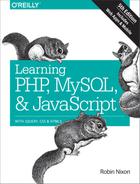
The animals on the cover of Learning PHP, MySQL, & JavaScript are sugar gliders (Petaurus breviceps). Sugar gliders are small, gray-furred creatures that grow to an adult length of 6 to 7.5 inches. Their tails, which are distinguished by a black tip, are usually as long as their bodies. Membranes extend between their wrists and ankles and provide an aerodynamic surface that helps them glide between trees.
Sugar gliders are native to Australia and Tasmania. They prefer to live in the hollow parts of eucalyptus and other types of large trees with several other adult sugar gliders and their own children.
Though sugar gliders reside in groups and defend their territory together, they don’t always live in harmony. One male will assert his dominance by marking the group’s territory with his saliva and then by marking all group members with a distinctive scent produced from his forehead and chest glands. This ensures that members of the group will know when an outsider approaches; group members will fight off any sugar glider not bearing their scent. However, a sugar glider group will welcome and mark an outsider if one of their adult males dies (the group will typically replace a deceased adult female with one of their own female offspring).
Sugar gliders make popular pets because of their inquisitive, playful natures, and because many think they are cute. But there are disadvantages to keeping sugar gliders as pets: as they are exotic animals, sugar gliders need specialized, complicated diets consisting of items such as crickets, a variety of fruits and vegetables, and mealworms; healthy housing requires a cage or space no less than the size of an aviary; their distinctive scents can be bothersome to humans; as they are nocturnal creatures, they will bark, hiss, run, and glide all night long; it’s not uncommon for them to lose control of their bowels while playing or eating; and in some states and countries, it is illegal to own sugar gliders as household pets.
Many of the animals on O’Reilly covers are endangered; all of them are important to the world. To learn more about how you can help, go to animals.oreilly.com.
The cover image is from Dover’s Animals. The cover fonts are URW Typewriter and Guardian Sans. The text font is Adobe Minion Pro; the heading font is Adobe Myriad Condensed; and the code font is Dalton Maag’s Ubuntu Mono.