Table of Contents for
Python for Secret Agents
 Python for Secret Agents
Published by
Packt Publishing, 2014
Python for Secret Agents
Published by
Packt Publishing, 2014
- Cover
- Table of Contents
- Python for Secret Agents
- Python for Secret Agents
- Credits
- About the Author
- About the Reviewers
- www.PacktPub.com
- Preface
- What you need for this book
- Who this book is for
- Conventions
- Reader feedback
- Customer support
- 1. Our Espionage Toolkit
- Getting more tools – a text editor
- Confirming our tools
- Background briefing – math and numbers
- Handling text and strings
- Organizing our software
- Working with files and folders
- Solving problems – recovering a lost password
- Summary
- 2. Acquiring Intelligence Data
- Using a REST API in Python
- Organizing collections of data
- Solving problems – currency conversion rates
- Summary
- 3. Encoding Secret Messages with Steganography
- Using the Pillow library
- Some approaches to steganography
- Detecting and preventing tampering
- Solving problems – encrypting a message
- Summary
- 4. Drops, Hideouts, Meetups, and Lairs
- Finding out where we are with geocoding services
- How close? What direction?
- Compressing data to make grid codes
- Decoding a GeoRef code
- Creating natural area codes
- Solving problems – closest good restaurant
- Summary
- 5. A Spymaster's More Sensitive Analyses
- Creating Python modules and applications
- Creating our own classes of objects
- Comparisons and correlations
- Writing high-quality software
- Solving problems – analyzing some interesting datasets
- Summary
- Index
An important statistical question centers around correlation between variables. We often wonder if two sequences of values correlate with each other. If we have variables that correlate, perhaps we've found an interesting causal relationship. We might be able to use one variable to predict the values of another variable. We might also be able to prove that they're independent and have nothing to do with each other.
The essential statistical tool for this is the coefficient of correlation. We have several ways to compute this. One solution is to download NumPy or SciPy from the following links:
The correlation algorithms, however, aren't too complex. Implementing these two calculations will build up our basic data gathering espionage skills. We'll build some more basic statistical functions. Then, we'll build the correlation calculation, which will depend on other statistical functions.
The essential numerical depends on computing means and standard deviations. We looked at the mean calculation previously. We'll add the standard deviation to our bag of tricks. Given the standard deviation, we can standardize each value. We'll compute the distance from the mean using the standard deviation as the measurement of distance. We can then compare standardized scores to see if two sets of data correlate.
To compute the correlation coefficient, we need another descriptive statistic for a set of data: the standard deviation. This is a measure of how widely dispersed the data is. When we compute the mean, we find a center for the data. The next question is, how tightly do the values huddle around the center?
If the standard deviation is small, the data is tightly clustered. If the standard deviation is large, the data is spread all over the place. The standard deviation calculation gives us a numeric range that brackets about two-third of the data values.
Having the standard deviation lets us spot unusual data. For example, the mean cheese consumption is 31.8 pounds per person. The standard deviation is 1.27 pounds. We expect to see much of the data huddled within the range of 31.8 ± 1.27, that is, between 30.53 and 33.07. If our informant tries to tell as the per capita cheese consumption is 36 pounds in 2012, we have a good reason to be suspicious of the report.
There are a few variations to the theme of computing a standard deviation. There are some statistical subtleties, also, that relate to whether or not we have the entire population or just a sample. Here's one of the standard formulae  . The symbol
  represents the standard deviation of some variable,
  . The symbol
  represents the mean of a variable.
We have a method function, mean(), which computes the value. We need to implement the standard deviation formula.
The standard deviation formula uses the math.sqrt() and sum() functions. We'll rely on using import math in our script.
We can directly translate the equation into Python. Here's a method function we can add to our AnnualStat class:
    def stddev(self):
        μ_x = self.mean()
        n = len(self.data)
        σ_x= math.sqrt( sum( (x-μ_x)**2 for x in self.data )/n )
        return σ_x
We evaluated the mean() method function to get the mean, shown as , and assigned this to μ_x (yes, Greek letters are legal for Python variable names; if your OS doesn't offer ready access to extended Unicode characters, you might want to use mu instead). We also evaluated len(data) to get the value of n, the number of elements in the collection.
We can then do a very literal translation from math-speak to Python. For example, the  becomes
 sum((x-μ_x)**2 for x in self.data). This kind of literal match between mathematical notation and Python makes it easy to vet Python programming to be sure it matches the mathematical abstraction.
Here's another version of standard deviation, based on a slightly different formula:
    def stddev2(self):
        s_0 = sum(1 for x in self.data) # x**0
        s_1 = sum(x for x in self.data) # x**1
        s_2 = sum(x**2 for x in self.data)
        return math.sqrt( s_2/s_0 - (s_1/s_0)**2 )
This has an elegant symmetry to it. The formula looks like  . It's not efficient or accurate any more. It's just sort of cool because of the symmetry between
  ,
,  , and
, and  .
.
Once we have the standard deviation, we can standardize each measurement in the sequence. This standardized score is sometimes called a Z score. It's the number of standard deviations a particular value lies from the mean.
In  , the standardized score,
  , is the difference between the score,
  , and the mean, , divided by the standard deviation, .
If we have a mean,  , of 31.8 and a standard deviation,
  , of 1.27, then a measured value of 29.87 will have a Z score of -1.519. About 30 percent of the data will be outside 1 standard deviation from the mean. When our informant tries to tell us that consumption jumped to 36 pounds of cheese per capita, we can compute the Z score for this, 3.307, and suggest that it's unlikely to be valid data.
Standardizing our values to produce scores is a great use of a generator expression. We'll add this to our class definition too:
    def stdscore(self):
        μ_x= self.mean()
        σ_x= self.stddev()
        return [ (x-μ_x)/σ_x for x in self.data ]
We computed the mean of our data and assigned it to μ_x. We computed the standard deviation and assigned it to σ_x. We used a generator expression to evaluate (x-μ_x)/σ_x for each value, x, in our data. Since the generator was in [], we will create a new list object with the standardized scores.
We can show how this works with this:
print( cheese.stdscore() )
We'll get a sequence like the following:
[-1.548932453971435, -1.3520949193863403, ... 0.8524854679667219]
When we look at the result of the
stdscore() method, we have a choice of what to return. In the previous example, we returned a new list object. We don't really need to do this.
We can use this in the function to return a generator instead of a list:
return ((x-μ_x)/σ_x for x in self.data)
The rest of the function is the same. It's good to give this version a different name. Call the old one stdscore2() so that you can compare list and generator versions.
The generator stdscore() function now returns an expression that can be used to generate the values. For most of our calculations, there's no practical difference between an actual list object and an iterable sequence of values.
There are three differences that we'll notice:
- Firstly, we can't use
len()on the generator results - Secondly, a generator doesn't generate any data until we use it in a
forloop or to create a list - Thirdly, an iterable can only be used once
Try to see how this works with something simple like this:
print(cheese.stdscore())
We'll see the generator expression, not the values that are generated. Here's the output:
<generator object <genexpr> at 0x1007b4460>
We need to do this to collect the generated values into an object. The list() function does this nicely. Here's what we can do to evaluate the generator and actually generate the values:
print(list(cheese.stdscore()))
This will evaluate the generator, producing a list object that we can print.
One important question that arises when comparing two sequences of data is how well they correlate with each other. When one sequence trends up, does the other? Do they trend at the same rate? We can measure this correlation by computing a coefficient based on the products of the standardized scores:
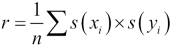
In this case,  is the standardized score for each individual value,
  . We do the same calculation for the other sequences and compute the product of each pair. The average of the product of the various standardized scores will be a value between +1 and -1. A value near +1 means the two sequences correlate nicely. A value near -1 means the sequences oppose each other. One trends up when the other trends down. A value near 0 means the sequences don't correlate.
Here's a function that computes the correlation between two instances of AnnualStat data collections:
def correlation1( d1, d2 ):
    n= len(d1.data)
    std_score_pairs = zip( d1.stdscore(), d2.stdscore() )
    r = sum( x*y for x,y in std_score_pairs )/n
    return r
We used the stdscore() method of each AnnualStat object to create a sequence of standardized score values.
We created a generator using the zip() function that will yield two-tuples from two separate sequences of scores. The mean of this sequence of products is the coefficient correlation between the two sequences. We computed the mean by summing and dividing by the length, n.