Table of Contents for
RESTful Rails Development
 RESTful Rails Development
Published by
O'Reilly Media, Inc., 2015
RESTful Rails Development
Published by
O'Reilly Media, Inc., 2015
- Cover
- nav
- RESTful Rails Development
- RESTful Rails Development
- section
- Preface
- Preface
- 1. From Hypertext to Hyperdata
- 2. Getting Started with Ruby on Rails
- 3. First Adventures in API Design
- 4. The REST of the World
- 5. Designing APIs in RoR
- 6. Asynchronous REST
- 7. Testing RESTful Services
- 8. Microservices and Microapplications
- 9. Mapping Data Streams onto an Application UI
- 10. Deploying an API
- 11. Managing an App Ecosystem
- 12. Consuming Data Streams: Integrating External APIs in Your Application
- 13. Device-Independent Development
- 14. Data Analytics
- 15. Scaling Gracefully
- 16. Privacy and Security
- A. HTTP Quick Reference
- Index
- About the Author
- Colophon
Colophon
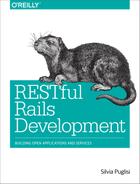
The animal on the cover of RESTful Rails Development is Desmarest’s hutia (Capromys pilorides, also known as the Cuban hutia), a large rodent found only in Cuba. It is named for Anselme Gaëtan Desmarest, a 19th-century French zoologist. Hutias live in a wide range of habitats throughout Cuba, including mangrove forests, plains, and swampland.
Desmarest’s hutias are stocky animals with short legs and a waddling gait. They have coarse black or brown fur, as well as large claws to help them climb. Hutias normally live in pairs, and are most active during the day. At night, this animal sleeps in hollows among trees or rocks (it does not create burrows). Its omnivorous diet is made up of bark, leaves, nuts, and fruit, with an occasional lizard or insect. The hutia’s stomach is among the most complex of all rodents, because it has three separate compartments.
These are the largest species of hutia, averaging 12–24 inches long and up to 19 pounds in weight. They were traditionally hunted for food in Cuba due to their size and agreeable taste, but became protected in 1968 when legislation made it illegal to kill the animals without a permit. Today, their population is so abundant that they damage crops and are considered pests.
It is likely that the first meat Christopher Columbus ate in the New World was hutia, which are common on Caribbean islands and were a staple in the diet of the indigenous people.
Many of the animals on O’Reilly covers are endangered; all of them are important to the world. To learn more about how you can help, go to animals.oreilly.com.
The cover image is from Lydekker’s Royal Natural History. The cover fonts are URW Typewriter and Guardian Sans. The text font is Adobe Minion Pro; the heading font is Adobe Myriad Condensed; and the code font is Dalton Maag’s Ubuntu Mono.