Table of Contents for
JavaScript: The Good Parts
 JavaScript: The Good Parts
Published by
O'Reilly Media, Inc., 2008
JavaScript: The Good Parts
Published by
O'Reilly Media, Inc., 2008
- Cover
- JavaScript: The Good Parts
- SPECIAL OFFER: Upgrade this ebook with O’Reilly
- A Note Regarding Supplemental Files
- Preface
- Using Code Examples
- Safari® Books Online
- How to Contact Us
- Acknowledgments
- 1. Good Parts
- Analyzing JavaScript
- A Simple Testing Ground
- 2. Grammar
- Names
- Numbers
- Strings
- Statements
- Expressions
- Literals
- Functions
- 3. Objects
- Retrieval
- Update
- Reference
- Prototype
- Reflection
- Enumeration
- Delete
- Global Abatement
- 4. Functions
- Function Literal
- Invocation
- Arguments
- Return
- Exceptions
- Augmenting Types
- Recursion
- Scope
- Closure
- Callbacks
- Module
- Cascade
- Curry
- Memoization
- 5. Inheritance
- Object Specifiers
- Prototypal
- Functional
- Parts
- 6. Arrays
- Length
- Delete
- Enumeration
- Confusion
- Methods
- Dimensions
- 7. Regular Expressions
- Construction
- Elements
- 8. Methods
- 9. Style
- 10. Beautiful Features
- A. Awful Parts
- Scope
- Semicolon Insertion
- Reserved Words
- Unicode
- typeof
- parseInt
- +
- Floating Point
- NaN
- Phony Arrays
- Falsy Values
- hasOwnProperty
- Object
- B. Bad Parts
- with Statement
- eval
- continue Statement
- switch Fall Through
- Block-less Statements
- ++ −−
- Bitwise Operators
- The function Statement Versus the function Expression
- Typed Wrappers
- new
- void
- C. JSLint
- Members
- Options
- Semicolon
- Line Breaking
- Comma
- Required Blocks
- Forbidden Blocks
- Expression Statements
- for in Statement
- switch Statement
- var Statement
- with Statement
- =
- == and !=
- Labels
- Unreachable Code
- Confusing Pluses and Minuses
- ++ and −−
- Bitwise Operators
- eval Is Evil
- void
- Regular Expressions
- Constructors and new
- Not Looked For
- HTML
- JSON
- Report
- D. Syntax Diagrams
- E. JSON
- Using JSON Securely
- A JSON Parser
- Index
- About the Author
- Colophon
- SPECIAL OFFER: Upgrade this ebook with O’Reilly
Farewell: the leisure and the fearful time Cuts off the ceremonious vows of love And ample interchange of sweet discourse, Which so long sunder'd friends should dwell upon: God give us leisure for these rites of love! Once more, adieu: be valiant, and speed well!
JavaScript Object Notation (JSON) is a lightweight data interchange format. It is based on JavaScript's object literal notation, one of JavaScript's best parts. Even though it is a subset of JavaScript, it is language independent. It can be used to exchange data between programs written in all modern programming languages. It is a text format, so it is readable by humans and machines. It is easy to implement and easy to use. There is a lot of material about JSON at http://www.JSON.org/.
JSON has six kinds of values: objects, arrays, strings, numbers, booleans
(true and false), and the special value null. Whitespace (spaces, tabs, carriage returns, and newline characters)
may be inserted before or after any value. This can make JSON texts easier for
humans to read. Whitespace may be omitted to reduce transmission or storage
costs.
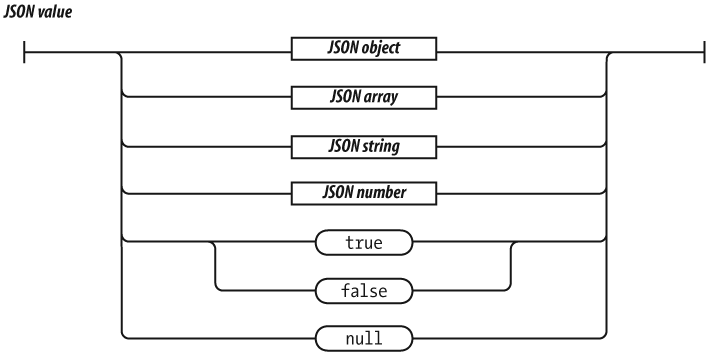
A JSON object is an unordered container of name/value pairs. A name can be any string. A value can be any JSON value, including arrays and objects. JSON objects can be nested to any depth, but generally it is most effective to keep them relatively flat. Most languages have a feature that maps easily to JSON objects, such as an object, struct, record, dictionary, hash table, property list, or associative array.

The JSON array is an ordered sequence of values. A value can be any JSON value, including arrays and objects. Most languages have a feature that maps easily onto JSON arrays, such as an array, vector, list, or sequence.

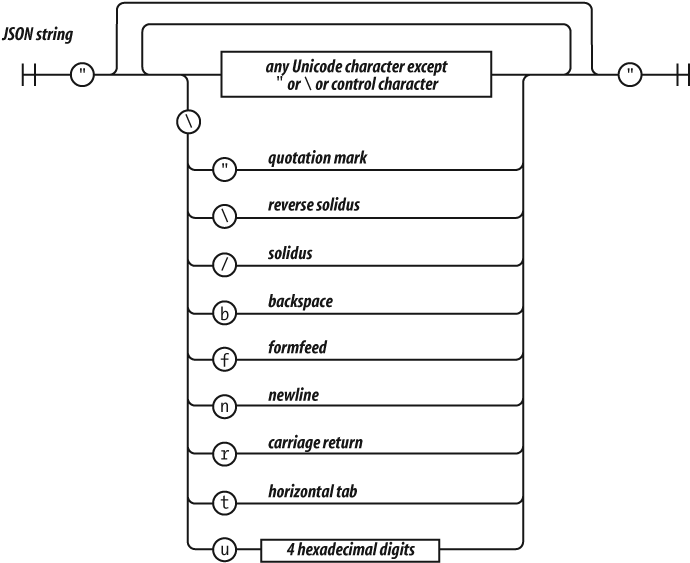
A JSON string is wrapped in double quotes. The \ character is used for escapement. JSON allows the / character to be escaped so that JSON can be embedded
in HTML <script> tags. HTML does not allow
the sequence </ except to start the </script> tag. JSON allows <\/, which produces the same result but does not
confuse HTML.
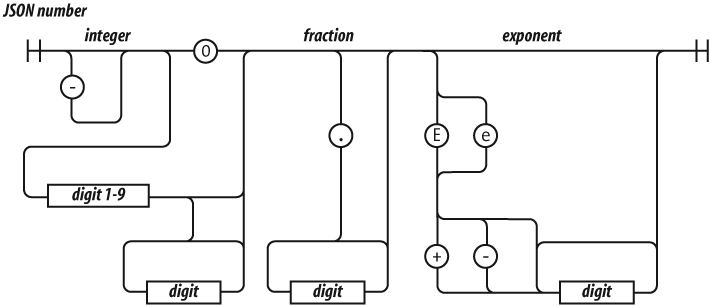
JSON numbers are like JavaScript numbers. A leading zero is not allowed on integers because some languages use that to indicate the octal. That kind of radix confusion is not desirable in a data interchange format. A number can be an integer, real, or scientific.
That's it. That is all of JSON. JSON's design goals were to be minimal, portable, textual, and a subset of JavaScript. The less we need to agree on in order to interoperate, the more easily we can interoperate.
[
    {
        "first": "Jerome",
        "middle": "Lester",
        "last": "Howard",
        "nick-name": "Curly",
        "born": 1903,
        "died": 1952,
        "quote": "nyuk-nyuk-nyuk!"
    },
    {
        "first": "Harry",
        "middle": "Moses",
        "last": "Howard",
        "nick-name": "Moe",
        "born": 1897,
        "died": 1975,
        "quote": "Why, you!"
    },
    {
        "first": "Louis",
        "last": "Feinberg",
        "nick-name": "Larry",
        "born": 1902,
        "died": 1975,
        "quote": "I'm sorry. Moe, it was an accident!"
    }
]