Table of Contents for
sendmail, 4th Edition
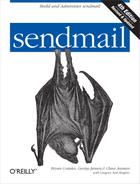 sendmail, 4th Edition
Published by
O'Reilly Media, Inc., 2007
sendmail, 4th Edition
Published by
O'Reilly Media, Inc., 2007
- sendmail, 4th Edition
- Cover
- sendmail, 4th Edition
- Dedication
- Preface
- 1. Some Basics
- I. Administration
- 2. Download, Build, and Install
- 3. Tune sendmail with Compile-Time Macros
- 4. Maintain Security with sendmail
- 5. Authentication and Encryption
- 6. The sendmail Command Line
- 7. How to Handle Spam
- 8. Test Rule Sets with -bt
- 9. DNS and sendmail
- 10. Build and Use Companion Programs
- 11. Manage the Queue
- 12. Maintain Aliases
- 13. Mailing Lists and ~/.forward
- 14. Signals, Transactions, and Syslog
- 15. Debug sendmail with -d
- II. Configuration Reference
- 16. Configuration File Overview
- 17. Configure sendmail.cf with m4
- 18. The R (Rules) Configuration Command
- 19. The S (Rule Sets) Configuration Command
- 20. The M (Mail Delivery Agent) Configuration Command
- 21. The D (Define a Macro) Configuration Command
- 22. The C and F (Class Macro) Configuration Commands
- 23. The K (Database-Map) Configuration Command
- 24. The O (Options) Configuration Command
- 25. The H (Headers) Configuration Command
- 26. The X (Milters) Configuration Command
- III. Appendixes
- A. The mc Configuration Macros and Directives
- B. What’s New Since Edition 3
- C. The checkcompat( ) Function
- Bibliography
- Index
- About the Authors
- Colophon
- Copyright
Colophon
The animal on the cover of sendmail is flying fox, a species of fruit bat found chiefly on the islands of the Malay-Indonesia archipelago. Of about 4,000 species of mammals, nearly one-quarter are bats; and of these, 160 are fruit bats. Sixty of the larger fruit bats make up the flying foxes, the largest having a wingspan of five feet. While smaller insect-eating bats navigate by echolocation, fruit bats depend on a keen sense of sight and smell to perceive their environment. They roost in trees by day, sometimes in extremely large numbers called “camps.” They hang from branches by one or both feet, wrap themselves in their wings, and sleep the day away. On hot days, these bats keep cool by fanning themselves with their wings.
Greatly elongated fingers form the main support for the web of skin that has allowed these mammals, alone, to master true flight. At sunset they awaken from their slumber and begin their nocturnal ramblings. A flying fox must flap its wings until it becomes horizontal to the ground before it can let go and fly away. Once airborne, they use their sensitive sense of smell to detect where flowers are blooming or fruits have ripened. Unlike most animals, fruit bats cannot generate vitamin C (a limitation shared by humans and guinea pigs); thus, it is supplied by fruit in the diet. Flying foxes can range up to 40 miles for food. Once a target is located, they are faced with a difficult landing. Sometimes they will simply crash into foliage and grab at what they can; other times they may attempt to catch a branch with their hindfeet as they fly over it and then swing upside-down; some will even attempt a difficult half-roll under a branch to grip it in the preferred position. Once attached and hanging, they will draw the flower or fruit to their mouths with a single hindfoot, or the clawed thumbs at the top of each wing. These awkward landings often cause fights among flying foxes, especially upon their return to camp at dawn. A single bad landing can cause an entire bat-laden tree to become highly agitated, full of fighting and screaming residents.
People have eaten flying foxes for ages. Samoans, who call the flying fox manu lagi (animal of the heavens) use branches bound to the end of long poles to swat the winged delicacy from the sky. Aborigines in Australia build fires beneath flying fox camps—the smoke stupefies the prey—and use boomerangs to knock the creatures to the ground.
The cover image is from 19th-century engraving from the Dover Pictorial Archive. The cover font is Adobe ITC Garamond. The text font is Linotype Birka; the heading font is Adobe Myriad Condensed; and the code font is LucasFont’s TheSans Mono Condensed.