Table of Contents for
sendmail, 4th Edition
 sendmail, 4th Edition
Published by
O'Reilly Media, Inc., 2007
sendmail, 4th Edition
Published by
O'Reilly Media, Inc., 2007
- sendmail, 4th Edition
- Cover
- sendmail, 4th Edition
- Dedication
- Preface
- 1. Some Basics
- I. Administration
- 2. Download, Build, and Install
- 3. Tune sendmail with Compile-Time Macros
- 4. Maintain Security with sendmail
- 5. Authentication and Encryption
- 6. The sendmail Command Line
- 7. How to Handle Spam
- 8. Test Rule Sets with -bt
- 9. DNS and sendmail
- 10. Build and Use Companion Programs
- 11. Manage the Queue
- 12. Maintain Aliases
- 13. Mailing Lists and ~/.forward
- 14. Signals, Transactions, and Syslog
- 15. Debug sendmail with -d
- II. Configuration Reference
- 16. Configuration File Overview
- 17. Configure sendmail.cf with m4
- 18. The R (Rules) Configuration Command
- 19. The S (Rule Sets) Configuration Command
- 20. The M (Mail Delivery Agent) Configuration Command
- 21. The D (Define a Macro) Configuration Command
- 22. The C and F (Class Macro) Configuration Commands
- 23. The K (Database-Map) Configuration Command
- 24. The O (Options) Configuration Command
- 25. The H (Headers) Configuration Command
- 26. The X (Milters) Configuration Command
- III. Appendixes
- A. The mc Configuration Macros and Directives
- B. What’s New Since Edition 3
- C. The checkcompat( ) Function
- Bibliography
- Index
- About the Authors
- Colophon
- Copyright
Chapter 20. The M (Mail Delivery Agent) Configuration Command
Other than relaying mail via SMTP or LMTP, the
sendmail program does not perform the
actual delivery of mail.[268] Instead, it calls other programs (called mail delivery
agents) to perform that service. Because the mechanics of delivery
can vary so widely from delivery agent to delivery agent,
sendmail needs a great deal of
information about each delivery agent. Each
sendmail
M configuration command defines a
mail delivery agent and the information that
sendmail needs.
The M Configuration Command
Like all sendmail.cf commands, the
M mail delivery
agent command must begin a line. One typical such command
looks like this:
  delivery program                                               command line
         ↓                                                              ↓
 Mlocal, P=/bin/mail, F=rlsDFMmnP, S=10, R=20, A=mail -d $u
                      ↑       ↑↑
                      flag               sender/recipient rules
This M configuration
command is composed of six parts: a symbolic name followed
by five delivery agent equates, each separated from the
others by commas. Spaces between the parts are optional. The
specific syntax of the mail delivery agent command
is:
Msymname, equate, equate, ...The letter M always begins
the delivery agent definition, followed by a symbolic name
(the symname) of your choosing
and a comma-separated list of delivery agent equates. Only
the P= and A= delivery agent equates
are required. The others are optional. If the P= is missing,
sendmail will print and
syslog(3) the following
error:
configfile: line num: Msymname : P= argument required
If the A= is missing,
sendmail will print and
syslog(3) the following
error:
configfile: line num: Msymname : A= argument required
In both error messages, configfile is the full pathname of the sendmail configuration file, num is the line number in that file where the error was found, and symname is the delivery agent definition that omitted the required piece of information.
The comma following the symbolic name is optional. As long as a space follows the symbolic name, sendmail parses it correctly. The comma should always be included for improved clarity, however.
In the following, the first example includes the comma, and the second omits it. Both are parsed by sendmail in exactly the same way:
Mlocal, P=/bin/mail, F=rlsDFMmnP, S=10, R=20, A=mail -d $u
Mlocal  P=/bin/mail, F=rlsDFMmnP, S=10, R=20, A=mail -d $u
The Symbolic Delivery Agent Name
The M that begins the
delivery agent definition command is immediately followed,
with no intervening whitespace, by the name of the delivery
agent. Note that the name is symbolic and is used only
internally by sendmail. The name can
contain no whitespace, and if it is quoted, the quotation
marks are interpreted as part of its name. In the following,
only the first is a good symbolic name:
Mlocal                  ← name is local, good
M local                 ← error: name required for mailer
Mmy mailer              ← error: mailer my: `='
 expected
M"mymailer"             ← quotation marks are retained
Although the symbolic name can contain any character other than a space or a comma, only letters, digits, dashes, and underscore characters are recommended:
Mprog-mailer             ← name is prog-mailer, good
Mprog_mailer             ← name is prog_mailer, good
Mmymailer[  ];             ← name contains [  ];—avoid such characters
The symbolic name is not case-sensitive; that is, local, Local, and LOCAL are all
identical.
Note that if two delivery agents have the same name, all the delivery agent equates for the second definition replace those for the first. Therefore, the last definition for a particular symbolic name is the one that is used.
The cumulative result of all delivery agent declarations can
be seen by using the -d0.15 debugging switch (-d0.15 on page 544) or the =M rule-testing command
(Show Delivery Agents with =M on page 307).
Required Symbolic Names
Only the local
delivery agent is required,[269] so if that required definition is
missing, sendmail prints the
following warning message but continues to
run:
No local mailer defined.
The mc Configuration Syntax
Under V8 sendmail’s mc configuration technique, you include delivery agent definitions in your configuration file using the MAILER( ) mc command. The form for that command looks like this:
MAILER(`name')For example, SMTP and UUCP support can be included in your file by using the following two commands:
MAILER(`smtp')
MAILER(`uucp')
If you include MAILER definitions for procmail, or uucp, those definitions must always
follow the definition for smtp. Note, too, that any modification of
a MAILER definition (as, for example, with UUCP_MAILER_MAX)
must precede that MAILER definition:
define(`UUCP_MAILER_MAX', `1000000')           ← here
MAILER(`uucp')
define(`UUCP_MAILER_MAX', `1000000')           ← not here
The delivery agent M
definitions that correspond to MAILER( ) commands are kept
in the cf/mailer directory.
In general, the files in the cf/mailer
directory should never be modified. If one of the
definitions needs to be tuned, use the special keywords
described under the individual delivery agent equates (Delivery Agent Equates on page 736). For
example, the following line modifies the maximum message
size (the M= delivery
agent equate, M= on page 746) for
the UUCP agent:
define(`UUCP_MAX_SIZE',`1000000')
Here, the maximum size of a UUCP message has been increased from the default of 100,000 bytes to a larger limit of 1,000,000 bytes.
Choose Preferred Agents
Four mc configuration macros are available, beginning with V8.10 sendmail, to help you choose the delivery agent you prefer in various situations.
confSMTP_MAILER
The confSMTP_MAILER
mc configuration macro is
used to specify your preference for the delivery
agent to handle outbound SMTP connections. If you
don’t define confSMTP_MAILER, the default is
esmtp (The esmtp delivery agent on page 732).
Other legal choices are relay (The relay delivery agent on page 733),
smtp (smtp, etc. on page 731), smtp8 (The smtp8 delivery agent on page 732),
and dsmtp
(The dsmtp delivery agent on
page 733):
define(`confSMTP_MAILER', `dsmtp')
Note that if you make a typo in the name, the
error will not be detected until you actually try
to send email. For example, if you misspelled
dsmtp as
xsmtp, you
would see the following message printed and logged
when trying to send a message to another
machine:
buildaddr: unknown mailer xsmtp
In general, all defined
mc configuration macros
should precede the associated MAILER definition,
but for confSMTP_MAILER, this is only a
recommendation, not a requirement.
confUUCP_MAILER
The confUUCP_MAILER
mc configuration macro is
used to specify your preference for the delivery
agent you prefer for handling UUCP. The default is
uucp. Other
possible values are uucp-old, uucp-new, uucp-dom, and uucp-uudom (see UUCP Support on page 606 for a
discussion of these choices):
define(`confUUCP_MAILER', `uucp-dom')
If you relay all UUCP mail offsite to a
special host with a UUCP modem connection, it is
reasonable to use relay for the delivery agent:
define(`confUUCP_MAILER', `relay')
confLOCAL_MAILER
The confLOCAL_MAILER
mc configuration macro is
used to specify the delivery agent you prefer for
local delivery. This is almost always local. The default for
Cyrus users is cyrus. In the rare circumstance that
you need to change this, you can declare something
like this:
define(`confLOCAL_MAILER', `newlocal')
See Deliver to a Unix domain socket on page 740 for an illustration of one use for this mc configuration macro.
confRELAY_MAILER
The confRELAY_MAILER
mc configuration macro is
used to specify your preference for the delivery
agent you prefer to perform relaying to another
machine. You might relay, for example, to a
SMART_HOST (SMART_HOST mc macro on page
597) or to a BITNET_RELAY ($B on page 808).
The default for this mc
configuration macro’s value is relay (The relay delivery agent on page 733),
which is the delivery agent for relaying mail to
another host or hosts. One possible alternative
might be:
define(`confRELAY_MAILER', `uucp-new')
This would be reasonable if you are on a UUCP-only connected site.
Tuning Without an Appropriate Keyword
Unfortunately, not all delivery agent equates can be
tuned with mc configuration
macros. The U=
delivery agent equate for the usenet agent is one
example. To change such a value, you need to copy
the original definition, modify it, and put the
modified definition in your local
mc configuration file. For
example, to add a U= delivery agent equate to the Usenet
delivery agent, you might do the following:[270]
% grep -h Musenet cf/mailer/*
Musenet,    P=USENET_MAILER_PATH, F=USENET_MAILER_FLAGS, S=10, R=20,
            _OPTINS(`USENET_MAILER_MAX', `M=', `, ')T=X-Usenet/X-Usenet/X-Unix,
            A=USENET_MAILER_ARGS $u
Here, the prototype definition for the usenet delivery agent is
found. Copy that definition into your
mc configuration file and add
the missing delivery agent equate:
MAILER(usenet)
MAILER_DEFINITIONS
Musenet,   P=USENET_MAILER_PATH, F=USENET_MAILER_FLAGS, S=10, R=20, U=news:news,
            _OPTINS(`USENET_MAILER_MAX', `M=', `, ')T=X-Usenet/X-Usenet/X-Unix,
            A=USENET_MAILER_ARGS $u
First, the MAILER( ) m4 command
causes initial support for the usenet delivery agent to
be included. The MAILER_DEFINITIONS section (MAILER_DEFINITIONS on page
716) then introduces your new delivery agent
definition. Your new definition follows, and thus
replaces, the original definition.
Create a new configuration file, and run grep(1) run to check the result:
%make our.cf%grep ^Musenet our.cfMusenet, P=/usr/lib/news/inews, F=rlsDFMmn, S=10, R=20, Musenet, P=/usr/lib/news/inews, F=rlsDFMmn, S=10, R=20, U=news:news,
Create a New mc Delivery Agent
From time to time you might need to create a brand-new delivery agent. To create a new delivery agent with the mc system, first change to the cf/mailer directory. Copy an existing m4 file, one that is similar to your needs. Then edit that new file, and include it in your configuration file with:
MAILER(newname)
Note that the MAILER mc configuration command automatically prefixes the name with the following (where _CF_DIR_ is described in The _CF_DIR_ m4 Macro on page 588):
_CF_DIR_/mailer/
and adds the suffix .m4, here forming cf/mailer/newname.m4.
Be aware, however, that creation of a new delivery
agent is not for the fainthearted. In addition to
the delivery agent definition, you might also need
to create brand-new S= and R= rules and rule sets.
MAILER_DEFINITIONS
Prior to V8.8 sendmail,
you had to use a divert(7) statement to force your new
delivery agent definitions to be grouped with all
the other delivery agent definitions. Beginning
with V8.8, this bit of “black magic” has been
removed.
To force new delivery agent definitions to be grouped with the other delivery agent definitions, use the MAILER_DEFINITIONS m4 command. For example:
MAILER_DEFINITIONS
place your new delivery agent definitions here
See Tuning Without an Appropriate Keyword on page 715 for an example of this m4 command.
Delivery Agents by Name
As we have shown earlier, the MAILER command is used to enable a class of delivery agents. For example:
MAILER(`smtp')
This command causes support for the smtp, esmtp, smtp8, dsmtp, and relay delivery agents to be included in
your configuration file. Further, the confSMTP_MAILER
mc configuration macro can be used to
define which one you want to use as your default outbound
delivery agent:
define(`confSMTP_MAILER', `dsmtp')
Before you can choose a default, however, you need to know what each delivery agent does and how they differ. In this section, we describe these and all the other standard and special delivery agents. We describe them in alphabetical order, with a convenient summary shown in Table 20-1.
|
MAILER( ) |
Agents declared |
Description |
|
|
cyrus (cyrus on page 717) cyrusbb (cyrus on page 717) |
Deliver to a local cyrus user. Handles user+where@local.host syntax to the user’s IMAP Vmailbox. |
|
|
cyrusv2 (cyrusv2 on page 719) |
Somewhat like |
|
None |
discard (discard on page 719) |
Causes the message to be accepted and discarded. |
|
None |
error (error on page 720) |
Causes the message to be rejected. |
|
|
fax (fax on page 724) |
Delivers to a program that handles fax delivery. |
|
None |
*file* (*file* and *include* on page 725) *include* (*file* and *include* on page 725) |
Performs delivery by appending to a file,
and handles delivery through |
|
|
local (The local delivery agent on page 726) prog (The prog delivery agent on page 727) |
Performs final, local delivery, either to a user’s mailbox or through a program. |
|
|
mail11 (mail11 on page 727) |
Allows use of the mail11 program for delivery to DECnet addresses. |
|
|
ph (ph on page 728) |
Delivery is through the phquery program, which looks up user information in the CCSO nameserver database, and then provides appropriate information for delivery (deprecated). |
|
|
pop (pop on page 729) |
Delivery for POP users who lack local accounts using MH’s spop. |
|
|
procmail (procmail on page 729) |
Delivers via procmail, which allows additional processing for local or special delivery needs. |
|
|
qpage (qpage on page 730) |
Part of a client/server software package that allows messages to be sent via an alphanumeric pager. |
|
|
smtp (smtp, etc. on page 731) esmtp (The esmtp delivery agent on page 732) smtp8 (The smtp8 delivery agent on page 732) dsmtp (The dsmtp delivery agent on page 733) relay (The relay delivery agent on page 733) |
The internal SMTP delivery agents. |
|
|
usenet (usenet on page 733) |
The |
|
|
uucp (uucp-old (a.k.a. uucp) on page 608) uucp-old (uucp-old (a.k.a. uucp) on page 608) uucp-new (uucp-new (a.k.a. suucp) on page 608) suucp (uucp-new (a.k.a. suucp) on page 608) uucp-dom (uucp-uudom on page 608) uucp-uudom (uucp-dom on page 608) |
The delivery agents used to send UUCP mail. |
cyrus
Deliver to a local cyrus user V8.7 and later
The cyrus and
cyrusbb
delivery agents are intended for use with the cyrus
V2 IMAP server from CMU. If you have upgraded to
Cyrus V2, you should skip this section and go to the
next one, which describes the cyrusv2 delivery agent.
First, note that the local delivery agent must be defined
before you can define cyrus:
MAILER(`local')    ← define first
MAILER(`cyrus')    ← define second
The cyrus delivery
agent can be used for local delivery, if you use an
mc configuration statement
such as this:
define(`confLOCAL_MAILER', `cyrus')
The cyrus delivery
agent, in addition to performing local delivery,
will also recognize local addresses of the form
user+where. When found, and
if permitted, it will deliver to an existing
subfolder of the INBOX on the IMAP server.
Users might or might not have local accounts, but it is assumed that they do not. Thus, if you run IMAP but have some local users who want to receive mail in the local spool, you can set up something such as this:
LOCAL_CONFIG
F{NonCyrus} /etc/mail/NonCyrus

LOCAL_RULE_0
R $={NonCyrus}                    $: $# local $: $1
R $={NonCyrus} < @ $=w . >        $: $# local $: $1
Here, users listed in the file
/etc/mail/NonCyrus will have
their mail delivered locally even if the local delivery agent is
defined as cyrus.
The cyrusbb
delivery agent is used to deliver mail to the IMAP
bulletin boards so that it can be fetched by
imapd(8). Any local user
address that begins with bb+
will be delivered for later fetching by IMAP.
The defaults for the cyrus delivery agent are listed in Table 20-2. The mc configuration macros at the left can be used to modify or replace those defaults.
|
mc macro |
§ |
Default |
|
CYRUS_MAILER_ARGS |
How to define A= with your mc configuration on page 738 |
|
|
CYRUS_MAILER_FLAGS |
Delivery Agent F= Flags on page 759 |
|
|
CYRUS_MAILER_MAX |
Modify M= using an mc configuration macro on page 746 |
No |
|
CYRUS_MAILER_PATH |
Modify P= using an mc configuration macro on page 750 |
|
|
None |
R= on page 751 |
|
|
None |
S= on page 753 |
|
|
None |
T= on page 754 |
|
|
CYRUS_MAILER_USER |
U= on page 755 |
|
|
CYRUS_MAILER_QGRP |
Q= on page 750 |
No |
|
CYRUS_BB_MAILER_ARGS |
How to define A= with your mc configuration on page 738 |
|
|
CYRUS_BB_MAILER_FLAGS |
Delivery Agent F= Flags on page 759 |
|
Note that mc configuration macro definitions must always precede the MAILER declaration to which they relate.
The Cyrus IMAP server as well as cyrus and cyrusbb delivery agents
are available from:
| http://cyrusimap.web.cmu.edu/ |
cyrusv2
Deliver to a cyrus IMAP V2 user V8.12 and later
The cyrusv2
delivery agent is intended for use with the Cyrus V2
IMAP server from CMU. It is much like the cyrus delivery agent
(described earlier), but it delivers using LMTP via
a Unix-domain socket and requires a Cyrus version 2
IMAP server. First note that the local delivery agent
must be defined before you can define cyrusv2:
MAILER(`local')    ← define first
MAILER(`cyrusv2')  ← define second
The cyrusv2
delivery agent can be used for local delivery, if
you use an mc configuration
statement such as this:
define(`confLOCAL_MAILER', `cyrusv2')
The cyrusv2
delivery agent, in addition to performing local
delivery, will also recognize local addresses of the
form user+where. When found,
and if permitted, it will deliver to an existing
subfolder of the INBOX on the IMAP server.
The defaults for the cyrusv2 delivery agent are listed in
Table 20-3. The mc configuration macros
at the left can be used to modify or replace those
defaults.
|
§ |
Default | |
|
CYRUSV2_MAILER_ARGS |
How to define A= with your mc configuration on page 738 |
|
|
CYRUSV2_MAILER_CHARSET |
C= on page 741 |
No |
|
CYRUSV2_MAILER_FLAGS |
Delivery Agent F= Flags on page 759 |
|
|
CYRUSV2_MAILER_MAXMSGS |
m= on page 747 |
No |
|
CYRUSV2_MAILER_MAXRCPTS |
r= on page 752 |
No |
|
CYRUSV2_MAILER_QGRP |
Q= on page 750 |
No |
Note that mc configuration macro definitions must always precede the MAILER declaration to which they relate.
The IMAP server and cyrusv2 delivery agent are available
from:
| http://cyrusimap.web.cmu.edu |
discard
Accept and then discard the message V8.9 and later
Prior to V8.9 sendmail, the only
way to discard mail was to deliver it to the
/dev/null device. Beginning
with V8.9, sendmail has the
ability to discard messages by delivering them with
the discard
delivery agent. The discard delivery agent is internally
defined by sendmail and should
not be defined by a MAILER( )
mc command.
The discard
delivery agent is primarily used by FEATURE(access_db)
(The access Database on page
277), but it can be used equally well by the various
policy rule sets. It is used like this:
R ... $#discard $: discard
Here, any workspace that matches the LHS will be
discarded. The event will be logged if the LogLevel option (LogLevel on page 1040) is 5 or
higher.
An example of how to use the discard delivery agent looks like
this:
LOCAL_CONFIG
C{Discard_To_Names}   allmyfriends

LOCAL_RULESETS
HTo: $>Screen_To

SScreen_To
R $={Discard_To_Names} @ $*      $# discard $: discard
Here, the value of a To: header (To:
on page 1167) is passed to the Screen_To rule set. That
rule set compares the user part of the address to
the list of usernames in the class {Discard_To_Names}. If
any are found (in this instance, only the name
allmyfriends
will be found), that message is discarded.
Note that when handling spam mail, it can be better to
reject the message with the error delivery agent than to discard it
with this discard
delivery agent. Rejection pushes the handling of
bounces back onto the sender.
error
Perform a policy-based rejection All versions
All versions of sendmail define a
special internal delivery agent called error that is designed
to aid in the issuance of error messages. It is
always available for use in the parse rule set 0, the
localaddr rule
set 5, and the Local_check and other policy setting
rule sets. It cannot be defined with an M command.
Beginning with V8.7, the form for using the error agent in the RHS
of a rule looks like this:
R... $#error $@ dsnstat $: text of error message here
In general terms, the text following the $: is the actual error
message that will be included in bounced mail and
sent back to a connecting SMTP host. For example,
the following rule in the parse rule set 0 would cause all mail
to the local user George Washington to
bounce:
RGeorge.Washington $#error 5.1.1 $: 553 George doesn't sleep here anymore
with an error message such as this:
553 5.1.1 <george.washington>... George doesn't sleep here anymore
The $@ dsnstat part when used with the error delivery agent
The $@ part
of the error
delivery agent specifies either a literal quarantine (Use rule sets to quarantine on page
442) or a DSN code. Here we describe the DSN
code.
Delivery Status Notification (DSN code, see RFC1893) provides a means for conveying the status of a message’s delivery. That status is conveyed in the form of a three-part numeric expression (so as to be easily parsed by machines). This expression is included in the “machine-readable” part of bounced messages:
success.category.detailEach part is separated from the others with dot characters. There can be no space around the dots. The parts are numeric, and the meanings are as follows:
successWas the overall delivery attempt a success? This part can be one of three digits. A 2 means the message was successfully delivered. A 4 means delivery has failed so far but might succeed in the future. A 5 means delivery failed (permanently).
categorySuccess or failure can be attributed to several reasons. For example, if this
categoryis a 1, it means the reason refers to an address. If it is a 4, it means the reason refers to the network. Other categories are described in RFC1893.detailThe
detailfurther illuminates thecategory. For example, a category 1 address (problem) can additionally be specified as a detail of 1 (no such mailbox), or 4 (ambiguous address).
The $@ part
of the error
delivery agent declaration specifies a DSN code
that is appropriate for the error:
R... $#error $@ success.category.detail $: text of error message hereThe sendmail program sets
its exit(2) value according
to the
success.category.detail
specified. Table 20-4 shows the relationship between those DSN codes
on the left and Unix exit(2)
values on the right. Note that the exit values are
defined in
<sysexits.h>, and note
that success codes of 2
and 4 completely ignore any
category and
detail that might be
present (that is,
2.anything.anything
marks successful delivery, and
4.anything.anything
marks a temporary failure). If $@ lists a code that is
not in the table, the default exit value is
EX_CONFIG. To illustrate, observe that 5.7.1 (see RFC1893) will
exit with EX_DATAERR because it corresponds to the
*.7.* in the
table.
|
DSN |
exit(2) |
String |
Meaning |
|
|
EX_OK |
Successful delivery | |
|
|
EX_TEMPFAIL |
|
Temporary failure, will keep trying |
|
|
EX_UNAVAILABLE |
|
Other address status |
|
|
EX_DATAERR |
Other address status | |
|
|
EX_NOUSER |
|
Address is that of a bad mailbox |
|
|
EX_NOHOST |
|
Address of recipient is bad |
|
|
EX_USAGE |
|
Address of recipient has bad syntax |
|
|
EX_UNAVAILABLE |
|
Address is ambiguous |
|
|
EX_CONFIG |
Address of destination is valid | |
|
|
EX_NOUSER |
|
Address has moved, no forwarding |
|
|
EX_USAGE |
|
Address of sender has bad syntax |
|
|
EX_NOHOST |
|
Address of sender is bad |
|
|
EX_UNAVAILABLE |
|
Mailbox status is undefined |
|
|
EX_UNAVAILABLE |
|
Mailbox disabled |
|
|
EX_UNAVAILABLE |
|
Mailbox full |
|
|
EX_DATAERR |
Mailbox is too small or message is too large | |
|
|
EX_UNAVAILABLE |
|
Mailbox led to mail list expansion problems |
|
|
EX_OSERR |
Operating system error | |
|
|
EX_IOERR |
Network error is undefined | |
|
|
EX_TEMPFAIL |
|
Network: no answer from host |
|
|
EX_IOERR |
Network bad connection | |
|
|
EX_TEMPFAIL |
|
Network routing failure |
|
|
EX_PROTOCOL |
|
Network unable to route |
|
|
EX_TEMPFAIL |
|
Network congestion |
|
|
EX_CONFIG |
|
Network routing loop detected |
|
|
EX_UNAVAILABLE |
|
Network delivery time expired |
|
|
EX_PROTOCOL |
|
Protocol failure |
|
|
EX_UNAVAILABLE |
|
Message contents bad, or media failure |
|
|
EX_DATAERR |
Security: general security rejection | |
|
|
EX_UNAVAILABLE |
|
Any unrecognized 5.y.z code |
|
|
EX_CONFIG |
|
Any other unrecognized code |
To illustrate, consider the need to reject all mail from a particular host (such as, say, evilhost.domain). We want to reject that host for security reasons, so we might set up a rule such as this:
R$* < @ evilhost.domain > $* $#error $@ 5.7.1 $: You are bad, go away
Here, the number following the $@ contains a dot, so it
is interpreted as a DSN status expression. The
.7. causes
sendmail to set its exit
value to EX_DATAERR. The 5.7.1 is defined in RFC1893 as meaning
“Permanent failure, delivery not authorized,
message refused.”
If the number following the $@ does not contain a
dot, sendmail sets its
exit(2) value to that number.
For example, the following code results in the
same exit(2) value as the
preceding code but gives a less informative DSN
status line in the bounce message:
R$* < @ evilhost.domain > $*        $#error $@ 65 $: You are bad, go away
                                                ↑
                                    the value of EX_DATAERR from <sysexits.h >
If the expression following the $@ is non-numeric,
sendmail looks up the string
and translates any string it recognizes into the
appropriate exit(2) value.
The recognized strings are listed in the third
column of Table 20-4. For example, the following will cause
sendmail to exit with an
EX_UNAVAILABLE value:
R$* < @ evilhost.domain > $*        $#error $@ unavailable
 $: You are bad, go away
If the string following the $@ is not one of those
listed in the table, and is not the special word
quarantine
(Use rule sets to quarantine on
page 442) the default exit(2)
value becomes EX_UNAVAILABLE.
The $: part when used with the error delivery agent
Recall that the text of the error message
following the $: is used as a literal error message.
That is, this $: part:
R... $#error $@ 5.0.0 $: george doesn't sleep here anymoreproduces this error for the address george@wash.dc.gov:
553 5.0.0 <george@wash.dc.gov>... george doesn't sleep here anymore
Here, the 553 is an SMTP code (see RFC821). If
you want a different SMTP code issued, you can do
so by prefixing the $: part with it, as shown:
R... $#error $: 450 george doesn't sleep here anymoreIf three digits followed by a space are present as a prefix, those digits are used as the SMTP reply code when sendmail is speaking SMTP. If no digits and space prefix the text, the default SMTP reply code is 553.
A few SMTP codes that are useful with $: are listed in Table 20-5.
The complete list of all SMTP codes can be found
in RFC2821.
|
Code |
Meaning |
|
421 |
Service not available (queue the message), and close the connection |
|
450 |
Service not available (queue the message) |
|
550 |
General permanent failure (bounce the message)[a] |
|
553 |
Requested action not taken (bounce the message) |
[a] a All the 5xy codes generally mean permanent failure for the address. | |
Note that you should restrict yourself to the
small set of codes that can legally be returned to
the RCPT SMTP command. Also note that any DSN
status expression that is specified in the
$@ part must
avoid conflicting with the meaning of the SMTP
code. For example, the following construct is
wrong and should be avoided:
R... $#error $@ 2.1.1 $: 553 ... ← avoid such conflictsHere, the DSN 2.1.1 means that delivery was
successful, whereas the SMTP 553 means that delivery
failed and the message bounced. In general, the
first digit of the SMTP code should match the
first digit of the DSN status expression.
fax
Deliver with a fax-sending program V8.8 and later
The fax delivery
agent is used to deliver mail to a fax-sending
program. If you define this delivery agent
with:
MAILER(`fax')
any address that ends in .fax is automatically sent to that delivery agent. Thus, to fax mail to a user on the local machine, you might do the following:
To: joe@5554321.fax
This will cause the message to be sent to the faxmail program for delivery to the number 555-4321.[271] The faxmail program will parse the message for a recipient, and for fax-tuning parameters passed in header lines that begin with x-fax-. It will format and send the result to the hfaxd daemon, which actually communicates with fax modems.
Note that hfaxd and the modems need not exist on the local machine. If you have a central fax server, you can set up all the client machines by defining the FAX_RELAY mc configuration macro to point at that machine:
define(`FAX_RELAY', `fax.your.domain')
With this definition, any mail addressed to an address ending in .fax will be forwarded to fax.your.domain for sending as a fax. Obviously, you will need to have fax-sending software and fax modems installed on that machine.
Note that you should use either MAILER(fax) or FAX_RELAY—not both. If
you declare both, the MAILER(fax) will supersede the FAX_RELAY, and all fax
mail will be delivered locally.
Another way to handle faxes is to set up aliases for each user that can receive faxes:
userA+fax: "|/usr/local/bin/faxmail -d userA@5551234"
userB+fax: "|/usr/local/bin/faxmail -d userB@5556789"
The defaults for the fax delivery agent are listed in Table 20-6. The mc configuration macros at the left can be used to modify or replace those defaults.
|
§ |
Default | |
|
FAX_MAILER_ARGS |
How to define A= with your mc configuration on page 738 |
|
|
None |
Delivery Agent F= Flags on page 759 |
|
|
FAX_MAILER_PATH |
Modify P= using an mc configuration macro on page 750 |
|
|
FAX_MAILER_MAX |
Modify M= using an mc configuration macro on page 746 |
|
|
None |
R= on page 751 |
|
|
None |
S= on page 753 |
|
|
None |
T= on page 754 |
|
|
FAX_MAILER_QGRP |
Q= on page 750 |
No |
The faxmail program, the hfaxd daemon, and all the other supporting software you need to email faxes is available from ftp://ftp.hylafax.org/.
Also, a number of commercial products are available that allow users to email faxes. They are easily found by searching on the Web.
*file* and *include*
Internal delivery agents V8.1 and later
The *file* delivery
agent (the *
characters are part of the name) handles delivery to
files. The *include* delivery agent handles
delivery through :include: lists. Neither can be
considered a true delivery agent, however, because
actual delivery is still handled internally by
sendmail. Instead, they
provide a way to tune delivery agent behavior for
these two delivery needs.
The defaults for these delivery agents are predefined. They can be viewed with the following command (note that output lines are wrapped to fit the page):[272]
% /usr/sbin/sendmail -d0.15 -bt < /dev/null | egrep "file|include"
mailer 1 (*file*): P=[FILE] S=parse/parse R=parse/parse M=0 U=0:0 F=9DEFMPloqsu L=0 E=
\n T=X-Unix/X-Unix/X-Unix r=100 A=FILE $u
mailer 2 (*include*): P=/dev/null S=parse/parse R=parse/parse M=0 U=0:0 F=su L=0 E=\n
T=<undefined>/<undefined>/<undefined> r=100 A=INCLUDE $u
These predefined defaults can be overwritten, however,
by declaring *file* and *include* in the configuration file.
For example, the following configuration file
declaration overrides the internal definition shown
earlier, and limits the size of any mail message
that is delivered to files to 1 MB:
M*file*, P=[FILE], M=1000000, F=9DEFMPloqsu, T=X-Unix/X-Unix/X-Unix, A=FILE $uNote that any delivery agent equate that does not
default to zero (such as the P=, F=, T=, and A= delivery agent
equates) needs to be copied to this configuration
file declaration, or the original value will be
lost.
A similar change in definition for the mc configuration of V8 sendmail would look like this:
MAILER_DEFINITIONS
M*file*, P=[FILE], M=1000000, F=9DEFMPloqsu, T=X-Unix/X-Unix/X-Unix, A=FILE $u
local and prog
Final local delivery V8.1 and later
When you enable the local delivery agent with:
MAILER(`local')
you are really enabling two delivery agents—local and prog. The local delivery agent is
charged with local, final delivery to a user’s
mailbox. The prog
delivery agent is used to pipe mail through
programs.
The local delivery agent
The local
delivery agent’s job is to deliver mail to its
final destination in the user’s mailbox. Its name
doesn’t tell you what program is actually run to
perform that delivery, but it is usually either
/bin/mail or
/usr/libexec/mail.local,
although it could also be
procmail or
spop.
The program you select to perform the role of
final delivery will determine the defaults that
this delivery agent starts with. If you need to
change any of those defaults, you can first
determine what they are by looking in your
configuration file for the Mlocal lines. They might
look like this, for example:
Mlocal,         P=/usr/lib/mail.local, F=lsDFMAw5:/|@qPSXfmnz9,
                S=EnvFromSMTP/HdrFromL, R=EnvToL/HdrToL,
                T=DNS/RFC822/SMTP, A=mail.local -l
You can use any of the mc configuration macros shown in Table 20-7 to modify or replace these defaults.
|
mc macro |
§ |
Default |
|
LOCAL_MAILER_ARGS |
How to define A= with your mc configuration on page 738 |
|
|
LOCAL_MAILER_CHARSET |
C= on page 741 |
No |
|
LOCAL_MAILER_DSN_DIAGNOSTIC_CODE |
T= on page 754 |
|
|
LOCAL_MAILER_EOL |
E= on page 742 |
No |
|
LOCAL_MAILER_FLAGS |
Delivery Agent F= Flags on page 759 |
|
|
LOCAL_MAILER_MAX |
Modify M= using an mc configuration macro on page 746 |
No |
|
LOCAL_MAILER_MAXMSGS |
m= on page 747 |
No |
|
LOCAL_MAILER_MAXRCPTS |
r= on page 752 |
No |
|
LOCAL_MAILER_PATH |
Modify P= using an mc configuration macro on page 750 |
|
|
LOCAL_MAILER_QGRP |
Q= on page 750 |
No |
Note that mc configuration macro definitions must always precede the MAILER declaration to which they relate.
The prog delivery agent
The prog delivery agent
is used to send mail through programs for final
delivery (see Delivery Via Programs on page 468 for
a discussion of this process as it relates to the
|prog form
of aliases). The prog delivery agent is co-declared with
the local
delivery agent by this MAILER
declaration:
MAILER(`local')
The prog
delivery agent does not actually run programs
itself. Instead, it executes a program that is
expert at running other programs. In general, that
program is the Bourne shell,
/bin/sh. But it as easily can
be other shells or programs, such as
smrsh(8) (The smrsh Program on page 379) or
ksh(1). To find the defaults
defined for your site, look in the
sendmail.cf file for a line
that begins with Mprog:
Mprog, P=/bin/sh, F=lsDFMoqeu9, S=EnvFromL/HdrFromL, R=EnvToL/HdrToL, D=$z:/,
T=X-Unix/X-Unix/X-Unix,
A=sh -c $uYou can use any of the mc configuration macros shown in Table 20-8 to modify or replace these defaults.
|
mc macro |
§ |
Default |
|
LOCAL_SHELL_ARGS |
How to define A= with your mc configuration on page 738 |
|
|
LOCAL_SHELL_FLAGS |
Delivery Agent F= Flags on page 759 |
|
|
LOCAL_MAILER_MAX |
Modify M= using an mc configuration macro on page 746 |
No |
|
LOCAL_SHELL_DIR |
D= on page 741 |
|
|
LOCAL_SHELL_PATH |
Modify P= using an mc configuration macro on page 750 |
|
|
LOCAL_PROG_QGRP |
Q= on page 750 |
No |
Note that mc configuration macro definitions must always precede the MAILER declaration to which they relate.
mail11
Deliver to DECnet nodes V8.7 and later
The mail11 delivery
agent is used to send mail to users on remote DECnet
nodes using the mail11(8)
program. DECnet addresses are of the form:
host::userHere, host is the node name
of a remote DECnet machine.
You declare support for the mail11 delivery agent in your
mc configuration file with
the following line:
MAILER(`mail11')
The defaults for the mail11 delivery agent are shown in
Table 20-9.
|
Macro |
§ |
Default |
|
MAIL11_MAILER_ARGS |
How to define A= with your mc configuration on page 738 |
|
|
MAIL11_MAILER_FLAGS |
Delivery Agent F= Flags on page 759 |
|
|
MAIL11_MAILER_PATH |
Modify P= using an mc configuration macro on page 750 |
|
|
None |
R= on page 751 |
|
|
None |
S= on page 753 |
|
|
None |
T= on page 754 |
|
|
MAIL11_MAILER_QGRP |
Q= on page 750 |
No |
ph
Deliver with phquery program V8.7 and later, deprecated
When using the ph
delivery agent, actual delivery is through the
phquery(8) program, which
looks up user information in the CCSO nameserver
database and then injects that mail back into
sendmail for
delivery.[273] This program cannot be used by itself
because you must also install the
qi server, and include your
own database of user information.
Support is included in your mc configuration file like this:
MAILER(`local') ← define first MAILER(`phquery') ← define second
Note that the local
delivery agent must be defined before you can define
phquery.
The defaults for the ph delivery agent are shown in Table 20-10,
along with the mc configuration
macros used to alter those defaults.
|
§ |
Default | |
|
PH_MAILER_ARGS |
How to define A= with your mc configuration on page 738 |
|
|
PH_MAILER_FLAGS |
Delivery Agent F= Flags on page 759 |
|
|
PH_MAILER_PATH |
Modify P= using an mc configuration macro on page 750 |
|
|
None |
R= on page 751 |
|
|
None |
S= on page 753 |
|
|
None |
T= on page 754 |
|
|
PH_MAILER_QGRP |
Q= on page 750 |
No |
The phquery and qi programs, and links to help with both, are available from:
| http://www-dev.cso.uiuc.edu/ph/ |
pop
Deliver using MH’s spop V8.6 and later
When using the pop
delivery agent, actual delivery is via the
spop(8) program, which
provides a way to perform local delivery for any
user that does not have a local Unix account. This
is handy in a POP universe where it is often
undesirable for thousands of POP clients to also
have local accounts. It is also useful at sites
where security concerns prevent POP-only users from
also having Unix accounts.
Support is included in your mc configuration file like this:
MAILER(`local') ← define this MAILER(`pop') ← before this
Note that the local
delivery agent must be defined before you can define
pop.
The defaults for the pop delivery agent are shown in Table 20-11,
along with the mc configuration
macros used to alter those defaults.
|
§ |
Default | |
|
POP_MAILER_ARGS |
How to define A= with your mc configuration on page 738 |
|
|
POP_MAILER_FLAGS |
Delivery Agent F= Flags on page 759 |
|
|
POP_MAILER_PATH |
Modify P= using an mc configuration macro on page 750 |
|
|
None |
R= on page 751 |
|
|
None |
S= on page 753 |
|
|
None |
T= on page 754 |
|
|
POP_MAILER_QGRP |
Q= on page 750 |
No |
The spop program is distributed as part of the mh suite of software, and is available from:
| http://rand-mh.sourceforge.net/ |
procmail
Deliver using procmail V8.7 and later
When using the procmail delivery agent, actual
delivery is performed by the
procmail(1) program, which
can be used for local delivery. We described one use
of procmail when
we described FEATURE(local_procmail) (FEATURE(local_procmail) on page 627). In that example, local_procmail was tuned
with LOCAL_ mc configuration
macros, but here it is tuned with PROCMAIL_
mc configuration
macros.
Support for the procmail delivery agent is included in
your mc configuration file like
this:
MAILER(`smtp') ← define first MAILER(`procmail') ← define second
Note that the smtp
delivery agent must be defined before you can define
procmail.
The procmail(1) program can be
made to filter mail and even route mail to different
files by changing a few configuration file rules.
For example, it can be used as a delivery agent to
handle inbound bounces for mailing lists by setting
up a new rule in the parse rule set 0 that routes all
recipients that end in -request for delivery with
procmail:
LOCAL_CONFIG Kisrequest regex -a@MATCH -request$ LOCAL_RULE_0 R $+ < @ $+ > $: $(isrequest $1 $) $| $1 <@$2> R $* @MATCH $| $+ < @ $+ > $#procmail $@ $3 $: $2 R $* $| $* $2
This bit of magic requires that you first declare a
regex
database-map type (regex on page
932) that will match any user part of an address
that ends in -request. Then we use LOCAL_RULE_0 to
declare three new rules in the parse rule set 0. The
first tries to match -request in the address. The second
detects a match and calls the procmail delivery agent.
The third restores the original workspace in the
event that no match was found.
This solution is only a suggestion and a starting
place from which to work out your own solutions. In
addition to new maps and rules, you will also have
to tune the procmail delivery agent (possibly
adding a U=
delivery agent equate, U= on
page 755) and configure the
procmail program to do the
right thing with the -request addresses it gets.
The defaults for the procmail delivery agent are shown in
Table 20-12, along with the mc
configuration macros used to alter those
defaults.
|
Macro |
§ |
Default |
|
PROCMAIL_MAILER_ARGS |
How to define A= with your mc configuration on page 738 |
|
|
PROCMAIL_MAILER_FLAGS |
Delivery Agent F= Flags on page 759 |
|
|
PROCMAIL_MAILER_MAX |
Modify M= using an mc configuration macro on page 746 |
No |
|
PROCMAIL_MAILER_PATH |
Modify P= using an mc configuration macro on page 750 |
|
|
None |
R= on page 751 |
|
|
None |
S= on page 753 |
|
|
None |
T= on page 754 |
|
|
PROCMAIL_MAILER_QGRP |
Q= on page 750 |
No |
The procmail(1) program is available from:
| http://www.procmail.org/ |
qpage
Deliver via a pager V8.10 and later
The qpage delivery
agent delivers messages by running the
qpage(8) program. The
qpage(8) program is part of a
client/server software package that allows messages
to be sent via an alphanumeric pager.
Support is included in your mc configuration file like this:
MAILER(`qpage')
The defaults for this delivery agent are shown in Table 20-13, along with the mc configuration macros used to alter those defaults.
|
Macro |
§ |
Default |
|
QPAGE_MAILER_ARGS |
How to define A= with your mc configuration on page 738 |
|
|
QPAGE_MAILER_FLAGS |
Delivery Agent F= Flags on page 759 |
|
|
QPAGE_MAILER_MAX |
Modify M= using an mc configuration macro on page 746 |
|
|
QPAGE_MAILER_PATH |
Modify P= using an mc configuration macro on page 750 |
|
|
None |
T= on page 754 |
|
|
QPAGE_MAILER_QGRP |
Q= on page 750 |
No Q= default |
The qpage program is available from:
| http://www.qpage.org/ |
smtp, etc.
Deliver using SMTP V8.1 and later
The five smtp
delivery agents all use TCP to connect to other
hosts. They are the smtp, esmtp, smtp8, dsmtp, and relay delivery agents. All five start
with the same basic defaults, which are shown in
Table 20-14. Support for all five is included in your
mc configuration file like
this:
MAILER(`smtp')
|
§ |
Default | |
|
SMTP_MAILER_ARGS |
How to define A= with your mc configuration on page 738 |
|
|
SMTP8_MAILER_ARGS |
How to define A= with your mc configuration on page 738 |
|
|
ESMTP_MAILER_ARGS |
How to define A= with your mc configuration on page 738 |
|
|
DSMTP_MAILER_ARGS |
How to define A= with your mc configuration on page 738 |
|
|
RELAY_MAILER_ARGS |
How to define A= with your mc configuration on page 738 |
|
|
SMTP_MAILER_CHARSET |
C= on page 741 |
No |
|
RELAY_MAILER_CHARSET |
C= on page 741 |
No |
|
None |
E= on page 742 |
|
|
SMTP_MAILER_FLAGS |
Delivery Agent F= Flags on page 759 |
|
|
SMTP_MAILER_FLAGS |
Delivery Agent F= Flags on page 759 |
|
|
SMTP_MAILER_FLAGS |
Delivery Agent F= Flags on page 759 |
|
|
SMTP_MAILER_FLAGS |
Delivery Agent F= Flags on page 759 |
|
|
RELAY_MAILER_FLAGS |
Delivery Agent F= Flags on page 759 |
|
|
SMTP_MAILER_LL |
L= on page 745 |
|
|
RELAY_MAILER_LL |
L= on page 745 |
|
|
SMTP_MAILER_MAX |
Modify M= using an mc configuration macro on page 746 |
No |
|
SMTP_MAILER_MAXMSGS |
m= on page 747 |
No |
|
RELAY_MAILER_MAXMSGS |
m= on page 747 |
No |
|
None |
Modify P= using an mc configuration macro on page 750 |
|
|
SMTP_MAILER_MAXRCPTS |
r= on page 752 |
No |
|
None |
R= on page 751 |
|
|
None |
R= on page 751 |
|
|
None |
S= on page 753 |
|
|
None |
T= on page 754 |
|
|
SMTP_MAILER_QGRP |
Q= on page 750 |
No |
|
SMTP8_MAILER_QGRP |
Q= on page 750 |
No |
|
ESMTP_MAILER_QGRP |
Q= on page 750 |
No |
|
DSMTP_MAILER_QGRP |
Q= on page 750 |
No |
|
RELAY_MAILER_QGRP |
Q= on page 750 |
No |
Note that each of the five smtp class delivery agents has it own
way of specifying the A= delivery agent equate. That is so
that you can run each on a different port if you so
desire (The use of $h in A=TCP on
page 739).
The smtp delivery agent
The smtp
delivery agent speaks SMTP and has the F=mDFMuX delivery agent
flags set by default (see The use of $h in A=TCP on
page 739 for the meaning of these delivery agent
flags). It is a useful delivery agent if you
connect to sites that disconnect when they are
greeted with EHLO. Although such behavior violates
standards, some hosts still run such broken
software.
In general, esmtp is preferred over this smtp delivery
agent.
The esmtp delivery agent
The esmtp
delivery agent speaks ESMTP and has the F=mDFMuXa delivery agent
flags set by default (see The use of $h in A=TCP on
page 739 for the meaning of these delivery agent
flags). Note that these are the same delivery
agent flags smtp uses, but with the F=a delivery agent flag
added to enable ESMTP. This is the preferred
delivery agent for delivery over
networks.
The smtp8 delivery agent
The smtp8
delivery agent speaks SMTP and has the F=mDFMuX8 delivery agent
flags set by default (see The use of $h in A=TCP on
page 739 for the meaning of these delivery agent
flags). Note that these are the same delivery
agent flags smtp uses, but with the F=8 delivery agent flag
added to force sending 8-bit data over SMTP even
if the receiving server doesn’t support 8-bit
MIME. You might prefer to use this delivery agent
when forwarding to a central server that does not
understand 8-bit MIME, but that can handle 8-bit
data.
The dsmtp delivery agent
The dsmtp
delivery agent speaks ESMTP and has the F=mDFMuXa% delivery
agent flags set by default (see The use of $h in A=TCP on
page 739 for the meaning of these delivery agent
flags). Note that these are the same delivery
agent flags smtp uses, but with the F=a and F=% delivery agent flags
added. The F=a
delivery agent flag enables support for ESMTP. The
F=% delivery
agent flag causes all outbound email to be queued
instead of sent, and not attempted on normal queue
runs. This is extremely useful at a site that is
polled only for email. A server with only dial-up
accounts might be one example, or a server outside
a firewall that is not allowed to push mail
inward. With the F=% delivery agent flag set,
destination hosts need to request delivery with
the ETRN command (Process the queue via ESMTP ETRN on
page 433). The local administrator can also cause
delivery to occur with the -qI, -qR, or -qS command-line
switches (Process by identifier/recipient/sender:
-q[ISR] on page 431).
The relay delivery agent
The relay
delivery agent uses TCP to connect to other hosts.
It speaks ESMTP and has the F=mDFMuXa8 delivery
agent flags set by default (see The use of $h in A=TCP on
page 739 for the meaning of these delivery agent
flags). Note that these are the same delivery
agent flags smtp uses, but with the F=a and F=8 delivery agent flags
added. The F=a
delivery agent flag enables support for ESMTP. The
F=8 delivery
agent flag forces sending 8-bit data over SMTP
even if the receiving server doesn’t support 8-bit
MIME. The relay
delivery agent also uses an L= (L= on page 745) setting of 2040.
It also does less header rewriting than the other
SMTP-based mailers. This is the delivery agent
chosen for forwarding mail to the SMART_HOST
(SMART_HOST mc macro
on page 597), LUSER_RELAY (LUSER_RELAY mc Macro on
page 605), BITNET_RELAY ($B on page 808), UUCP_RELAY
(UUCP_RELAY mc Macro
on page 606), DECNET_RELAY (DECNET_RELAY mc Macro on
page 604), FAX_RELAY (FAX_RELAY mc Macro on page
604), and MAIL_HUB (MAIL_HUB mc Macro on page
605).
usenet
Deliver through inews V8.4 and later
The usenet delivery
agent is used to post messages to Usenet newsgroups
by means of the inews program.
It is declared like this:
MAILER(`local') ← define first MAILER(`usenet') ← define second
Note that the local
delivery agent must be defined before you can define
usenet. The
preceding declaration causes any mail addresses that
end in a literal .usenet to be sent via this delivery
agent. This works for addresses that end in .usenet, and addresses
that end in .usenet@$=w where the class $=w ($=w on page 876) contains
all the names of the hosts that represent the local
machine.
The user portion of the address that precedes the
.usenet should
be the name of the newsgroup to which you are
posting, such as
comp.mail.sendmail.usenet.
The usenet
delivery agent calls the inews
program to deliver the posting to that
newsgroup.
The defaults for the usenet delivery agent are shown in
Table 20-15, along with the mc
configuration macros used to alter those
defaults.
|
Macro |
§ |
Default |
|
USENET_MAILER_ARGS |
How to define A= with your mc configuration on page 738 |
|
|
USENET_MAILER_FLAGS |
Delivery Agent F= Flags on page 759 |
|
|
USENET_MAILER_MAX |
M= on page 746 |
No |
|
USENET_MAILER_PATH |
Modify P= using an mc configuration macro on page 750 |
|
|
None |
R= on page 751 |
|
|
None |
S= on page 753 |
|
|
None |
T= on page 754 |
|
|
USENET_MAILER_QGRP |
Q= on page 750 |
No |
The source for inews is available with the nntp program, which is available in many forms from various sites. Use your web browser to find a version suitable to your needs. One such site is:
| http://www.isc.org/products/inn/ |
These are the same folks who supply the BIND nameserver software.
uucp
Deliver using UUCP V8.1 and later
The UUCP delivery agents are used to forward email over UUCP networks. The following declaration enables six delivery agents (although two are synonyms for others, meaning there are really only four):
MAILER(`uucp')
The enabled UUCP delivery agents are shown in Table 20-16.
|
Agent |
§ |
Versions |
Description |
|
|
uucp-old (a.k.a. uucp) on page 608 |
V8.6 and later |
Old-style, all ! form of UUCP |
|
|
uucp-old (a.k.a. uucp) on page 608 |
V8.1 and later |
Synonym for the above (obsolete) |
|
|
uucp-new (a.k.a. suucp) on page 608 |
V8.6 and later |
Old-style with multiple recipients |
|
|
uucp-new (a.k.a. suucp) on page 608 |
V8.1 and later |
Synonym for the above (obsolete) |
|
|
uucp-uudom on page 608 |
V8.6 and later |
Domain-form headers, old-form envelope |
|
|
uucp-dom on page 608 |
V8.6 and later |
Domain-form headers and envelope |
Note that the smtp
delivery agent must be defined first if you want to
use uucp-dom and
uucp-uudom:
MAILER(`smtp') ← define first MAILER(`uucp') ← define second
Table 20-17 shows the mc configuration
macros that are used to change the defaults for all
the uucp delivery
agents. Changing one will affect all of them.
|
Macro |
§ |
Default |
|
|
How to define A= with your mc configuration on page 738 |
|
|
|
C= on page 741 |
No |
|
|
Delivery Agent F= Flags on page 759 |
|
|
|
m= on page 747 |
|
|
|
Modify P= using an mc configuration macro on page 750 |
|
|
None |
R= on page 751 |
|
|
None |
R= on page 751 |
|
|
None |
S= on page 753 |
|
|
None |
S= on page 753 |
|
|
None |
S= on page 753 |
|
|
None |
T= on page 754 |
|
|
|
Q= on page 750 |
No |
[a] a This is the
basic set for all the | ||
These delivery agents are described in greater detail in Chapter 17, beginning in UUCP Support on page 606.
The LOCAL_UUCP mc macro
If you need to add rules between the detection
of local UUCP addresses and remote UUCP addresses,
you may do so by utilizing this (V8.13 and later)
LOCAL_UUCP
mc macro. For
example, the following mc file entry:
LOCAL_UUCP
R$* < @ $={ServerUUCP} . UUCP. > $* $#uucp-uudom $@ $2 $: $1 < @ $2 .UUCP. >
$3causes the preceding new rule to be added to
the parse rule
set 0 in the location shown here:
# resolve locally connected UUCP links
...
← New rules added here.
# resolve remotely connected UUCP links (if any)Note that the LOCAL_UUCP
mc macro is
not intended for casual use. It should be used
only to solve special UUCP needs that cannot be
solved using more conventional means.
Delivery Agent Equates
Recall that the form for the M command is:
Msymname, equate, equate, equate, ...Each equate expression is of the
form:
field=arg
The field is one of those
in Table 20-18. Only the
first character of the field is recognized. For example, all of
the following are equivalent:
S=21 Sender=21 SenderRuleSet=21
The field is followed by
optional whitespace, the mandatory = character, optional whitespace, and
finally the arg. The form of the
arg varies depending on
the field. The
arg might or might not be
required.
Special characters can be embedded into the
field as shown in Table 21-2
on page 788. For example, the backslash notation can be used
to embed commas into the A= delivery agent equate like
this:
... A=eatmail -F0\,12\,99
The complete list of delivery agent equates is shown in Table 20-18. A full description of each begins in the next section. They are presented in alphabetical order, rather than the order in which they would appear in typical delivery agent definitions.
|
Equate |
Field name |
§ |
Meaning |
|
|
/path |
/=(forward slash) on page 737 |
Set a chroot directory (V8.10 and later) |
|
|
Argv |
A= on page 738 |
Delivery agent’s command-line arguments |
|
|
CharSet |
C= on page 741 |
Default MIME character set (V8.7 and later) |
|
|
Directory |
D= on page 741 |
Delivery agent working directory (V8.6 and later) |
|
|
EOL |
E= on page 742 |
End-of-line string |
|
|
Flags |
F= on page 743 |
Delivery agent flags |
|
|
LineLimit |
L= on page 745 |
Maximum line length (V8.1 and later) |
|
|
MaxMsgSize |
M= on page 746 |
Maximum message size |
|
|
maxMsgsPerConn |
m= on page 747 |
Max messages per connection (V8.10 and later) |
|
|
Niceness |
N= on page 748 |
How to nice(2) the agent (V8.7 and later) |
|
|
Path |
P= on page 748 |
Path to the delivery agent |
|
|
QueueGroup |
Q= on page 750 |
The name of the queue group to use (V8.12 and later) |
|
|
Recipient |
R= on page 751 |
Recipient rewriting rule set |
|
|
recipients |
r= on page 752 |
Maximum recipients per envelope (V8.12 and later) |
|
|
Sender |
S= on page 753 |
Sender rewriting rule set |
|
|
Type |
T= on page 754 |
Types for DSN diagnostics (V8.7 and later) |
|
|
UID |
U= on page 755 |
Run agent as user-id:group-id (V8.7 and later) |
|
|
Wait |
W= on page 756 |
Timeout for a process wait (V8.10 and later) |
/=(forward slash)
Set a chroot directory V8.10 and later
There are times when, for security reasons, you might wish to restrict delivery to a chroot(8) hierarchy. You might, for example, wish to restrict local spool delivery to a small subset of the total filesystem. One way to manage such a change is to set up that new directory hierarchy so that it looks something like this:
/secure/etc/passwd
/secure/etc/group
/secure/etc/mail/sendmail.cf
/secure/etc/mail/aliases.db
/secure/etc/mail/access.db
/secure/var/spool/mail
/secure/usr/sbin/sendmail
/secure/var/mqueue
/secure/var/clientmqueue
etc.If this /= delivery
agent equate is declared for the local delivery agent as
/=/secure, all
local delivery will first cause
sendmail to
chroot(8) into the
/secure hierarchy. If that
chroot(8) fails,
sendmail will log the failure
and continue to chroot(8) into
the root directory.
One way to declare the /= delivery agent equate and change the
location of mail.local at the
same time is like this:
define(`LOCAL_MAILER_PATH', `/bin/mail.local, /=/secure')
Note that other files will have to appear in the /secure hierarchy. A /secure/dev/zero, for example, will be necessary for Solaris-based systems. A Bourne shell will also be necessary (e.g., /secure/bin/sh), as will a local delivery agent, such as /secure/bin/mail.local. Running delivery agents in a chroot(8) environment is not for the fainthearted, and much experimentation will doubtless be required to get it right for your system.
Note that this /=
delivery agent equate is intended to run
sendmail’s delivery agents in
a chroot(8) environment. It is
not intended to run
sendmail.
A=
The argv for this delivery agent All versions
The program that is to be run (specified by the
P= delivery
agent equate) is given its C-language char **argv array (list
of command-line arguments) by this A= delivery agent
equate. This delivery agent equate is traditionally
the last one specified because prior to V8.7, the
argv arguments
were all those from the = to the end of the line:
Mlocal, P=/bin/mail, F=rlsDFMmnP, S=10, R=20, A=mail -d $u
↑
prior to V8.7, argv to end of line
...Beginning with V8.7, the A= is treated like any other delivery
agent equate, in that it ends at the end of the line
or at the first comma. The
backslash character can be used as a prefix to embed
commas in the A=
delivery agent equate.
Macros are expanded and can be used in this argv array. For
example:
A=mail -d
                                                  $u
The A= begins the
declaration of the argument array. The program that
is specified by the P= delivery agent equate
(/bin/mail) will be executed
with an argv
of:
argv[0] = "mail" argv[1] = "-d" ← switch means perform final delivery argv[2] = "fred" ← where sendmail macro $u contains fred
The macro value of $u contains the current recipient name
or names ($u on page 848).
Another sendmail macro that
commonly appears in A= fields is $h, the recipient host ($h on page 825). You are, of
course, free to use any
sendmail macro you find
necessary as a part of this argv array. Note that $u is special, in that
if it is missing, sendmail will
speak SMTP to the delivery agent (The special case of $u in A= on page 740) or LMTP if the delivery agent has
the F=z flag set
(F=z on page 783). Also
note that any arguments in excess of the maximum
number defined by MAXPV (MAX... on
page 120), usually 40, are silently ignored.
How to define A= with your mc configuration
Under V8 sendmail’s
mc configuration, you can
define the A=
delivery agent equate using one of the handy
mc macros provided. With the
local delivery
agent, for example, you can change the A= equate like
this:
define(`LOCAL_MAILER_ARGS', `put.local -l -d $u')
See the section describing a particular
delivery agent to find an appropriate
mc macro with which to
redefine the A=
for that delivery agent. See Table 20-1 on
page 717 for a guide to all delivery agents. And
note that when $u appears in an A= equate, it should
always be last because there might be multiple
recipients.
In general, the definitions in the
cf/ostype subdirectory are
pretuned in a way that is best for most sites. If
you want to make changes, remember that each
definition that you put in your mc file
replaces the definition in
cf/ostype. Therefore, it’s
best to copy an existing definition and modify it
for your own use. Just be sure you don’t omit
something important.
The use of $h in A=TCP
For network delivery via the P=[IPC] delivery agent,
the A= delivery
agent equate is usually declared like this:
A=TCP
                                                  $h
The value in $h is the value returned by the
parse rule set
0’s $@ operator
and is usually the name of the host to which
sendmail should connect.
During delivery the sendmail
program expands this hostname into a possible list
of MX records.[274] It attempts delivery to each MX
record. If all delivery attempts fail and if the
V8 FallbackMXhost option (FallbackMXhost on page 1030) is set,
delivery is attempted to that fallback host. In
all cases, if there are no MX records, delivery is
attempted to the A or AAAA record instead.
Beginning with V8.13, if DNS lookups find no host
to which to deliver, and if the FallBackSmartHost option
(FallBackSmartHost on page 1031)
is set, delivery is to the FallBackSmartHost
defined by that option.
Beginning with V8
sendmail, $h (possibly as returned
by the parse
rule set 0) can be a colon-separated list of
hosts. The sendmail program
attempts to connect to each in turn, left to
right:
A=TCP hostA:hostB:hostCHere, it tries to connect to
hostA first. If that
fails, it next tries
hostB, and so on. As
usual, trying a host means trying its MX records
first, or its A or AAAA record if there are no MX
records.
The host (as $h) is usually the only argument given
to TCP. But
strictly speaking, TCP can accept two arguments, like
this:
A=TCP hostlist portThe port is usually
omitted and so defaults to 25. However, a port
number can be included to force
sendmail to connect on a
different port.
To illustrate, consider the need to force mail
to a gateway machine that must always be delivered
on a particular port. First, design a new delivery
agent that uses TCP for transport:
Mgateway, P=[IPC], ..., A=TCP gateway.domain $h
Here, any mail that selects the gateway delivery agent
is transported over the network (the TCP) to the machine
gateway.domain.
The port number is carried in $h, which usually
carries the hostname.
Next, design a rule in the parse rule set 0 that
selects this delivery agent:
R$+ < @ $+ .gateway > $* $#gateway $@ 26 $: $1 < @ $2 .gateway> $3
This rule selects the gateway delivery agent for any address
that ends in .gateway. The host part that is
returned by the $@ is the port number to use. The
$: part (the
address) is passed in the envelope. Note that the
gateway also has to be listening on the same port
for this to work.
In the event that you wish to carry the port
number in a sendmail macro,
you can do so by specifying the host with $h. For example:
Mgateway, P=[IPC], ..., A=TCP $h $P
R$+ < @ $+ .gateway > $*            $#gateway $@ $2 $: $1 < @ $2 .gateway> $3
Then sendmail can be run with the command-line argument:
-MP26
to cause gateway mail to go out on port
26.
The special case of $u in A=
The $u
sendmail macro is special in
the A= delivery
agent equate’s field. If $u does not appear in the array,
sendmail assumes that the
program in the P= delivery agent equate speaks SMTP,
or LMTP if the delivery agent has the F=z flag set (F=z on page 783). If $u does appear in the
array, sendmail assumes that
the program in P= will speak neither SMTP nor LMTP.
Consequently, you should
never use a $u when defining mail
delivery agents that speak SMTP or LMTP. All
agents that use [IPC] in their P= delivery agent equate’s field must
use SMTP.
If $u
appears and the F=m delivery agent flag is also
specified, the argument containing $u is repeated as many
times as there are recipients. For example, a
typical uucp
delivery agent definition looks like this:
Muucp, P=/bin/uux, F=msDFMhuU, S=13, R=23, A=uux - -r $h!rmail ($u)
                     ↑
                                          ↑
                    note
                  note
In this example, the m delivery agent flag is set in the
F= delivery
agent equate’s field, which tells
sendmail that this delivery
agent can deliver to multiple recipients
simultaneously. The $u
sendmail macro is also
included as one of the arguments specified by the
A= command-line
array. Thus, if mail is sent with this delivery
agent to multiple recipients—say, jim, bill, and joe—the ($u) argument[275] is repeated three times, once for each
recipient:
uux - -r $h!rmail (jim) (bill) (joe)
Deliver to a Unix domain socket
Beginning with V8.10
sendmail, delivery can be
made to Unix domain sockets. This is enabled by
defining a delivery agent that has P= defined as [IPC] and A= defined with FILE, followed by the
full pathname of the Unix domain socket.
To illustrate, consider a site that has devised a daemon which will deliver local mail into a central database. Such a daemon might be best designed to listen for inbound email on a Unix domain socket, and to receive that mail with the LMTP protocol. Should such a daemon exist, you could tie sendmail into it with a simple setup such as this:
define(`confLOCAL_MAILER', `dbd')
MAILER_DEFINITIONS
Mdbd, P=[IPC], F=lsDFMmnqSXzA5@/:|,
               S=EnvFromL/HdrFromL, R=EnvToL/HdrToL,
               T=DNS/RFC822/SMTP, A=FILE /var/run/dbd
Here, in our mc
configuration file, we declare that the dbd delivery agent will
become our preference for all local delivery by
defining the confLOCAL_MAILER
mc configuration macro (confLOCAL_MAILER on page
714).
Then, under MAILER_DEFINITIONS, we define the
new dbd
delivery agent. Its P= is defined as [IPC], which tells
sendmail that delivery will
be over a socket connection. The FILE following the
A= tells
sendmail that the socket will
be a Unix domain socket. The
/var/run/dbd path is the full
pathname of the Unix domain socket. If the socket
does not exist, delivery will fail.[276]
The F=l
delivery agent flag (F=l (lowercase L) on page 774) tells
sendmail that this delivery
agent handles final, local delivery. The F=z delivery agent flag
(F=z on page 783) tells
sendmail to deliver using the
LMTP protocol.
C=
Default MIME character set V8.7 and later
The C= delivery
agent equate (introduced with V8.7
sendmail) is used to define a
default character set for use with the MIME Content-Type: header
(Content-Type: on page
1154). If it is present, its value supersedes that
of the DefaultCharSet option (DefaultCharSet on page 1000).
Note that the C=
delivery agent equate is examined only when the
delivery agent is selected for an envelope sender
address.
When a mail message is converted from 8 to 7 bits (see
the EightBitMode
option in EightBitMode on page
1025) it is important that the result looks like a
MIME message. V8.7 sendmail
first outputs the following header (if one is not
already present):
MIME-Version: 1.0
Next, V8.7 sendmail looks for a
Content-Type:
header (Content-Type: on page
1154). If none is found, the following is inserted,
where charset is the
value declared for the C= delivery agent equate of the
sender’s delivery agent:
Content-Type: text/plain; charset=charsetIf the argument to C= is missing, the following error is
printed and C=
becomes undefined:
mailer agent_name: null charsetIf the C= delivery
agent equate is undefined in your configuration
file, charset defaults to
the value of the DefaultCharSet option. If both are
undefined, the value for
charset becomes
unknown-8bit.
D=
Delivery agent working directory V8.6 and later
Ordinarily, whenever sendmail
executes a program via the prog delivery agent, it does so from
within the sendmail queue
directory. One unfortunate side effect of this
behavior is that shell scripts written with the C
shell (and possibly other programs) can fail because
they cannot stat(2) the current
directory. To alleviate this problem, V8
sendmail introduced the
D= delivery
agent equate. This equate allows you to specify a
series of directories for
sendmail to attempt to
chdir(2) into before invoking
the delivery program.
The form of the D=
delivery agent equate looks like this:
D=path1:path2...The D= is followed
by a colon-separated series of directory pathnames.
Before running the delivery program,
sendmail tries to
chdir(2) into each in turn,
leftmost to rightmost, until it succeeds. If it does
not succeed with any of the directories (perhaps
because none of them exists),
sendmail remains in its queue
directory.
One recommended setting for the D= delivery agent equate
is this:
D=$z:/
Here, sendmail first tries to
chdir(2) into the directory
defined by the $z
sendmail macro ($z on page 852). That macro
either contains the full pathname of the recipient’s
home directory or is NULL. If it is NULL or if the
home directory is unavailable, the
chdir(2) fails, and
sendmail instead does a
chdir(2) to the / (root)
directory.
In using V8 sendmail’s
mc configuration, the value
given to D= can
be easily changed only for the prog delivery agent,
which defaults to:
D=$z:/
For prog it can be
redefined by using LOCAL_SHELL_DIR, as, for
example:
define(`LOCAL_SHELL_DIR', `$z:/disks/3/secure')     ← this must be
MAILER(`local')                                     ← before this
Here, LOCAL_SHELL_DIR is given a new value before the
prog delivery
agent is loaded (via the local).
For all other delivery agents you must first copy an existing delivery agent definition, and then modify it as outlined in Tuning Without an Appropriate Keyword on page 715.
If the D= argument
is missing, the following error is printed and
D= becomes
undefined:
mailer agent_name: null working directoryE=
The end-of-line string All versions
The E= delivery
agent equate specifies the end-of-line character or
characters. Those characters are generated by
sendmail for outgoing
messages and are recognized by
sendmail for incoming
messages.
The end-of-line characters are defined with the
E= delivery
agent equate as backslash-escaped control
characters, such as:
E=\r\n
Prior to V8.8, the default end-of-line string, if the
E= field was
missing, was the C-language newline character,
\n.[277] Beginning with V8.8
sendmail, the default is
\n for all
except delivery agents that speak SMTP, in which
case the default is \r\n.
In general, delivery agents that speak SMTP or LMTP
(those that lack a $u in the A= argument array)
should have their end-of-line field set to E=\r\n (for a
carriage-return/line-feed pair).[278] Delivery agents that do not speak SMTP
(those that include a $u in the A= argument array)
should have their end-of-line field set to E=\n (for a lone
line-feed character).
In using V8 sendmail’s
mc configuration, the value
given to E=
cannot be easily changed. It is supplied to the
MAILER(smtp)
delivery agents as \r\n, but it is left as the default
\n for all
others. If you need to change this value at the
mc configuration level, you
must first copy an existing delivery agent
definition, and then modify it as outlined in Tuning Without an Appropriate Keyword
on page 715.
If the E= delivery
agent equate’s argument is missing, the following
error message is printed and the E= becomes
undefined:
mailer agent_name: null end-of-line stringF=
Delivery agent flags All versions
The F= delivery
agent equate is probably more fraught with peril
than the others. The delivery agent flags specified
with F= tell
sendmail how the delivery
agent will behave and what its needs will be. These
delivery agent flags are used in one or more of
three ways.
First, if a header definition relies conditionally on a delivery agent flag:
H?P?Return-Path: <$g >
  ↑
  apply if P delivery agent flag is specified in F= delivery agent equate
and if that delivery agent flag is listed as a part of
the F= delivery
agent equate:
Mlocal, P=/bin/mail, F=rlsDFMmnP, S=10, R=20, A=mail -d $u
                               ↑
                               apply in header
that header is included in all mail messages that are sent via this delivery agent.
Second, if a delivery agent needs a special
command-line argument that
sendmail can produce for it
but requires that argument only under special
circumstances, selected F= delivery agent flags can produce
that result. For example, the F=f delivery agent flag
specifies that the delivery agent needs a -f command-line switch
when it is forwarding network mail.
Third, the F=
delivery agent flags also tell
sendmail how this particular
delivery agent behaves. For example, the F= delivery agent flag
might specify that it perform final delivery or
require that it preserve uppercase for
usernames.
Many delivery agent flags have special meaning to sendmail; others are strictly user-defined. All the delivery agent flags are detailed at the end of this chapter (Delivery Agent F= Flags on page 759).
Note that whitespace characters cannot be used as delivery agent flags. Also note that delivery agent flags OR together (they are really just bits), so they can be declared separately, for clarity, as in the following:
F=D,     # include Date: header if not present
F=F,     # include From: header if not present
F=7,     # strip the high-bit when delivering
Or they can be declared all together, with no change in meaning or effect, like this:
F=DF7,
Note that the argument following the F= is optional, and an
empty declaration is silently ignored. Also note
that the comma can be used as a delivery agent flag
by prefixing it with a backslash.
The MODIFY_MAILER_FLAGS mc macro
Beginning with V8.10 sendmail, it is possible to delete from, add to, and modify delivery agent flags with a single command. The MODIFY_MAILER_FLAGS command is used like this:
MODIFY_MAILER_FLAGS(`which', `change')Here, which is the
first part (up to the underscore) of any of the
_MAILER_FLAGS shown for the various delivery
agents, beginning in Delivery Agents by Name on page 716.
That is, name_MAILER_FLAGS,
for example, could be SMTP_MAILER_FLAGS, thus
causing which to become
SMTP. This name is
case-sensitive and must match the case of the
_MAILER_FLAGS you use (SMTP and LOCAL will work, but smtp and local will not).
Thus, to add an F=% to the smtp8 delivery agent, you could use
this command:
MODIFY_MAILER_FLAGS(`SMTP', `+%')
But be aware that this modifies all the
delivery agents that are associated with the
SMTP_MAILER_FLAGS mc
configuration macro, not just the smtp8 delivery
agent.
You can also use MODIFY_MAILER_FLAGS to remove
delivery agent flags by prefixing the
change with a minus
character:
MODIFY_MAILER_FLAGS(`RELAY', `-a')
Here, the intention is to remove ESMTP support
from the relay
delivery agent.
The MODIFY_MAILER_FLAGS command can also be
used to totally replace all a delivery agent’s
delivery agent flags with a whole new set. To
replace, just omit the plus or minus from the
front of change:
MODIFY_MAILER_FLAGS(`SMTP', `mDFMuXa8')
Here, all the delivery agents associated with
the SMTP_MAILER_FLAGS mc
configuration macro will have their delivery agent
flags set to the common set mDFMuXa8.
As a final caution, note that FEATURE(local_lmtp)
(FEATURE(local_lmtp) on page 625) and FEATURE(procmail) (FEATURE(local_procmail) on page 627) unconditionally set their
LOCAL_MAILER_FLAGS, and that those delivery agent
flags can only be overridden with this
MODIFY_MAILER_FLAGS command, if it follows the
feature:
FEATURE(`local_lmtp')                   ← must be first
MODIFY_MAILER_FLAGS(`LOCAL', `-P')
Pre-V8.10 mc modification of F=
Prior to V8.10 sendmail, you could use your mc configuration to modify various delivery agent flags for inclusion with most delivery agents. Some modifications were made by appending the new delivery agent flags to the original delivery agent flags. Others are made by replacing a few delivery agent flags with new ones and appending the result to the originals. For example, the following declaration:
define(`LOCAL_MAILER_FLAGS', `Prmn9f')               ← first
MAILER(`local')                                      ← second
resulted in these delivery agent flags being
defined for the local delivery agent:
lsDFMAwq5:/|@Prmn9f
Here, the lsDFMAwq5:/|@ flags were retained, and
the f flag was
added. The Prmn9 flags would have been replaced if
we had not restated them.
See cf/README to learn which are retained and which are replaced. For example, the following extract from that file illustrates the earlier example:
LOCAL_MAILER_FLAGS      [Prmn9] The flags used by the local mailer.  The
                        flags lsDFMAw5:/|@q are always included.
See the section describing a particular
delivery agent to find an appropriate
mc macro with which to
redefine the F=
for that delivery agent. See Table 20-1 on
page 717 for a guide to all delivery
agents.
Beginning with V8.10 sendmail, you instead use the MODIFY_MAILER_FLAGS mc command described in the previous section.
L=
Maximum line length V8.1 and later
The L= delivery
agent equate is used to limit the length of text
lines in the body of a mail message. If this equate
is omitted and if the delivery agent has the
obsolete F=L
delivery agent flag set (F=L on page 775), sendmail
defaults to SMTPLINELIM (990) as defined in
conf.h (SMTPLINELIM on page 144). If the
F=L is clear
(as it is in modern configuration files),
sendmail defaults to 0 (which
means an unlimited line length). The F=L is honored for
compatibility with older versions of
sendmail that lack this
L= delivery
agent equate.
Limiting line length causes overly long lines to be
split. When an output line is split, the text up to
the split is first transmitted, followed by the
! character.
After that, the characters defined by the E= delivery agent equate
are transmitted. A line can be split into two or
more pieces. For example, consider the following
text from the body of a mail message:
The maximum line length for SMTP mail is 990 characters.
A delivery agent speaks SMTP when the $u sendmail macro
is omitted from the A= equate.
A delivery agent could limit line length to 20 characters with a declaration of:
L=20
With that limit, the preceding text would be split during transmission into the following lines:
The maximum line len!
gth for SMTP mail is!
990 characters.
A delivery agent spe!
aks SMTP when the $u!
sendmail macro
is omitted from the !
A= equate.
Limiting the line length can be useful for programs that can’t handle long lines, such as a 40-character Braille print-driving program. (But such conversions to shorter lines are probably best left to the specialty delivery agent.)
If the argument to L= is missing or if it evaluates to 0
or less, the maximum line limit is internally set to
zero, in which case no limit is enforced.
In using V8 sendmail’s
mc configuration, the default
for the smtp,
dsmtp, esmtp, and smtp8 delivery agents is
990. The default for the relay delivery agent is 2040. The
default for all other delivery agents is 0. To
change the default at the mc
level select the appropriate expression from the
following two, for example:
define(`SMTP_MAILER_LL', `4096')       ← smtp, esmtp, smtp8, dsmtp (V8.14 and later)
define(`RELAY_MAILER_LL', `4096')      ← relay (V8.14 and later)
Note that prior to V8.14, you had to copy an existing delivery agent definition and modify it as outlined in Tuning Without an Appropriate Keyword on page 715.
M=
Maximum message size All versions
The M= delivery
agent equate is used to limit the total size (header
and body combined) of messages handled by a delivery
agent. The form for the M= delivery agent equate is:
M=nbytesHere, nbytes is the ASCII
representation of an integer that specifies the
largest size in bytes that can be transmitted. If
nbytes is missing, or
if the entire M=
delivery agent equate is missing,
nbytes internally
becomes zero. If the value is zero, the limit is set
by the MaxMessageSize option (MaxMessageSize on page 1047). If both
are zero or undeclared, no checking is done for a
maximum.
If the size of the message exceeds the limit specified, an error message is returned (bounced) that looks like this:
----- Transcript of session follows -----
 552 5.3.4 <recipient>... Message is too large;  nbytes  bytes max
Bounced mail includes a copy of only the headers. The body is specifically not bounced, even if RET=BODY is requested in the SMTP envelope. The DSN status is set to 5.3.4 (see RFC1893).
This delivery agent equate is usually used with UUCP agents, where the cost of telephone connections is of concern. It can also prove useful in mail to files, where disk space is limited.
Modify M= using an mc configuration macro
Using V8 sendmail’s mc configuration technique, the maximum message size can be changed by defining an appropriate macro. The following, for example, is one way to increase the limit on UUCP traffic to a more reasonable figure of one million:
define(`UUCP_MAILER_MAX' `1000000')      ← this must be
MAILER(`uucp')                           ← before this
See the section describing a particular
delivery agent to find an appropriate
mc macro with which to
redefine the M=
for that delivery agent. See Table 20-1 on
page 717 for a guide to all delivery
agents.
To change the limit for agents that lack a definition, copy an existing delivery agent definition, and then modify it as outlined in Tuning Without an Appropriate Keyword on page 715.
m=
Max messages per connection V8.10 and later
The m= delivery
agent equate is used to limit the number of
envelopes that can be delivered during any single
SMTP or LMTP connection.[279] This can prove useful because more and
more sites on the Internet have started rejecting
envelopes after too many have been sent.
For example, consider a malicious user at your site
who wants to advertise to thousands of users at
aol.com by
sending a single envelope to all of them. By
defining this m=
delivery agent equate to a value of, say, 25, only
the first 25 envelopes would be delivered on the
initial connection to aol.com. For the 26th,
sendmail would have to
reestablish the connection to send the next 25.
Thousands of envelopes would require a new
connection for each group of 25 envelopes, thus
slowing the flow and giving you more time to detect
the affront.
The way to add this delivery agent equate to your SMTP delivery agents looks like this:
define(`SMTP_MAILER_MAXMSGS', `25')
This m= delivery
agent equate can also be used with FEATURE(local_lmtp)
(FEATURE(local_lmtp) on page 625), which causes
mail.local to accept
envelopes via LMTP. This can be useful if your
machine receives many envelopes from another machine
for local delivery. Instead of expecting
mail.local to deliver
hundreds of envelopes locally during a single run,
you can reduce the stress on your machine by
limiting the number of envelopes to a comfortable
few. Consider defining the following in your
.mc configuration
file:
define(`LOCAL_MAILER_MAXMSGS', `50')
Here, mail from a site—say, hotmail.com—would be gathered by sendmail until that site finished sending. Then, sendmail would begin delivering all the local addresses via mail.local and LMTP. After the 50th had been delivered, sendmail would exit its run of mail.local and a new run of mail.local would have to begin.
If m= is defined as
zero, or is undefined, there is no limit on the
number of envelopes. If m= is defined with a negative value,
sendmail will issue no error,
and will act as though zero were defined.
Modify m= using an mc configuration macro
Using V8 sendmail’s mc configuration technique, the maximum number of envelopes allowed per connection can be changed by defining an appropriate macro. Here, for example, is one way to limit the number of envelopes per outbound UUCP connection to 25:
define(`UUCP_MAILER_MAXMSGS', `25')         ← this must be
MAILER(`uucp')                              ← before this
See the section describing a particular
delivery agent to find an appropriate
mc macro with which to
redefine the m=
for that delivery agent. See Table 20-1 on
page 717 for a guide to all delivery
agents.
To change the limit for agents that lack a definition, copy an existing delivery agent definition, and then modify it as outlined in Tuning Without an Appropriate Keyword on page 715.
N=
How to nice(3) the delivery agent V8.7 and later
The N= delivery
agent equate is used to give a delivery agent a
higher or lower priority in relation to other
processes. In general, this equate is useful only
for programs that can affect other programs because
of increased system or disk load, or for programs
that are affected by others for the same reasons.
This mechanism is discussed in the online manual for
nice(3).
The form for the N=
delivery agent equate looks like this:
N=valHere, val is a signed
integer expression that will set the “niceness” to a
positive or negative value. If
val is zero or missing,
the niceness of the delivery agent is
unchanged.
One possible application for the N= delivery agent equate
might be with Usenet news. Because news seldom needs
to flow as quickly as normal email, its delivery
agent (usenet)
can be forced to run at a low system priority. Just
add a line such as the following to your
mc configuration file:
define(`USENET_MAILER_PATH', `/usr/lib/news/inews, N=10')
The path shown should, of course, match the actual location of inews.
P=
Path to the delivery agent All versions
The P= delivery
agent equate specifies the full pathname of the
program that will act as the delivery agent. The
form for the P=
delivery agent equate looks like this:
P=pathIf path is missing,
sendmail will print the
following error message and set P= to NULL:
mailer agent_name: empty pathnameThe path can also be one of
three names that are defined internally to
sendmail. Those internally
defined names are [IPC], which tells
sendmail to forward mail over
a kernel-supported (usually TCP/IP) network;
[FILE], which
tells sendmail to deliver to a
file; and [LPC],
which is used for debugging.
P=pathWhen the
pathbegins with a slash character (when it is a full pathname), sendmail first forks (creates a copy of itself), and then the child process (the copy) execs (replaces itself with) the program. The argument vector (argv, or command-line arguments) supplied to the program is specified by theA=delivery agent equate (A= on page 738). The program inherits the environment[280] of sendmail and has its standard input and output connected to the parent process (the sendmail that forked). The message (header and body) is fed to the program through its standard input. The envelope (sender and recipient addresses) might or might not be provided on the command line, depending on the nature of the program as defined by itsF=delivery agent flags. IfA=does not include the$usendmail macro, sendmail will speak SMTP, or LMTP if the delivery agent has theF=zflag set (F=z on page 783).P=[IPC]The special internal name
[IPC]specifies that sendmail is to make a network connection to the recipient host and that it should talk SMTP or LMTP to that host. Beginning with V8.10, sendmail allows[IPC]delivery agents to also connect to Unix domain sockets (Deliver to a Unix domain socket on page 740). Some current versions of sendmail allow the name[TCP]to be a synonym for[IPC], but[TCP]is deprecated as of V8.10, and removed from V8.12, and should not be used. The$usendmail macro should never be included in theA=for this internal name.P=[FILE]Beginning with V8 sendmail, the internal name
[FILE]specifies that delivery will be made by appending the message to a file. This name is intended for use by the*file*delivery agent (*file* and *include* on page 725).[FILE]can be useful for designing a custom delivery agent whose purpose is to append to files (perhaps coupled with theU=delivery agent equate, U= on page 755, to force particular ownership of the file).P=[LPC]The special internal name
[LPC](for local person communication) causes sendmail to run in a sort of debugging mode. In this mode, you act as an SMTP server, interacting with the sendmail program’s standard input and output.The
[LPC]mode can be very helpful in tracking down mail problems. Consider the mystery of duplicate five-character "From" header lines that appear at the beginning of a mail message when mail is sent with UUCP. To solve the mystery, make a copy of your sendmail.cf file and in that copy change theP=for the UUCP delivery agent to[LPC]:Muucp, P=/usr/bin/uux, F=msDFMhuU, S=13, R=23, A=uux - -r $h!rmail ($u) ↓ change to ↓ Muucp, P=[LPC], F=msDFMhuU, S=13, R=23, A=uux - -r $h!rmail ($u)Then run sendmail by hand to see what it is sending to the uux program:
#
/usr/lib/sendmail -Ccopy.cf uucpaddress < messageHere, the
-Ccopy.cfcommand-line argument causes sendmail to use the copy of the sendmail.cf file rather than the original. Theuucpaddressis the address of a recipient that would normally be sent via UUCP. Themessageshould contain only aSubject: header line and a minimal body:Subject: test ← one-line header ← a blank line This is a test. ← one-line body
If sendmail prints the message with a five-character "
From" header line at the top, you know that sendmail is the culprit.Note that some sites have developed delivery agents that receive messages using SMTP over standard input/output. Such delivery agents use this
P=[LPC]equate to achieve this effect. Beginning with V8.13, sendmail enables connection caching (ConnectionCacheSize on page 987) for such delivery agents, thereby increasing delivery performance.
Modify P= using an mc configuration macro
Using V8 sendmail’s
mc configuration technique
the P= delivery
agent equate can easily be changed by defining an
appropriate mc macro. For
example, the following modifies the P= for the procmail delivery
agent:
define(`PROCMAIL_MAILER_PATH', `/usr/local/bin/procmail')    ← this must be
MAILER(`procmail')                                           ← before this
See the section describing a particular
delivery agent to find an appropriate
mc macro with which to
redefine the P=
for that delivery agent. See Table 20-1 on
page 717 for a guide to all delivery
agents.
In general, the default values given to these
are automatically set when you include the
appropriate OSTYPE( ) directive (OSTYPE( ) m4 macro on page 590).
Q=
Queue group to use V8.12 and later
Queue groups and the Q= delivery agent equate were
introduced in V8.12 sendmail.
In Queue Groups (V8.12 and Later) on page 408, we show you how to declare and use
queue groups. For example, the following
mc configuration line
declares a queue group named slowmail, in which we
plan to defer SMTP mail:
QUEUE_GROUP(`slowmail', `P=/var/spool/mqueue/slowqueue')
Here, the P=
queue-group equate says that the queue for the
slowmail queue
group will be
/var/spool/mqueue/slowqueue.
The Q= delivery
agent equate associates a delivery agent with a
queue group. For the smtp delivery agent, for example, the
following delivery agent equate will cause its queue
directory to become
/var/spool/mqueue/slowqueue
because of the previous queue group
declaration:
Q=slowmail
Several mc configuration macros
are available with which to declare queue groups for
selected delivery agents. For example, the following
defines the slowmail queue group, and associates
the smtp delivery
agent with it:
QUEUE_GROUP(`slowmail', `P=/var/spool/mqueue/slowqueue')
define(`SMTP_MAILER_QGR', `slowmail')
MAILER(`smtp')                                   ← must follow the above two
Whenever you assign a queue-group to a delivery agent, the use of a macro that ends in _MAILER_QGRP must precede the MAILER declaration for that delivery agent.
See the section describing a particular delivery agent
to find an appropriate mc macro
with which to redefine the Q= for that delivery agent. See Table 20-1 on
page 717 for a guide to all delivery agents.
R=
Recipient rewriting rule set All versions
The R= delivery
agent equate specifies a rule set to be used for
processing all envelope- and header-recipient
addresses for a specific delivery agent. Mail
messages are always addressed to at least one
recipient, but there can be more. The addresses of
the recipients are given in the envelope and are
usually repeated in the mail message’s
header.[281] The envelope address is given to
sendmail in one of three
ways: as a command-line argument; as an SMTP
RCPT To:
command; or as To:, Cc:, and Bcc: headers (if the -t command-line switch
is given).[282]
Figure 20-1 shows how the R= rule set fits into the flow of
addresses through rule sets.
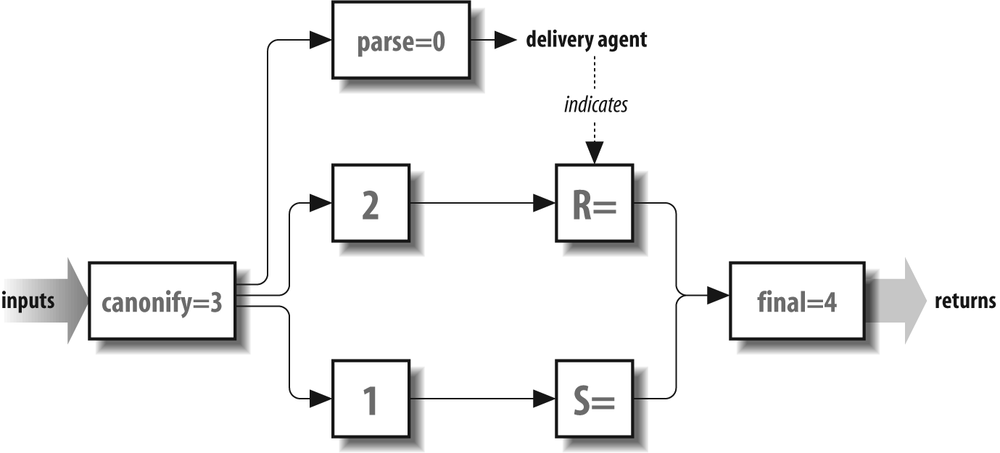
There are two forms for the R= delivery agent equate. One is the
standard form, and the other is an enhanced
alternative beginning with V8
sendmail:
R=ruleset             ← legal for all
R=eset/hset           ← legal beginning with V8
In the first case, ruleset
specifies the rule set to use in rewriting both
headers and the envelope. If that value is zero or
if the entire R=
delivery agent equate is missing, no rule set is
called.
In the second case, two rule sets can be
specified.[283] One rule set is specific to the
envelope, and the other is specific to headers. The
envelope-specific rule set is the one to the left of
the slash; the header-specific rule set is to the
right (R=eset/hset).
If both values are missing, both default to zero. If
only one is missing, the missing value defaults to
the other value.
Either rule set can be specified by using names or numbers, or both:
R=Myset                   ← name
R=12                      ← number
R=Myset=12                ← both
See Chapter 19 on page 683 for a description of possible errors and how the new V8.7 symbolic rule set names can be used.
Macros cannot be used in delivery agent rule set specifications. That is:
R=$X ← illegalwill not give the expected result. Instead, sendmail will complain about a missing rule set specification.
When using V8 sendmail’s
mc configuration, you cannot
change or specify R= rule sets. If the need arises,
however, you can copy an existing delivery agent
definition and then modify it as outlined in Tuning Without an Appropriate Keyword
on page 715.
r=
Maximum recipients per envelope V8.12 and later
Normally, sendmail limits the
number of outbound SMTP RCPT To: commands allowed per session
to the size of the DEFAULT_MAX_RCPT compile-time
macro (MAX... on page 120), which
is defined as 100 in
sendmail/conf.c. When
delivering an envelope,
sendmail will deliver only
the maximum number of recipients on the first try.
Any that are left over will be deferred until a
later delivery attempt (usually during the same
queue run).
One problem with piling many recipients into a single envelope is that some sites on the Internet refuse to accept mail when the envelope contains too many recipients. Another, but opposite, problem is that some sites can accept more than 100 recipients per envelope, and you would prefer to send them as many as they can handle in a single transaction.
One way to limit or expand the number of recipients
allowed in an envelope is to use this r= delivery agent
equate:
r=valIf val is set to a nonzero
value, it changes the limit on the number of
recipients allowed to the value specified. If
val is less than or
equal to zero, the limit is set to the value of the
DEFAULT_MAX_RCPT compile-time macro (MAX... on page 120).
Some delivery agents provide mc
macros with which to add an r= equate. For example, the following
mc configuration lines add
that default to the various smtp delivery agents:
define(`SMTP_MAILER_MAXRCPTS', `80')    ← this must be
MAILER(`smtp')                          ← before this
See the section describing a particular delivery agent
to find an appropriate mc macro
with which to redefine the r= for that delivery agent. See Table 20-1 on
page 717 for a guide to all delivery agents.
For some delivery agents, there are no
mc configuration macros
available to directly give a value to this r= equate. Instead, you
can use a bit of sleight of hand to add an r= to a particular
delivery agent:
define(`LOCAL_MAILER_PATH', `/usr/lib/mail.local, r=200')    ← this must be
MAILER(`local')                                              ← before this
The LOCAL_MAILER_PATH mc
configuration macro (Modify P= using an mc configuration
macro on page 750) is usually used to define the path
for the local
delivery agent. Instead of using it for that reason,
here we simply restate the path that appears in the
current sendmail.cf file, and
add the r=
declaration to that path. As with all modifications
of delivery agent equates, the modification must
precede the MAILER declaration for the corresponding
delivery agent.
S=
Sender rewriting rule set All versions
The S= delivery
agent equate specifies a rule set to be used for
processing both envelope- and header-sender
addresses. The sender’s address is given in the
envelope and generally repeated in the mail
message’s From:
header line.[284] The envelope sender address is given to
sendmail in one of four ways:
as a -f
command-line argument; as an SMTP MAIL From: command; as a
From: header;
or it can be derived from the identity of the user
who ran the program. (Note that the latter two are
used only during initial message submission.) Figure 20-2
shows how the S=
rule set fits into the flow of addresses through
rule sets.
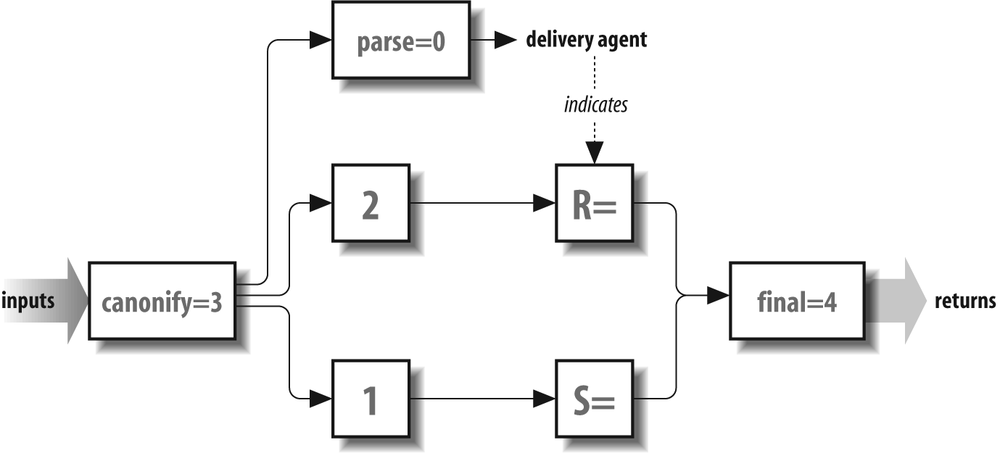
There are two forms for the S= delivery agent equate. One is the
standard form, and the other is an enhanced
alternative beginning with V8
sendmail:
S=ruleset             ← legal for all
S=eset/hset           ← legal beginning with V8
The first case specifies a rule set
(ruleset) that will
process both recipient and header addresses. If
ruleset is zero or if
the entire S=
delivery agent equate is missing, no rule set is
called.
In the second case, one rule set is specific to the
envelope, and the other is specific to headers. The
envelope-specific rule is the one to the left of the
slash; the header-specific rule is the one to the
right (S=eset/hset).
If both values are missing, no sender S= processing is done.
If only one is missing, the missing value defaults
to become the other value. (See Chapter 19 on page 683 for a description of possible errors
and how symbolic rule set names can be used.)
Either rule set can be specified using names or numbers or both:
S=Myset                   ← name
S=12                      ← number
S=Myset=12                ← both
See The S Configuration Command on page 683 for a discussion of the various legal ways rule sets can be specified.
Macros cannot be used in delivery agent rule set specifications. That is:
S=$X ← illegalwill not give the expected result. Instead, sendmail will complain about a missing rule set specification.
When using V8 sendmail’s
mc configuration, you cannot
change or specify S= rule sets. If the need arises,
however, you can copy an existing delivery agent
definition, and then modify it as outlined in Tuning Without an Appropriate Keyword
on page 715.
T=
Types for DSN diagnostics V8.7 and later
Beginning with V8.7 sendmail,
notification of successful, deferred, or failed
delivery is now done by using DSN (see RFC1891). The
T= delivery
agent equate provides three pieces of required
information to DSN. The pieces are separated by the
slash character:
T=mta-type/addr-type/diag-typeThe first piece, the
mta-type, is later
supplied to the Reporting-MTA: DSN header as its first
argument:
Reporting-MTA: dns; here.us.edu
               ↑
               mta-type here
The second piece, the
addr-type, is later
supplied to the Final-Recipient: DSN header as its
first argument:
Final-Recipient: rfc822; badname@here.us.edu
                 ↑
                 addr-type here
The third piece, the
diag-type, is later
supplied to the Diagnostic-Code: DSN header as its
first argument:
Diagnostic-Code: smtp; 550 <badname@here.us.edu>... User unknown
                 ↑
                 diag-type here
If the P= for a
delivery agent is [IPC], an undeclared
mta-type defaults to
dns, an
undeclared addr-type to
rfc822, and an
undeclared diag-type to
smtp. For any
other P= the
default for an undeclared entry is NULL.
In configuring with the m4
technique, the declarations of the T= delivery agent
equates are:
T=X-Phone/X-FAX/X-Unix          ← fax
T=DNS/RFC822/X-Unix             ← cyrus, cyrusv2, local, ph, pop, procmail, qpage
T=DNS/RFC822/SMTP               ← all SMTP and LMTP agents
T=X-Usenet/X-Usenet/X-Unix      ← Usenet
T=X-UUCP/X-UUCP/X-Unix          ← all UUCP agents
T=DNS/X-DECnet/X-Unix           ← mail11
T=X-Unix/X-Unix/X-Unix          ← prog
Other than for the local delivery agent, you cannot change
these T=
defaults. If the need arises, you can, however, copy
an existing delivery agent definition and then
modify it as outlined in Tuning Without an Appropriate Keyword
on page 715.
U=
Run agent as user-id:group-id V8.7 and later
Prior to V8.7, the user and group identities under
which sendmail ran were defined
by an elaborate set of properties (described under
the F=S delivery
agent flag in F=S on
page 780). Beginning with V8.7,
sendmail now offers the
U= delivery
agent equate as the means to define those
identities. If the U= delivery agent equate is specified,
it sets the default user and group identities for
the delivery agent and always overrides the values
of the DefaultUser option (DefaultUser on page 1000). If the
F=S delivery
agent flag is not set, any controlling user will
override this U=
delivery agent equate.
The form of the U=
delivery agent equate looks like this:
U=user:groupHere, user is the
alphanumeric identity of a user on the local system.
The user is looked up
with the method defined by the MailboxDatabase option
(MailboxDatabase on page
1042).[285] If user is
found, the numeric user-id
returned becomes the value used. Otherwise,
user, which must be
fully numeric, becomes the value used.
The colon,[286] if present, is followed by the
alphanumeric identity of a group on the local
system. If group is found
in the local group(5) file, the
numeric group-id from that file
is used. Otherwise,
group, which must be
fully numeric, becomes the value used. If the colon
and group are missing and if
user was found when
looked up, the value is taken from the
group-id returned by the
lookup.
Some delivery agents provide mc
macros with which to add a U= equate. For example, the following
mc configuration lines add
that default to the various cyrus delivery agents:
define(`CYRUS_MAILER_USER', `cyrus:nullmail')    ← this must be
MAILER(`cyrus')                                  ← before this
See the section describing a particular delivery agent
to find an appropriate mc macro
with which to redefine the U= for that delivery agent. See Table 20-1 on
page 717 for a guide to all delivery agents.
For some delivery agents, there are no
mc configuration macros
available to directly give a value to this U= equate. Instead, you
can use a bit of sleight of hand to add a U= to a particular
delivery agent:
define(`LOCAL_MAILER_PATH', `/usr/lib/mail.local, U=mail:mail')    ← this must be
MAILER(`local')                                                    ← before this
The LOCAL_MAILER_PATH mc
configuration macro (Modify P= using an mc configuration
macro on page 750) is usually used to define the path
for the local
delivery agent. Instead of using it for that reason,
here we simply restate the path that appears in the
current sendmail.cf file, and
add the U=
declaration to that path. As with all modifications
of delivery agent equates, the modification must
precede the MAILER declaration for the corresponding
delivery agent.
W=
Timeout for a process wait V8.10 and later
When sendmail delivers a message via a local program (such as mail.local, procmail, uux, and the like), sendmail will fork(2) and the child will execute the program. Delivery is usually a pipe connection between sendmail and the program.
Usually programs complete their jobs promptly, and exit. The exit(2) code produced by the program tells sendmail whether the program succeeded. Because the program must exit before sendmail can consider the delivery a success, sendmail must wait(2) for the program to exit.
Some programs, in some circumstances, will delay for an excessively long time before exiting. Consider, for example, the procmail delivery agent. If it is configured to allow delivery over NFS, and the NFS server goes down, the procmail delivery agent can hang for a very long time.
Whenever there is risk that a delivery agent might
hang because of system problems, you would be wise
to either eliminate that dependency or add this
W= delivery
agent equate to its definition. To add W= to
procmail, for example, you
can do the following in your
.mc configuration
file:
define(`PROCMAIL_MAILER_PATH', `/usr/local/bin/procmail, W=2m')
The argument following W= (the 2m) is a time expression as described
in Periodically with -q on page
427. Here, the 2m
means two minutes.
How a Delivery Agent Is Executed
For safety and efficiency, sendmail undertakes a complicated series of steps to run (execute) a delivery agent.[287] Some (such as setting the environment) are intended to improve security. Others (such as forking) are required so that sendmail can launch delivery agents. Here, we discuss those steps in the order in which they are taken by sendmail.
The Fork
When sendmail performs delivery, it cannot simply replace itself with the delivery agent program. Instead, it must fork(2), and the child will replace itself.
If sendmail is running in verbose mode (Verbose on page 1117), it shows that it is about to start this process:
Connecting to delivery agentIf a traffic-logging file was specified with the
-X command-line
switch (Log Transactions with -X on
page 512), sendmail appends the
following line to that file:
pid = == EXEC the expanded A= here
Here, the A=
delivery agent equate (A= on
page 738) from the delivery agent’s declaration is
printed with all its sendmail
macros expanded and with the recipients
listed.
Next, sendmail creates a
pipe so that it will be able
to print the email message to the delivery agent and
so that it can read errors emitted by the delivery
agent. See the -d11 debugging switch (-d11.1 on page 550) for a description
of what can go wrong.
If all has gone well, sendmail fork(2)s a copy of itself. The parent then pipes the email message to the child.
When the entire message has been sent, the parent then wait(3)s for the child to complete its work and exit(2)s. The parent collects the exit(2) value from the child and determines delivery success based on that exit value.
The Child
The child is the copy of sendmail that will transform into the delivery agent. Before the child can transform, it must perform a few more necessary steps.
If sendmail was compiled with HASSETUSERCONTEXT defined (HAS... on page 114), it calls setusercontext(3) like this:
setusercontext(NULL, pwd, user-id, LOGIN_SETRESOURCES|LOGIN_SETPRIORITY);Here, pwd is a pointer to a
structure of type passwd for
the user whose user-id is
user-id. The
user-id is that of the
controlling user (Delivery to Files on page 466) or the recipient (F=o on page 777).
The sendmail program next sets
its group-id as appropriate. If
the DontInitGroups option (DontInitGroups on page 1023) is false,
sendmail calls
initgroups(3). The group
identity used is that described under the DefaultUser option
(DefaultUser on page
1000).
If the /= delivery
agent equate (/=(forward slash) on page 737) has a non-NULL value,
sendmail calls
chroot(8) to change its
topmost directory into a private directory
tree.
If the N= delivery
agent equate (N= on page
748) has a nonzero value,
sendmail calls
nice(3) to “re-nice” the
delivery agent to that value.
The sendmail program then sets
its user-id. The user identity
used is chosen by the mailer F=S and U= equates and the
DefaultUser
option, as detailed in DefaultUser
on page 1000.
The sendmail program then
attempts to chdir(2) into one
of the directories listed in the D= delivery agent equate
(D= on page 741).
Next, sendmail dup(2)s the pipes created in the previous section.
Finally, sendmail calls setsid(2) to become a process-group leader and execve(2) to become the delivery agent. That latter call looks like this:
execve(agent, argv, envp);Here, agent is the full
path of the delivery agent as specified in the
P= delivery
agent equate (P= on page
748). The argument vector (the contents of the
A= delivery
agent equate with all the
sendmail macros expanded and
all the recipients added) is passed as
argv. The environment
is that originally given to
sendmail, massaged for
security and augmented by the E configuration command
(The E Configuration Command on
page 156).
If the execve(2) fails, the child exits with an appropriate error code.
Pitfalls
The
F=fandF=rdelivery agent flags are similar in their implementation but can differ in their result. Consider, for example, the SunOS 4.x version of /bin/mail. That program expects the-rcommand-line argument to specify the sender’s name. Setting theF=rdelivery agent flag correctly causes mail to be seen as being from the sender (-r sender), but mistakenly using theF=fdelivery agent flag invokes /bin/mail with-f senderinstead. This fails because the SunOS 4.x version of /bin/mail expects the-fcommand-line argument to mean that it should interactively read mail from the mailbox named sender.The
F=Cdelivery agent flag can cause problems when it is specified for delivery agents for which the @domain form of address is inappropriate. This delivery agent flag should be avoided for DECnet and thelocaldelivery agents. Note that LMTP-awarelocaldelivery agents that can handle domain addresses can use this delivery agent flag.A common problem with SysV versions of /bin/mail is their annoying habit of prefixing a "
From" line to the beginning of each message, even if one is already there. This confuses users because it makes their mail appear to come from uucp or daemon instead of the real sender. The problem stems from the fact that the SysV /bin/mail lacks a-rcommand-line argument (or its equivalent) to indicate who the sender is. Instead, that program assumes that the sender’s identity can be taken from the identity of the person who ran the program. This works correctly with local mail; but when mail comes in from the outside world, /bin/mail is being run by root, daemon, or uucp. The best fix is to get a newer /bin/mail[288] from one of the many anonymous FTP sites. A less satisfactory fix is to delete theF=ndelivery agent flag from the appropriate (usuallylocal) delivery agent. This leaves two "From" lines, the second prefixed with a > character (the correct line).Never use either the
F=for theF=rdelivery agent flags with theprogdelivery agent. That delivery agent usually runs programs by evoking the Bourne shell, which misinterprets both delivery agent flags. The-fcommand-line argument tells /bin/sh to disable filename generation. The-rcommand-line argument is unknown to /bin/sh. Both command-line arguments produce the wrong result.
Delivery Agent F= Flags
In this section, we detail each delivery agent flag. The complete list is shown in Table 20-19. They are presented in alphabetical order, where lowercase letters precede uppercase letters for each delivery agent flag.
When configuring with the mc technique, examine cf/README to determine which delivery agent flags are set by default for which delivery agents.
|
§ |
Meaning | |
|
|
F=% on page 761 |
Hold delivery until ETRN or |
|
|
F=0 (zero) on page 761 |
Turn off MX lookups for delivery agent (V8.8 and later). |
|
|
F=1 (one) on page 762 |
Don’t send null bytes (V8.10 and later). |
|
|
F=2 on page 763 |
Force SMTP even if ESMTP is offered (V8.12 and later). |
|
|
F=3 on page 763 |
Extend quoted-printable to EBCDIC (V8.7 and later). |
|
|
F=5 on page 764 |
Use the |
|
|
F=6 on page 764 |
Always strip headers to 7 bits (V8.10 and later). |
|
|
F=7 on page 764 |
Strip the high bit when delivering (V8.6 and later). |
|
|
F=8 on page 764 |
Force |
|
|
F=9 on page 765 |
Convert 7- to 8-bit if appropriate (V8.8 and later). |
|
|
F=: (colon) on page 765 |
Check for |
|
|
F=| (vertical bar) on page 765 |
Check for |program addresses (V8.7 and later). |
|
|
F=/ (forward slash) on page 766 |
Check for /file addresses (V8.7 and later). |
|
|
F=@ on page 766 |
User can be User Database key (V8.7 and later). |
|
|
F=a on page 767 |
Run extended SMTP protocol (V8.6 and later). |
|
|
F=A on page 767 |
User can be to the LHS of an alias (V8.7 and later). |
|
|
F=b on page 767 |
Add a blank line after message (V8.6 and later). |
|
|
F=B on page 768 |
Strip one leading backslash (V8.13 and later). |
|
|
F=c on page 768 |
Exclude comment from |
|
|
F=C on page 768 |
Add @domain to recipient. |
|
|
F=d on page 769 |
Never enclose route addresses in <> (V8.7 and later). |
|
|
F=D on page 769 |
Need |
|
|
F=e on page 770 |
Mark expensive delivery agents. |
|
|
F=E on page 770 |
Change extra |
|
|
F=f on page 771 |
Delivery agent adds |
|
|
F=F on page 771 |
Need |
|
|
F=g on page 771 |
Suppress |
|
|
F=h on page 772 |
Preserve uppercase in hostname. |
|
|
Reserved for Mail11v3 (preview headers). | |
|
|
F=i on page 772 |
User Database sender rewrite of envelope (V8.7 and later). |
|
|
F=I (uppercase i) on page 773 |
Send SMTP VERB to other site (deprecated). |
|
|
F=j on page 773 |
User Database rewrite of header recipient addresses (V8.7 and later). |
|
|
F=k on page 773 |
Don’t check for loops in EHLO command (V8.7 and later). |
|
|
F=l (lowercase L) on page 774 |
Agent performs local (final) delivery. |
|
|
F=L on page 775 |
Specify SMTP line limits (obsolete). |
|
|
F=m on page 775 |
Multiple recipients possible. |
|
|
F=M on page 776 |
Need |
|
|
F=n on page 776 |
Don’t use Unix-style |
|
|
Reserved for Mail11v3 (returns multistatus). | |
|
|
F=o on page 777 |
Always run delivery agent as recipient (V8.7 and later). |
|
|
F=p on page 777 |
Process return path per RFC821 (deprecated). |
|
|
F=P on page 777 |
Need |
|
|
F=q on page 778 |
250 versus 252 return for SMTP VRFY (V8.8 and later). |
|
|
F=r on page 778 |
Delivery agent adds |
|
|
F=R on page 779 |
Use a reserved TCP port (V8.6 and later). |
|
|
F=s on page 779 |
Strip quotation marks. |
|
|
F=S on page 780 |
Assume specified user-id and group-id (Revised for V8.7). |
|
|
F=u on page 780 |
Preserve uppercase for username. |
|
|
F=U on page 781 |
Use UUCP-style |
|
|
Reserved for SysVR4. | |
|
|
Reserved for UIUC. | |
|
|
F=w on page 781 |
Check for valid user identity (V8.7 and later). |
|
|
F=W on page 782 |
Ignore host status for this delivery agent (V8.13 and later). |
|
|
F=x on page 782 |
Need |
|
|
F=X on page 782 |
Delivery agent needs RFC2821 hidden dot. |
|
|
F=z on page 783 |
Deliver with LMTP (V8.9 and later). |
|
|
F=Z on page 783 |
Apply |
|
|
Reserved for SGI (check for valid home directory). |
F=%
Hold delivery until ETRN or -qI or -qR or -qS V8.10 and later
Ordinarily, outbound mail is dispatched as soon as it
is handed to sendmail. There
are times, however, when mail should not be sent
until it is asked for. Consider the typical ISP.
Clients who connect over dial-up lines are not
necessarily connected when mail arrives for delivery
to them. The F=%
delivery agent flag has been added to prevent
sendmail from trying to
discover if there is a connection.
The F=% delivery
agent flag, when set, prevents immediate delivery to
destination hosts. Instead,
sendmail queues all messages.
Each destination host must then request delivery
using the ETRN command (Process the queue via ESMTP ETRN on
page 433) after connecting. One way a client can
give the ETRN command is by using the
etrn.pl script supplied in
the contrib subdirectory of the
source distribution.
The local administrator can also cause delivery to
occur manually for specific clients with any of the
-qI, -qR, or -qS command-line
switches (Process by identifier/recipient/sender:
-q[ISR] on page 431). Note that a standard queue run (as
with -q) will not
send messages that have been deferred because of
this F=% delivery
agent flag.
F=0 (zero)
F= delivery agent flags:Turn off MX lookups for delivery agent V8.8 and later
During the delivery phase of a message, sendmail looks up the destination hostname with DNS and (possibly) redirects delivery to MX hosts, if present. One way (but not the best way) to suppress that MX lookup is to surround the destination hostname with square brackets:
% /usr/ucb/mail -v user@\[mail.us.edu\]Note that the square brackets are retained as part of the SMTP envelope:
RCPT To:<user@[mail.us.edu]> ← square brackets retainedThe F=0 delivery
agent flag is another way to suppress MX lookups. To
illustrate, consider using this delivery agent flag
with FEATURE(nullclient) (FEATURE(nullclient) on page 637):
FEATURE(`nullclient',`mail.us.edu')
Here, all mail will be forwarded to mail.us.edu. To suppress
MX lookups, we could surround the address with
square brackets:
FEATURE(`nullclient',`[mail.us.edu]')
But this is unattractive and unnecessary. Instead, we
use the F=0
delivery agent flag to achieve the same MX
suppression effect:
define(`SMTP_MAILER_FLAGS', `0')        ← prior to V8.10
define(`RELAY_MAILER_FLAGS', `0')       ← prior to V8.10

MODIFY_MAILER_FLAGS(`SMTP', `+0')       ← V8.10 and later
MODIFY_MAILER_FLAGS(`RELAY', `+0')      ← V8.10 and later

FEATURE(`nullclient',`mail.us.edu')
Note that the F=0
delivery agent flag is suitable only for
configurations such as nullclient. It can be extremely
dangerous to use with any other delivery agents
because it will cause necessary MX lookups to be
skipped.
F=1 (one)
Don’t send null bytes V8.10 and later
Prior to V8.10, sendmail would not screen header lines to make sure they contained no null (zero) bytes. Instead, such null bytes were passed through, and sometimes caused misinterpretation of addresses and the like.
It might seem impossible that a null byte could appear in a string, because the C-language string library routines use a null character to terminate all strings. But consider the case of a hexadecimal 0x80 character. Such a character has the high bit set, but when delivery is to a 7-bit-only site, sendmail will strip the high bit from 0x80, leaving behind a new 0x00 value in the middle of a string. A null byte!
Beginning with V8.10, sendmail
offers a way to strip such null bytes from headers
before sending those headers onward. The F=1 delivery agent flag,
when set, tells sendmail to
strip all null bytes that it finds from all headers.
Note that only the headers in the header portion of
the message are screened. MIME headers in the body
of the message are not screened.
The F=1 delivery
agent flag is not set by default for any delivery
agent. To add it, just use the MODIFY_MAILER_FLAGS
command (The MODIFY_MAILER_FLAGS mc macro on page 744). In the following, for example, we
add it to the smtp class of delivery agents:
MODIFY_MAILER_FLAGS(`SMTP', `+1')
In general, this delivery agent flag should be set for outbound delivery agents and for local, final delivery agents. In both, there is a small vulnerability to forgeries that use the hex 80 value. Consider:
From: friend0x80@spam.siteIf the 0x80 were to
be converted to a zero, the message might wrongly
appear to be from a friend on the local
machine.[289]
F=2
Force SMTP even if ESMTP is offered V8.12 and later
When sendmail connects to a remote site, it looks for a literal ESMTP string anywhere in the initial acceptance message:
220 wash.dc.gov ESMTP CommuniGate Pro 3.5.9
If the accepting site says that it can accept extended SMTP by including the ESMTP string, the local sendmail will answer with EHLO instead of HELO.
If you want to limit a particular delivery agent to
nonextended SMTP, no matter what the receiving site
says, you can do so by defining this F=2 delivery agent
flag:
MODIFY_MAILER_FLAGS(`SMTP', `+2')              ← this must be
MAILER(`smtp')                                 ← before this
Here, we add the F=2 delivery agent flag to the smtp class of delivery
agents. As with all modifications of delivery agent
flags, the modification must precede the MAILER
declaration of the delivery agent.
This F=2 flag is
most useful with broken MTAs and firewalls. When
sendmail connects to such a
broken site, that site will print ESMTP in its
greeting message. But that ESMTP is incorrect, and
when sendmail sends EHLO, the
broken site will reject the salutation and drop the
connection.
F=3
Extend quoted-printable to EBCDIC V8.7 and later
When sendmail is required to
convert a message body into quoted-printable form as determined by
the EightBitMode
option (EightBitMode on page 1025)
it ordinarily converts only those characters that
are required by RFC1521. Unfortunately, mail that is
transmitted to some IBM machines (specifically those
that speak EBCDIC instead of ASCII) can become
garbled because of the way EBCDIC represents (or
fails to represent) certain characters. Those
characters are:
! " # $ @ \ [ ] ^ ` { | } ˜When sending MIME mail to such sites, you should
probably set the F=3 delivery agent flag for any
delivery agents that handle those sites. Setting
this delivery agent flag tells
sendmail to encode those
characters, in addition to those normally encoded,
using quoted-printable.
Note that sendmail does this encoding only if 8-bit characters appear in the message. This delivery agent flag solves one EBCDIC problem but should not be thought of as a general solution for all EBCDIC problems.
F=5
Use localaddr rule set 5 after local aliasing V8.7 and later
Prior to V8.7 sendmail, only the
local delivery
agent could cause the localaddr rule set 5 to be called
(The localaddr Rule Set 5 on
page 700). The localaddr rule set 5 is called after
aliasing and before forwarding, and can be used to
select a new delivery agent. Beginning with V8.7,
any delivery agent with the F=A delivery agent flag set (F=A on page 767) can cause
an address to be looked up in the
aliases(5) file. Therefore,
any delivery agent that has the F=A and F=5 delivery agent flags
set will cause the localaddr rule set 5 to be called as
though the agent were the local delivery agent.
In configuration files prior to version 6 (The V Configuration Command on page
580), this delivery agent flag is automatically set
for the local
delivery agent. Note that addresses that (perhaps
artificially) begin with an @ character cause the localaddr rule set 5 to
be skipped (The localaddr Rule Set 5 on page 700).
F=6
Always strip headers to 7 bits V8.10 and later
Older versions of sendmail strip
only the high bit from header characters when
transmitting an 8-bit message to a 7-bit-only site.
Beginning with V8.10 sendmail,
it is possible to use this F=6 delivery agent flag to force
sendmail to always strip the
high bit from all header characters, no matter
what.
This F=6 delivery
agent flag is not set by default for any delivery
agent.
F=7
Strip the high bit when delivering V8.6 and later
Under old versions of sendmail,
all lines of text output by
sendmail (including the
header and body of a message) automatically have the
high bit cleared (zeroed) for every character. This
behavior remains unchanged under V8
sendmail for configuration
file versions 2 or less (The V Configuration Command on page
580). But with version 3 and later configuration
files, the message body is transmitted with the high
bit intact by default. For those delivery agents
that should not allow 8-bit data to be transmitted,
you can use the F=7 delivery agent flag to force the
old behavior.
Beginning with V8.7, the F=7 delivery agent flag can be used to
suppress certain kinds of MIME conversions. For
example, if the EightBitMode option (EightBitMode on page 1025) is set to
p (pass 8) and
if the message contains 8-bit MIME data in its body,
this F=7 delivery
agent flag will force sendmail
to bounce the message with the following SMTP error,
and to exit with EX_DATAERR:
554 5.6.3 Cannot send 8-bit data to 7-bit destination
Note that F=7
affects only the message body. Headers always have
the high bit cleared.
F=8
Force EightBitMode=p MIME encoding V8.7 and later
Beginning with V8.7 sendmail, you
can set the EightBitMode option (EightBitMode on page 1025) to m (mimefy) to force all
unlabeled 8-bit mail to be converted into
MIME-labeled mail.
You can suppress this conversion for particular
delivery agents by specifying the F=8 delivery agent flag.
This form of suppression has the effect of setting
the EightBitMode
option to p
(pass8) for an individual delivery agent.
F=9
Convert 7- to 8-bit if appropriate V8.8 and later
The F=9 delivery
agent flag causes the MIME message body of a
delivered message to be converted back from either
quoted-printable or base64 into its original
8-bit form. The F=9 delivery agent flag is effective
only if sendmail was compiled
with MIME7TO8 defined (MIME7TO8 on
page 123).
Conversion works only on single-part MIME messages. If
the Content-Type:
header is other than text/plain, no conversion is done.
Otherwise, the Content-Transfer-Encoding: header is
examined. If the Content-Transfer-Encoding: header type
is base64,
conversion is done from base64 to 8-bit. Otherwise, if the
Content-Transfer-Encoding: header type
is quoted-printable, conversion is done
from quoted-printable to 8-bit. If the
Content-Transfer-Encoding: header type
is neither, no conversion is done.
F=: (colon)
Check for :include: files V8.7 and later
Prior to V8.7 sendmail, only the
local delivery
agent could recognize the :include: directive for creating
mailing lists (:include: Mailing Lists on
page 486).
Beginning with V8.7, any delivery agent can be made to
recognize the :include: directive by setting the
F=: delivery
agent flag (or to ignore it by not setting the
F=: delivery
agent flag). This delivery agent flag allows you to
design a local
delivery agent without :include: support or local-type clones
with :include:
support. In configuration files prior to version 6
(The V Configuration Command on
page 580), this delivery agent flag is automatically
set for the local
delivery agent.
This delivery agent flag is legal only for addresses
contained in ~/.forward files
or aliases(5) databases. Any
:include:
address in an SMTP dialog or on the command line
will be rejected.
F=| (vertical bar)
Check for |program addresses V8.7 and later
Prior to V8.7 sendmail, only the
local delivery
agent could recognize the | character as a directive to pipe the
mail message through a program (see Delivery Via Programs on page 468 and
Piping Through Programs on page
504).
Beginning with V8.7, any delivery agent can be made to
accept the leading | character. If the F=| delivery agent flag
is present, the delivery agent will accept the
leading |
character and call the prog delivery agent to pipe the message
through a program. If the delivery agent flag is
absent, this ability to pipe is prohibited. In
general, the F=|
delivery agent flag should be present for the
local and
local-clone delivery agents but absent for all
others. In configuration files prior to version 6
(The V Configuration Command on
page 580), this delivery agent flag is automatically
set for the local
delivery agent.
This delivery agent flag is legal only for addresses
contained in ~/.forward files
or aliases(5) databases. Any
|program
address in an SMTP dialog or on the command line
will be rejected.
F=/ (forward slash)
Check for /file addresses V8.7 and later
Prior to V8.7 sendmail, only the
local delivery
agent could recognize a leading / character as a
directive to append the mail message to a file (see
Delivery Via Programs on page
468 and Piping Through Programs on
page 504).
Beginning with V8.7, any delivery agent can be made to
accept the leading / character. If the F=/ delivery agent flag
is present, the delivery agent will accept a leading
/ character and
call the *file*
delivery agent to append the mail message to a file.
If the delivery agent flag is absent, this ability
to append is prohibited. In general, the F=/ delivery agent flag
should be present for the local and local-clone delivery agents
but absent for all others. In configuration files
prior to version 6 (The V Configuration Command on page
580), this delivery agent flag is automatically set
for the local
delivery agent.
This delivery agent flag is legal only for addresses
contained in ~/.forward files
or aliases(5) databases. Any
/
file address in an SMTP
dialog or on the command line will be
rejected.
F=@
User can be User Database key V8.7 and later
When V8.7 or above sendmail has
been compiled with User Database support (userdb on page 942) you can
specify this delivery agent flag for a delivery
agent and thereby cause that delivery agent to
perform a User Database lookup for each address it
handles. For sender header and envelope addresses, a
User Database mailname keyword is used to perform
reverse aliasing. For recipient envelope addresses,
a User Database maildrop keyword is used to perform
additional forward aliasing.[290] Note that any address with a leading
@ character (in
the $: part of
the triple returned by the parse rule set 0) causes User Database
lookups to be skipped. Also note that the absence of
an F=i delivery
agent flag (F=i on page
772) suppresses User Database rewriting of the
envelope sender.
If the F=@ delivery
agent flag is present, the delivery agent will try
to use the User Database. If the F=@ delivery agent flag
is absent, all User Database lookups are skipped. In
general, this delivery agent flag should be present
for the local and
local-clone delivery agents but absent for all
others. In configuration files prior to version 6
(The V Configuration Command on
page 580), this delivery agent flag is automatically
set for the local
delivery agent.
F=a
Run extended SMTP protocol V8.6 and later
Most old versions of sendmail run
only basic SMTP defined in RFC821. In 1993, that
service was extended by RFC1425 (obsoleted by
RFC1869) to become Extended SMTP (ESMTP). Beginning
with V8 sendmail, you can
enable a delivery agent to use ESMTP by specifying
the F=a delivery
agent flag. This causes
sendmail to first try to use
the extended form of the HELO command, called EHLO.
If that fails to be acknowledged as OK,
sendmail tries again with
nonextended SMTP. If the initial SMTP server
greeting includes a line containing the word ESMTP,
the F=a delivery
agent flag is assumed. (See also the F=2 flag, F=2 on page 763.)
F=A
User can be to the LHS of an alias V8.7 and later
Prior to V8.7 sendmail, only the
local delivery
agent could cause addresses to be looked up in the
aliases(5) database (Local Must Be Local on page 462).
Beginning with V8.7 sendmail,
any delivery agent that has an F=A delivery agent flag
set will cause its $: address to be looked up on the
lefthand side of the aliases(5)
file.
For example, the F=A delivery agent flag can be used to
design a local-clone delivery agent that recognizes
certain nonlocal addresses as local for aliasing
purposes:[291]
R$+ <@ FIRE.WALL> $#firelocal $: $1@fire.wall
This allows an alias file such as the following to legally exist:
George.Washington@fire.wall: gw@internal.net
For example, as a safety net (and if the F=5 delivery agent flag
is also specified), any address that is not found in
the aliases(5) database will be
passed to the localaddr rule set 5 (The localaddr Rule Set 5 on page 700)
where another delivery agent can be selected.
In configuration files prior to version 6 (The V Configuration Command on page
580), the F=A
delivery agent flag is automatically set for the
local delivery
agent.
F=b
Add a blank line after message V8.6 and later
Some Unix mailbox formats require a blank line at the
end of one message and before the start of the next
message. If your local version of
/bin/mail does not ensure
that this blank line exists, you can use the
F=b delivery
agent flag. If this delivery agent flag is specified
and if the message being sent to the delivery agent
lacks a blank line at the end,
sendmail adds one. This
delivery agent flag is also appropriate for use with
the *file*
delivery agent.
F=B
Strip one leading backslash V8.13 and later
The F=s
delivery-agent flag (F=s on
page 779) causes sendmail to dequote the recipient’s
address before passing it to the selected delivery
agent. Dequoting causes all quotation marks (“) and
all leading backslashes (\) to be removed. But when
a lighter touch is needed, you may use this F=B flag instead, which
just removes all leading backslashes. For
example:
"\\\user"@relayhost    with F=s becomes
    user@relayhost
"\\\user"@relayhost    with F=B becomes
   "user"@relayhost
Note that because F=B is a subset of F=s, we discourage you
from using both flags at the same time.
F=c
Exclude comment from $g in headers V8.6 and later
Ordinarily, sendmail tries to
preserve all RFC2822 comments in sender addresses
(Comments in the Header Field on
page 1125). Beginning with V8.7, however,
RFC2822-style comments can be stripped by setting
this F=c delivery
agent flag. (An RFC2822-style comment is one in
parentheses or text outside angle brackets.) The
sender address, always without a comment and
stripped of angle brackets, is placed into $g ($g on page 824) and is used with
the -f or
-r arguments to
A= (F=r on page 778). In assembling
headers, the comment is ordinarily restored to
$g; but if this
F=c delivery
agent flag is set, the comment is left out.
The main use for this delivery agent flag is to supply
just the address to programs that cannot handle
anything else.[292] Another use might be to suppress
disclosure of potentially proprietary information.
By adding F=c to
the smtp delivery
agent, for example, you can cause sender headers
that are defined with $g to go out without RFC2822
comments:
From: George Washington (The Prez!) <CX75G@fire.wall>    ← without F=c
From: CX75G@fire.wall                                    ← with F=c
Note that this does no good at all if users send out mail with disclosing headers already present, or if they give out information in signature lines.
F=C
Add @domain to recipient All versions
The F=C delivery
agent flag causes sendmail to
append an @domain extension to
any recipient address that lacks one after having
been rewritten by the canonify rule set 3. The
@domain that is added is
copied from the envelope sender’s address.
This F=C delivery
agent flag is not looked for in the delivery agent
definition that was selected to send the message.
Rather, it is looked for in the delivery agent that
would be selected if the sender were the recipient
(as in the case of bounced mail).
To illustrate, consider the following mail:
From: bill@oursite.edu
To: john@remotesite.gov, alice
The recipient address alice lacks an
@domain specification. The
sendmail program processes
the envelope sender address bill@oursite.edu to decide on a
delivery agent definition that can be used if this
mail needs to be returned. If that envelope sender’s
return mail delivery agent has the F=C delivery agent flag
set, the @oursite.edu part of the envelope
sender’s address is appended to alice:
From: bill@oursite.edu
To: john@remotesite.gov, alice@oursite.edu
The F=C delivery
agent flag is traditionally used for the smtp class of delivery
agent that is supposed to always supply an
@domain part for all
addresses.
Note that the domain part of the envelope sender is used. In our example, the envelope and header sender are the same.
See also FEATURE(always_add_domain) (FEATURE(always_add_domain) on page 616).
F=d
Never enclose route addresses in <> V8.7 and later
Ordinarily, V8 sendmail forces
envelope-sender route addresses[293] to be enclosed in angle brackets. But
beginning with V8.7 sendmail,
angle brackets can be omitted by specifying F=d.
Under some circumstances, it is possible for these
angle-bracketed addresses to be given to a shell,
causing them to be wrongly viewed as I/O
redirection. This problem is most common with the
UUCP and prog
delivery agents.
F=D
Need Date: in header All versions
The F=D delivery
agent flag is used by
sendmail.cf header commands
to force the inclusion of date information:
H?D?Resent-Date: $a
H?D?Date: $a
The F=D delivery
agent flag has no special internal meaning to
sendmail. It is a convention
that is used only in the assorted Date: (Date: on page 1155) header
definitions. See F= on page
743 for a general description of this
process.
F=e
Mark expensive delivery agents All versions
The sendmail.cf
HoldExpensive
option (HoldExpensive on page
1036) tells sendmail not to
connect to expensive delivery agents. Instead, mail
destined for those agents is queued for later
delivery. This F=e delivery agent flag marks a
delivery agent as expensive.
For example, consider a site connected to the Internet over a dial-on-demand ISDN link that costs lots of money per minute. Such a site might want all the Internet mail to be queued and would arrange for that queue to be processed only once every other hour.
Under V8 sendmail, verbose output
(watch delivery) cancels the effect of the F=e delivery agent flag
(suppresses queueing).[294] Verbose output is set with the -v command-line switch
(-v on page 249) or the
Verbose option
(Verbose on page 1117).
F=E
Change extra From into >From All versions
Many Unix mail-reading programs, such as
/usr/ucb/Mail, require that
each mail message in a file of many mail messages be
delimited from the others by a blank line, and then
a line that begins with the five characters
"From“:
and thanks again. -- bill               ← one message ends
                                        ← a blank line
From george Fri Dec 13 12:03:45 2002    ← next message starts
This means that any given mail message can have only
one line in it that begins with the five characters
"From“. To
prevent such lines from being improperly fed to such
mail delivery agents, sendmail
offers the F=E
delivery agent flag. This delivery agent flag tells
sendmail to insert a >
character at the front of all but the first such
lines found. Consider the following:
From tim@here.us.edu Fri Dec 13 13:00:03 2002
From now on, let's meet on Saturdays instead of Tuesdays,
like we discussed.
If the F=E delivery
agent flag is specified for the delivery agent that
delivers the preceding message,
sendmail converts it to
read:
From tim@here.us.edu Sat Dec 14 13:00:03 2002

>From now on, let's meet on Saturdays instead of Tuesdays,
like we discussed.
This F=E delivery
agent flag is rarely needed, and is routinely
included only with the *file* delivery agent. Usually, the
program specified by the local delivery agent definition handles
From line
conversions. This delivery agent flag should be used
only with delivery agents
that handle final local delivery.
F=f
Delivery agent adds -f to argv All versions
If sendmail is run with a
-f command-line
switch (-f on page 241) and if
the F=f delivery
agent flag is specified, the A= for this delivery
agent will have the two additional arguments
-f and $g inserted between its
argv[0] and
argv[1]. For
example, if sendmail is run
as:
/usr/lib/sendmail -f jim host!bill
and if the delivery agent for sending to host is defined
as:
Muucp, P=/bin/uux, F=fmsDFMhuU, S=13, R=23, A=uux - -r $h!rmail ($u)
the f in F=fmsDFMhuU causes the
A= of:
A=uux - -r $h@rmail ($u)
to be rewritten as:
A=uux -f $g - -r $h@rmail ($u)
Here, $g is
jim from the
original command line (but rewritten to be a return
address relative to the recipient). The original
-f argument
jim is first
rewritten by the canonify rule set 3, the rule set 1,
and then the final rule set 4. The result of those
rewrites is placed into $f. The $f
sendmail macro is rewritten by
the canonify rule
set 3, the rule set 1, the S= rule set, and then the final rule set 4, and
the result is placed into $g. ($f and $g are described in $g on page 824.)
Note that the F=f
and the F=r
delivery agent flags are very similar and easily
confused.
F=F
Need From: in header All versions
The F=F delivery
agent flag is used by
sendmail.cf header commands
to force the inclusion of sender (From) information (F= on page 743):
H?F?Resent-From: $q
H?F?From: $q
The F=F delivery
agent flag has no special internal meaning to
sendmail. It is a convention
that is used only in the assorted From: (From: on page 1157) header
definitions. See F= on page
743 for a general description of this
process.
F=g
Suppress From:<> V8.6 and later
The special address <> is used as the envelope sender
when sendmail bounces a mail
message. This address is intended to prevent bounced
messages from bouncing. Unfortunately, not all
configuration files properly handle this form of
sender address. The stock SunOS configuration files
prior to Solaris 2.3, for example, caused
sendmail to enter an endless
loop when processing <>. Also, some UUCP
implementations get confused when they are executed
with command-line arguments of:
-f <>
As an interim measure, until all programs learn to
correctly handle the <> address, you can use the
F=g delivery
agent flag to suppress that address for selected
delivery agents. If the F=g delivery agent flag is set for a
delivery agent, it uses the value of $g ($g on page 824) in place of the
<>, where
$g contains
$n (usually
MAILER-DAEMON, $n on page
836) with an @
and the local domain name appended.
F=h
Preserve uppercase in hostname All versions
Some delivery agents, such as those that deal with
files, require that the recipient’s hostname be left
as is. The hostname portion of the recipient’s
address is ordinarily converted to lowercase before
being tucked into $h. Specifying the F=h delivery agent flag
tells sendmail to not convert
that address to lowercase.[295]
The $h
sendmail macro ($h on page 825) is usually used
with the A=
delivery agent equate of a delivery agent. For
example:
Muucp, P=/usr/bin/uux, F=msDFMhuU, A=uux - -r $h!rmail ($u)
                              ↑
                            note
Here, the h in
F=msDFMhuU
tells sendmail to leave the
$h alone and
not to convert the hostname
in that sendmail macro to
lowercase.
F=i
User Database sender rewrite of envelope V8.7 and later
The F=@ delivery
agent flag (F=@
on page 766) allows all addresses for a given
delivery agent to be rewritten by the User Database
(userdb on page 942). The
F=i delivery
agent flag either suppresses that rewrite for the
sender envelope (if absent) or allows that rewrite
for the sender envelope (if present). For example,
consider mail from the user jane:
MAIL From:<jane>        ← SMTP envelope sender
From: jane              ← header sender
Now assume that a User Database entry such as the following exists:
jane:mailname Jane.Doe
If the F=i delivery
agent flag is absent but the F=@ delivery agent flag
is present, the envelope-sender address will remain
unchanged, but the header-sender address will be
rewritten by the User Database:
MAIL From:<jane>        ← SMTP envelope sender
From: Jane.Doe          ← header sender
But if both the F=i
and F=@ delivery
agent flags are present, the envelope- and
header-sender addresses will both be rewritten by
the User Database:
MAIL From:<Jane.Doe>    ← SMTP envelope sender
From: Jane.Doe          ← header sender
F=I (uppercase i)
Send SMTP VERB to other site All versions, deprecated
The F=I delivery
agent flag tells the local
sendmail to send the
following VERB[296] SMTP command to the receiving
sendmail:
VERB                                  ← ours sends
200 2.0.0 Verbose mode                ← recipient replies
The VERB SMTP
command causes the receiving
sendmail to go into verbose
mode and to set its deliver
mode to interactive. This has
the same effect as would occur if the receiving
sendmail had been run with
the command-line options -v and -odi set.
The F=I delivery
agent flag is intended as an aid in debugging a
remote receiving site’s
sendmail. The VERB SMTP command causes
that remote site to run in verbose mode. By
temporarily adding the F=I delivery agent flag to a delivery
agent’s definition and then running
sendmail locally with the
-v command-line
argument, you can watch both the local and the
remote site’s verbose output. Each line of the
remote site’s verbose output will be seen locally,
prefixed with 050.
Note that if the PrivacyOptions option on the remote
site’s sendmail is set to
noexpn (PrivacyOptions=noexpn on page
1067) or noverb
(PrivacyOptions=noverb on
page 1068), that site’s response to the VERB SMTP command will
be this rejection:
502 5.7.0 Verbose unavailable
Also note that if the other side is not running sendmail, you might see other errors:
501 No argument given in VERB command.  ← PMDF V5.0
250 Ok                                  ← post.office v1.9.1 (but ignores the
request)
In both of these cases, the request to the other machine to go into verbose mode has failed.
F=j
User Database rewrite of header recipient addresses V8.7 and later
If sendmail was compiled with
User Database support (userdb
on page 942) and if that database is being used
(UserDatabaseSpec on page 1116),
you can have sendmail rewrite
header recipient addresses using that database. The
F=j delivery
agent flag tells sendmail to
look up recipient addresses in the User Database
(using the mailname keyword). If an appropriate
entry is found, it is used in place of the original
address in the recipient headers. The process is the
same as that described for the F=i delivery agent flag,
except that it is used here for recipient
headers.
F=k
Don’t check for loops in EHLO/HELO V8.7 and later
When another host connects to the local host and that
other host claims to have the same canonical name as
the local host, it should be considered an error. In
V8.6 sendmail, setting the
CheckLoopBack
variable in conf.c determined
whether this error was detected. But beginning with
V8.7 sendmail, this check is
based on the delivery agent. If the F=k delivery agent flag
is absent, the check is done. If the F=k delivery agent flag
is present, the check is skipped.
The check is performed only for SMTP connections. The literal canonical name given in the connecting host’s HELO or EHLO response is compared to the canonical name for the local host. If they are the same, the following error is printed, and the connection is disallowed:
553 5.3.5 host config error: mail loops back to myself            ← V8.6
553 5.3.5 host config error: mail loops back to me (MX problem?) ← V8.7 and later
Here, host is the name of the offending host.
A problem can arise at sites that run two different
invocations of sendmail (one
for SMTP connections and another for command-line
invocation, where each uses a different
configuration file). In this instance, when the
latter connects to the former, this error can occur.
Such sites might find it necessary to set the
F=k delivery
agent flag for the delivery agent that handles SMTP
connections (usually smtp). With an mc
configuration, the following command does just
that:
define(`SMTP_MAILER_FLAGS',`k')                ← prior to V8.10
MODIFY_MAILER_FLAGS(`SMTP', `+k')              ← V8.10 and later
MAILER(`smtp')                                 ← must be last
Note that sendmail must recognize
its local hostname among many possible names. See
$=w on page 876 for
a discussion of $=w and MX records.
F=l (lowercase L)
Agent performs local (final) delivery All versions
The F=l delivery
agent flag tells sendmail that
this delivery agent will be performing final
delivery (usually on the local machine). This
notification affects sendmail’s
behavior in five ways.
First, it enables the DSN notify-on-success mechanism.[297] That is, if the message were received via SMTP with the envelope:
RCPT To: <user@here.us.edu> NOTIFY=SUCCESS
or via the command line with a -Nsuccess command-line
switch, sendmail (upon final
local delivery) returns to the original sender an
email message acknowledging receipt. This mechanism
should be used sparingly.
Second, the F=l
delivery agent flag allows
sendmail to ignore any host
part of the triple returned by the parse rule set 0.
Ordinarily, the $@ operator must appear in the RHS for
all delivery agents selected. If no host is selected
by $@,
sendmail prints this error
and bounces the message:
554 5.3.5 buildaddr: no host
But because the host is not always needed for final
delivery, the presence of the F=l delivery agent flag
tells sendmail to silently
ignore a missing host part.
Third, the F=l
delivery agent flag influences how undeliverable
mail will be handled. When the ErrorMode option (ErrorMode on page 1028) is q (quiet), such mail is
usually reported in the
sendmail program’s
exit(2) status (sendmail’s exit( ) Status on
page 228). With the F=l delivery agent flag set for the
envelope sender address, the undeliverable message
will instead be appended to
~/dead.letter for a local
sender or mailed back for a remote sender.
Fourth, the F=l
delivery agent flag allows the address in the
From: header to
be compared to the address that
sendmail would create if it
was going to add the From: header. If the two addresses are
the same, the From: header is dropped and a new one
is created. This allows
sendmail to correct for
mh(1), which sometimes fails
to add full name information.
Fifth, if the sender address selects a delivery agent
with this F=l
flag set, and if the sender changed the sender
address using a -f command-line switch, and if the
sender’s name is not found in the class $=t,
sendmail will issue the
following X-Authentication-Warning:
header:
X-Authentication-Warning: sender set sender to new address using -f
In general, the F=l
delivery agent flag should always be specified for
the local,
prog, and
*file* delivery
agents.
Note that the processing of a user’s
~/.forward file is no longer
tied to the local
delivery agent, nor to this F=l delivery agent flag. The ability to
look in a user’s ~/.forward
file is now determined by the F=w delivery agent flag
(F=w on page 781).
F=L
Specify SMTP line limits Obsolete as of V8.8
Prior to V8.8 sendmail, this
F=L delivery
agent flag caused sendmail to
split output lines in the message body so that they
did not exceed 990 characters, and always caused
sendmail to clear the most
significant bit of the characters in those
lines.
Beginning with V8.8 sendmail,
F=L emulates
this old behavior under certain conditions. F=L causes
sendmail to assign L= a default value of
990, if it is missing one (L= on page 745), and (if the configuration file
level is 1 or less) to set the F=7 delivery agent
flag.
F=m
Allow delivery to multiple recipients All versions
Whenever the sendmail program
executes the program specified by the P= delivery agent equate
(P= on page 748), that
program is given its argv vector as specified by the
A= delivery
agent equate (A= on page
738). As the last step in building that argv,
sendmail appends one or more
recipient addresses.
The decision as to whether it appends one address or
many is determined by the F=m delivery agent flag. If this flag
is absent, the delivery agent is given only one
recipient. Otherwise, if it is present, the delivery
agent can be given many recipients (subject to any
limitation imposed by the MaxRecipientsPerMessage option, MaxRecipientsPerMessage on page 1050).
In either case, if there are more recipients than
argv can
accept, the delivery agent is rerun as many times as
is necessary to handle them all.
Note that sendmail is able to distinguish only between failures involving one, many, or all of the recipients when it is delivering with SMTP or LMTP. Otherwise, it judges delivery as successful if a zero exit(2) value is returned by a delivery agent. If the delivery agent fails to deliver to one of many recipients, it exits with a nonzero value, and because of that single failure, sendmail will presume that delivery to all recipients failed. If the error is temporary, this can result in duplicate delivery to each recipient listed prior to the bad recipient.
F=M
Need Message-ID: in header All versions
The F=M delivery
agent flag is used by
sendmail.cf header commands
to force the inclusion of message identification
information (F= on page
743):
H?M?Resent-Message-ID: <$t.$i@$j>
H?M?Message-ID: <$t.$i@$j>
The F=M delivery
agent flag has no special internal meaning to
sendmail. It is a convention
that is used only in the assorted Message-ID: (Message-ID: on page 1159) header
definitions. See F= on page
743 for a general description of this
process.
Note that the Message-ID: header definition should
always be included in the
sendmail.cf file because many
software packages expect the presence of that
header.
F=n
Don’t use Unix-style From in header All versions
The Unix-style mailbox (a single file into which many
mail messages are placed) requires that each message
be separated from the others by a blank line,
followed by a line that begins with the five
characters "From“:
and thanks again. -- bill                  ← one message ends
                                           ← a blank line
From george Fri Dec 13 12:03:45 2002       ← next message starts
Ordinarily, sendmail adds a
five-character "From" line to a message if there isn’t
one. The F=n
delivery agent flag prevents
sendmail from doing this. It
is intended for use when not dealing with a
Unix-style mailbox, or when dealing with a delivery
agent that adds the blank line and "From" by itself.
Note that if the F=U delivery agent flag is specified
(but not F=n),
the five-character UUCP-style "From" header line is
created, and the words remote from $g are appended to that
line. The F=n
delivery agent flag should
always be specified for SMTP
delivery agents. The five-character "From" line is not a
valid RFC2822 header (because it lacks a colon) and
is not permitted.
Apart from SMTP, the use of the F=n delivery agent flag
is best determined on a case-by-case basis. Some
delivery agents always generate a "From" line, so the
F=n delivery
agent flag can be used to avoid duplication. Some
delivery agents generate a "From" line only if there is not already
one there, so the F=n delivery agent flag is optional and
perhaps best omitted. Some delivery agents never
generate a "From"
line, yet require one (such as the
uux program); for these the
F=n delivery
agent flag should always be omitted.
F=o
Always run delivery agent as recipient V8.7 and later
Under certain circumstances, before
sendmail delivers to a file
or through programs, it can assume the identity
(user-id and
group-id) of the controlling
user (see Delivery to Files on
page 466 for a description of this process).
Beginning with V8.7, the F=o delivery agent flag changes this
behavior. Specifying the F=o delivery agent flag causes
sendmail to assume the
identity of the recipient. Omitting the F=o delivery agent flag
causes sendmail to assume the
identity of the controlling user where appropriate.
(See also the F=S
flag [F=S on page 780]
as a way to have sendmail
assume specified user-id and
group-id identities.)
In V5 and earlier configuration files (The V Configuration Command on page
580), this delivery agent flag is automatically set
for the prog and
*file* delivery
agents. Note that the U= delivery agent equate (U= on page 755), when specified,
always overrides the controlling user.
F=p
Process return path per RFC821 Deprecated
The SMTP MAIL From:
command normally uses the envelope address for the
sender:
MAIL From:<jqp@wash.dc.gov>
If the F=p delivery
agent flag is specified,
sendmail instead sends a
transformed version of that address. The
transformation can take one of two forms, depending
on the first character of the envelope address. If
that address begins with an @ character, an @, the local host name,
and a comma are prefixed to that address to create a
legal return path:
<@hub:jqp@wash.dc.gov>
  ↓
becomes
  ↓
<@ourhost,@hub:jqp@wash.dc.gov>
If the envelope address for the sender does not start
with an @
character, an @,
the local host name, and a colon are prefixed to
that address:
<jqp@wash.dc.gov> becomes <@ourhost:jqp@wash.dc.gov
See also the DontPruneRoutes option (DontPruneRoutes on page 1024).
Note that these forms of address transformations are
discouraged by RFC1123. For this reason, the
F=p delivery
agent flag is deprecated and might be removed from
future versions of
sendmail.
F=P
Need Return-Path: in header All versions
The F=P delivery
agent flag is used by
sendmail.cf header commands
to force the inclusion of return-path
information:
H?P?Return-Path: <$g>
The F=P delivery
agent flag has no special internal meaning to
sendmail. It is a convention
that is used only in the assorted Return-Path: (Return-Path: on page 1165) header
definitions. See F= on page
743 for a general description of this
process.
The sender’s envelope address (the address that would
be used to return mail if it were bounced, for
example) is placed into $g for use in the Return-Path: header
line. This is usually done during final delivery,
although it can also be done for delivery agents
that lack a clear envelope address. The form of the
address in the $g
sendmail macro ($g on page 824) depends on the
setting of the F=p delivery agent flag. Note that this
is normally the same as the address in the five
character "From"
line.
This F=P flag
should be used only with delivery agents that
perform final delivery (such as local, prog, and *file*) and which do not
add their own Return-Path: header. This F=P flag should not be
used for any delivery agent that delivers using
SMTP.
F=q
250 versus 252 return for SMTP VRFY V8.8 and later
Prior to RFC1123, a successful reply to the SMTP VRFY command was always prefixed with a 250, meaning that sending to this address was likely to result in successful delivery:
VRFY user
250 user@here.us.edu (Full Name)
Here, sendmail states (with the
250) that it
interpreted the address as valid
locally and that delivery or relaying
to another site would be attempted.
RFC1123 now requires that shades of meaning be conveyed in that success code, so the correct prefix should be 252, which means that the host will accept the address and might attempt to relay it elsewhere.
If the F=q delivery
agent flag is set, sendmail
returns the 250 prefix; otherwise, it returns the
252 prefix. It should be set only for delivery
agents doing local delivery. For configuration files
earlier than version 7, the F=q delivery agent flag is
automatically set for the local, prog, and *file* delivery agents.
F=r
Delivery agent adds -r to argv All versions
If sendmail is run with a
-f command-line
argument, and if the F=r delivery agent flag is specified,
the A= for this
delivery agent has the two additional arguments,
-r and $g, inserted between its
argv[0] and
argv[1].
Consider a case in which sendmail is run as:
/usr/lib/sendmail -f jim bill
If bill is a local
user and the delivery agent for local is defined
as:
Mlocal, P=/bin/mail, F=r
lsDFMmnP, S=10, R=20, A=mail -d $u
                       ↑
                     note
the r in F=rlsDFMmnP will cause the
A= of:
A=mail -d $u
to be rewritten as:
A=mail -r $g -d $uThe $g is jim from the original
command line (but rewritten to be a return address
relative to the recipient). The original -f argument jim is first rewritten
by the canonify
rule set 3, the rule set 1, and the final rule set 4. The
result of those rewrites is placed into $f ($f on page 824). The $f
sendmail macro is rewritten by
the canonify rule
set 3, the rule set 1, the S= rule set, and the final rule set 4, and
the result is placed into $g ($g on page
824).
Note that the F=f
and the F=r
delivery agent flags are very similar and easily
confused.
F=R
Use a reserved TCP port V8.6 and later
The F=R delivery
agent flag causes sendmail to
connect on a reserved (privileged) TCP port for
additional security. Privileged Internet ports are
those in the range of 0 to 1023. Only
root is allowed to bind to
such ports. The sendmail
program calls rresvport(3) to
obtain a socket on its selected port. Note that this
is done only when instantiating an outgoing
connection.
This delivery agent flag is suitable only for use with
the A=TCP
delivery agents. Note that
sendmail is usually started
by root when run as a
daemon.
F=s
Strip quotation marks All versions
Some delivery agents don’t correctly understand quotation marks in addresses. For example:
"dechost::user"@relay
For delivery agents that do not correctly understand
them, the F=s
delivery agent flag causes
sendmail to strip all
quotation marks from the address before handing it
to the delivery agent:
dechost::user@relay
The local delivery
agent should always have the F=s delivery agent flag
specified. The prog delivery agent commonly has the
F=s delivery
agent flag specified. The uucp delivery agent might or might not
require that delivery agent flag, depending on the
specifics of the program specified in the P= delivery agent
equate. The [IPC]
delivery agents should never
specify the F=s
delivery agent flag.
The F=s flag also
causes all leading backslash characters to be
stripped from the user part of the address.
"\\\user"@relayhost becomes user@relayhostNote that when a lighter touch is needed, you may use
F=B flag (F=B on page 768), which
just removes all leading backslashes. For
example:
"\\\user"@relayhost with F=B becomes "user"@relayhostF=S
F=SAssume specified user-id and group-id V8.9 and later
There are three major ways in which
sendmail can be run:[298] as a set-user-id
root process (that is, with the
permissions of root regardless
of who runs it), as a root
process because it was run by
root, or as an ordinary
process run by an ordinary (nonprivileged) user.
When sendmail is running with
root privilege and when the
F=S delivery
agent flag is specified for a delivery agent,
sendmail always invokes that
delivery agent as the effective user and effective
group specified by the U= delivery agent equate.[299] If the U= delivery agent equate is unspecified
or is specified as zero, it runs as the effective
user root. In both instances,
the real user and real group IDs remain those of the
recipient.
If the F=S flag is
omitted from the delivery agent, the following
scenarios occur:
If delivery is to a file, and if the set-user-id bit is set in the file’s permission bits, and if the execute-bit is not set, sendmail sets its user and group identities to those of the owner and group of the file.
Otherwise, if the set-user-id bit is not set, or if delivery is not to a file, and if there is a controlling user (C line on page 447) for the address, sendmail sets its identity to that of the controlling user for delivery.
Otherwise, if the user or group part of the
U=delivery agent equate was missing or was 0, sendmail assumes the identity of theDefaultUseroption (DefaultUser on page 1000).Otherwise, sendmail assumes the identity of the
U=delivery agent equate.
If it fails to set its identity, it prints and logs the following error:
insufficient privileges to change gid, RealGid=rgid, RunAsUid=ruid, gid=gid,
egid=egid
Note that this F=S
flag was revised once for V8.7. Then it was revised
again for V8.9, and has remained stable
since.
F=u
Preserve uppercase for username All versions
The username portion of the recipient’s address is
ordinarily converted to lowercase before being
tucked into $u.
The $u is usually
used with the A=
delivery agent equate of a delivery agent:
Mprog,  P=/bin/sh,   F=lsDFMeuP,  S=10, R=20, A=sh -c $u
                             ↑
                           note
Some delivery agents, such as the prog agent, execute
programs. They require that the program (user) name
be left as is (otherwise, the program name would not
be found). Specifying the F=u delivery agent flag tells
sendmail to
not convert that name to
lowercase.[300]
Beginning with V8.7 sendmail, the
F=u delivery
agent flag also determines how some aliases are
treated. If it is set, usernames are stored in the
aliases database without
conversion to lowercase. If it is clear, they are
converted to lowercase.
Also, if the F=u
delivery agent flag is set, looking up the owner
part that follows the owner- in a mailing list is done in a
case-sensitive manner. If the F=u delivery agent flag
is clear, the owner is converted to lowercase before
being looked up.
In general, the F=u
delivery agent flag should be set in all delivery
agent declarations, except possibly the local delivery
agent.
F=U
Use UUCP-style From line All versions
The F=U delivery
agent flag causes sendmail to
prefix a five-character "From" line to the start of the headers
if there is not already one there. Whether one was
prefixed or not, this delivery agent flag also tells
sendmail to add the words
remote from
host to the end of that line,
and also requires that $g be in the form
host!....
The F=U delivery
agent flag is required when a neighbor UUCP site
runs an old (or possibly SysV) version of the
rmail program. The newer BSD
versions of rmail do not
require this delivery agent flag.
Note that the F=n
flag (F=n on page 776), if
specified, overrides this F=U flag.
F=w
Check for valid user identity V8.7 and later
The sendmail program uses the
getpwnam(3) routine (and can
use others, such as LDAP) to determine whether a
local address corresponds to a local account. If it
does, the home directory for the user is copied into
$z ($z on page 852). Then the full
name of the user is extracted from the GECOS field
of the passwd(5) file and
placed into $x
($x on page 851).
Beginning with V8.7 sendmail, the
information in the passwd(5)
file is looked up only if the F=w delivery agent flag
is set for the recipient’s delivery agent. In
general, it must be present (set) for the local and any
local-clone delivery agents but should be absent for
all other delivery agents. For configuration files
of levels lower than 6 (The V Configuration Command on page
580), the F=w
delivery agent flag is automatically set for the
local delivery
agent.
Omitting the F=w
delivery agent flag has several consequences:
The recipient’s home directory is not looked up, and all user-level forwarding is prevented. Note that this voids all forwarding, even if the user’s home is defined as part of the
ForwardPathoption (ForwardPath on page 1034).The user’s full name is not looked up in the GECOS field of the passwd(5) file (the setting of the
MatchGECOSoption, MatchGECOS on page 1043, is ignored).The user-id and group-id of the recipient become unavailable, so the identity of the controlling user cannot be set to that of the recipient.
Note that if you are using Unix V7-style mailboxes (as
with /bin/mail), this delivery
agent flag should be considered mandatory for
local and local
clones. If you are using blackbox-style mailboxes
(as with cyrus),
this flag is meaningless because usernames are not
passed, and so should be omitted. If you want to
cancel forwarding, use the ForwardPath option. Attempting to
cancel forwarding by omitting the F=w delivery agent flag
can have unpredictable side effects that might cause
mail to fail.
F=W
Ignore host status for this delivery agent V8.13 and later
The HostStatusDirectory option (HostStatusDirectory on page 1037)
defines where long-term host status should be
maintained. If you prefer a particular delivery
agent to ignore that status, you may do so by
defining this F=W
flag. When defined, it acts as though the HostStatusDirectory
option were undefined for that particular delivery
agent.
F=x
Need Full-Name: in header All versions
The F=x delivery
agent flag is used by
sendmail.cf header commands
to force the inclusion of the user’s full name
(F= on page 743):
H?x?Full-Name: $x
The F=x delivery
agent flag has no special internal meaning to
sendmail. It is a convention
that is used only in the assorted Full-Name: (Full-Name: on page 1158) header
definitions. See F= on page
743 for a general description of this
process.
F=X
Need RFC2821 hidden dot All versions
Delivery agents that speak SMTP require that any line
of the message that begins with a dot have that dot
doubled. Delivery agents speak SMTP or LMTP when the
$u is missing
from the A=
delivery agent equate. For example:
Mether, P=[ICP], F=msDFMuCX, S=11, R=21, A=TCP $h
An example of a file that contains leading dots is a troff(1) source file:
.\" Show example
.Ps
Mether, P=[ICP], F=msDFMuCX, S=11, R=21, A=TCP $h
.Pe
In this example, three lines begin with a leading dot,
but the F=X
delivery agent flag causes
sendmail to transmit the
message as:
.." Show example
..Ps
Mether, P=[ICP], F=msDFMuCX, S=11, R=21, A=TCP $h
..Pe
The extra leading dot is automatically restored to a single dot at the receiving end.
This F=X delivery
agent flag should be used only with delivery agents
that speak SMTP or LMTP. It should not be used with
other delivery agents because they will not know to
strip the extra dots.
Note that declaring FEATURE(local_lmtp) causes this
F=X delivery
agent flag to be automatically included for the
local delivery
agent (as well as F=z, F=z on
page 783).
F=z
Deliver with LMTP V8.9 and later
The LMTP protocol (documented in RFC2033) is a language similar to SMTP, but it is used to deliver messages to a program that does local, final delivery. LMTP uses an acknowledged protocol that allows each recipient’s status to be reported individually, avoiding some of the problems of nonacknowledged delivery.
The F=z delivery
agent flag causes the delivery agent to speak LMTP
to the invoked delivery program. This delivery agent
flag should be set only when an appropriate program
is used. The easy way to use LMTP is described in
the section dealing with FEATURE(local_lmtp) (FEATURE(local_lmtp) on page 625). FEATURE(local_lmtp) uses the
mail.local program that is
supplied with the open source
sendmail distribution. (See
The mail.local Delivery Agent on
page 359 for a full description of the
mail.local program, and its
various switches that can modify how it uses
LMTP.)
Note that declaring FEATURE(local_lmtp) causes this
F=z delivery
agent flag to be automatically included for the
local delivery
agent (as well as F=X, F=X
on page 782).
F=Z
Apply DialDelay option’s sleep V8.12 and later
The DialDelay
option (DialDelay on page 1007),
if set, allows sendmail to try
to connect a second time if the first connection
attempt times out or fails. This option is intended
primarily for dial-up connections, but it can also
be useful if your fast connection is very
busy.
Prior to V8.12, setting the DialDelay option caused it to be used
by all delivery agents, even those for which it made
little sense. Beginning with V8.12, the DialDelay option only
affects delivery agents that have this F=Z delivery agent flag
set.
You can add this to a delivery agent with the MODIFY_MAILER_FLAGS mc configuration macro:
MODIFY_MAILER_FLAGS(`SMTP', `+Z')             ← this must be
MAILER(`smtp')                                ← before this
Here, we add the F=Z delivery agent flag to the smtp delivery agent. As
with all modifications of delivery agent flags, the
modification must precede the MAILER declaration of
the delivery agent.
[268] * For the purpose of this discussion, we gloss over the fact that sendmail actually can deliver directly to files (Delivery to Files on page 466).
[269] * Prior to V8
sendmail, both local and prog were
required.
[270] * We are fudging
here. The grep(1) won’t work
because the Musenet definition is split over three
lines. Instead, you need to use your editor to cut
and paste.
[271] * Note that in the United States, numbers that begin with 555 (other than 555–1212) are guaranteed to be non-existent or benign. That is why 555 numbers are often used in U.S.-produced movies and television programs (and in examples in books such as this).
[272] * Note that when
sendmail prints an S= or R=
number/number,
it will automatically print the delivery agent
name associated with each number, if there was
one. Thus, the parse/parse in the example does not
mean R=parse/parse was in the configuration
file. It means only that R=0/0 was in the configuration file (or
was omitted), and that the parse rule set happens
to be numbered 0. Recall that an S= or R= value of 0 means that
no rule set will be called.
[273] * V8.10
introduced the ph database map (ph on page 930), which allows
sendmail to perform direct
ph queries, and thereby avoid
this double processing.
[274] * Unless (V8.8
and later) the F=0 delivery agent flag is set (F=0 (zero)
on page 761) or unless the hostname is surrounded
by square brackets.
[275] * When $u is used as part of a
UUCP delivery agent’s A= array, it should be parenthesized.
This is what the uux(1)
program expects.
[276] * It is the responsibility of the listening program to make certain the socket exists. In an rc file, you should launch the listening program before you launch sendmail.
[277] * On some NeXT
computers (prior to OS version 2.0), the default
E= terminator
is \r\n. This
can cause serious problems when used with some
non-IPC delivery agents such as UUCP. If you have
a system that does this, you can override that
improper default with E=\n.
[278] * Note that a line feed is the same ASCII character as newline.
[279] * This was originally added because the CC:Mail could accept only one message at a time.
[280] * In most
versions of sendmail, the
environment is stripped for security. V8 passes
only TZ=, AGENT=, and (beginning with V8.7) the
environment variables specified with the E configuration command
(The E Configuration Command on
page 156).
[281] * They, in fact, often differ. For example, if the address has been forwarded or aliased, or has undergone mailing-list expansion, the header and the envelope will probably differ.
[282] † The -t switch is intended
for initial submissions only.
[283] ‡ This form was inspired by an identical form in IDA sendmail.
[284] * It is not
unusual for these to differ. For example, mail
that has been passed through a mailing list
“exploder” can show one address in the envelope
and another in the From: header line.
[285] * Prior to V8.12, the getpwent(3) routine was used to find the username in the passwd file.
[286] † A colon is used because the POSIX standard allows login names to contain a dot.
[287] * For the purpose of this discussion, we will exclude the internal agents (such as IPC) and focus on actual programs (such as /bin/mail).
[288] * The BSD /bin/mail requires considerable hacking to get it to work on a SysV machine. Alternatives are deliver, the mh suite’s slocal, and mail.local; the latter is supplied with the sendmail source distribution.
[289] * Despite this bit of protection, forgeries are still possible.
[291] * This example is
somewhat, contrived because the same thing can be
done in a more versatile manner with FEATURE(mailertable)
(FEATURE(mailertable) on page 629).
[292] * This was originally added because of a bug in an early version of Lotus Notes that rejected messages that included the comment.
[293] * Also see the
DontPruneRoutes
option in DontPruneRoutes on
page 1024, and how route addresses are handled in
rules in Handling Routing Addresses on page
693.
[294] * According to Eric Allman, “It’s assumed that if you say you want to watch delivery, you really want to watch it.”
[295] * This delivery agent flag was added specifically to handle the UUCP host named Shasta at Stanford University.
[296] * VERB is defined in RFC1700.
[297] * This replaces
the Return-Receipt-To: header line.
[298] * Beginning with V8.12, the default is to run sendmail as root only when it is executed by root (as it would be if executed from an rc boot-time script). Installing sendmail as a set-user-id root process is discouraged.
[299] † Prior to V8.7,
there was no U=
delivery agent equate, so F=S always ran as
root.
[300] * This flag can
be useful at sites that assign case-sensitive
usernames (that is, eric and Eric are names of different
users).