Table of Contents for
Learning Puppet 4
 Learning Puppet 4
Published by
O'Reilly Media, Inc., 2016
Learning Puppet 4
Published by
O'Reilly Media, Inc., 2016
- Cover
- nav
- Learning Puppet 4
- Learning Puppet 4
- Foreword
- Preface
- Introduction
- I. Controlling with Puppet Apply
- 1. Thinking Declarative
- 2. Creating a Learning Environment
- 3. Installing Puppet
- 4. Writing Manifests
- 5. Using the Puppet Configuration Language
- 6. Controlling Resource Processing
- 7. Expressing Relationships
- 8. Upgrading from Puppet 3
- 9. Wrap-Up of Puppet Basics
- II. Creating Puppet Modules
- 10. Creating a Test Environment
- 11. Separating Data from Code
- 12. Using Modules
- 13. Designing a Custom Module
- 14. Improving the Module
- 15. Extending Modules with Plugins
- 16. Documenting Modules
- 17. Testing Modules
- 18. Publishing Modules
- III. Using a Puppet Server
- 19. Preparing for a Puppet Server
- 20. Creating a Puppet Master
- 21. Creating a Puppet Server
- 22. Connecting a Node
- 23. Migrating an Existing Puppet Master
- 24. Utilizing Advantages of a Puppet Server
- 25. Managing TLS Certificates
- 26. Growing Your Puppet Deployment
- IV. Integrating Puppet
- 27. Tracking Puppet Status with Dashboards
- 28. Running the Puppet Agent on Windows
- 29. Customizing Environments
- 30. Controlling Puppet with MCollective
- 31. Managing Network Infrastructure with Puppet
- 32. Assimilating Puppet Best Practices
- 33. Finding Support Resources
- Afterword
- A. Installing Puppet on Other Platforms
- B. Configuring Firewalls on Other Platforms
- C. Installing Ruby
- Index
- About the Author
- Colophon
Colophon
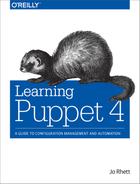
The animal on the cover of Learning Puppet 4 is an European polecat (Mustela putorius), a member of the weasel family found all throughout Europe. The name “polecat” is thought to derive either from the French poule (chicken) because of the species’ liking for poultry or the Old English ful (foul) for its disagreeable odor.
The European polecat is the ancestor of the ferret, which was domesticated 2,000 years ago to hunt rabbits and vermin. Indeed, apart from having a larger skull, wild polecats are nearly identical in appearance to ferrets. Both have thick, silky brown-black fur with a lighter undercoat and a white mask across the face. The size of European polecats varies widely (11–18 inches long and weighing 1–3 pounds), though males are generally larger than females.
Polecats are polygamous, and before mating, the male drags the female around by the scruff of the neck to stimulate ovulation. Litters of 5–10 kits are born in May or June. The newborn polecats are blind and deaf for a month after birth (and are not independent until 2-3 months of age). In addition to nursing her kits, their mother brings them small pieces of meat. The diet of the European polecat consists of rodents, amphibians, and birds.
Both sexes mark their territories with an oily strong-smelling musk, which is also used as a defense if it feels threatened. While polecats are still hunted for their fur in some European countries, this unpleasant smell lingers on their pelts and is difficult to remove.
Many of the animals on O’Reilly covers are endangered; all of them are important to the world. To learn more about how you can help, go to animals.oreilly.com.
The cover image is from an unknown source. The cover fonts are URW Typewriter and Guardian Sans. The text font is Adobe Minion Pro; the heading font is Adobe Myriad Condensed; and the code font is Dalton Maag’s Ubuntu Mono.