
To see how effective the method extraction technique can be, we will first try out a simple example on .filter() in the Twitter stream filtering code:
observeTwitterStream(configuration, filterQuery)
        .sample(2700, TimeUnit.MILLISECONDS)
        .map(StockUpdate::create)
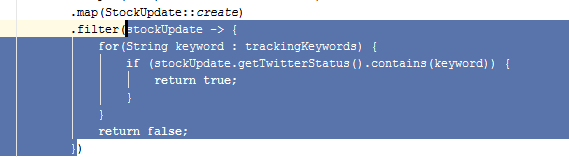
        .filter(stockUpdate -> {
            for(String keyword : trackingKeywords) {
                if (stockUpdate.getTwitterStatus()
                .contains(keyword)) {
                    return true;
                }
            }
        return false;
        })
The .filter() block here is responsible for the removal of tweets that do not contain the keywords. Let's make that explicit by extracting a method:
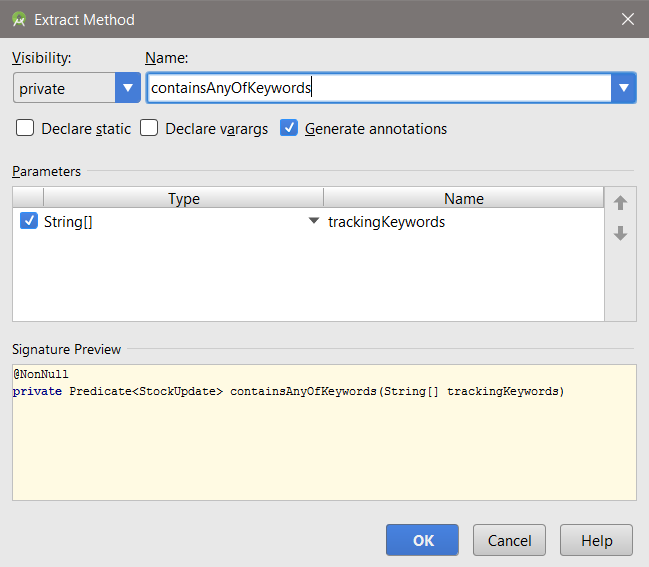
containsAnyOfKeywords()
So, the block before will become this:
observeTwitterStream(configuration, filterQuery)
        .sample(2700, TimeUnit.MILLISECONDS)
        .map(StockUpdate::create)
        .filter(containsAnyOfKeywords(trackingKeywords))
Also, the extracted method contains the following:
@NonNull
private Predicate<StockUpdate> containsAnyOfKeywords(String[] trackingKeywords) {
    return stockUpdate -> {
        for(String keyword : trackingKeywords) {
            if (stockUpdate.getTwitterStatus().contains(keyword)) {
                return true;
            }
        }
        return false;
    };
}
In the last code block, we can see that it returns a lambda that conforms to the type of Predicate<StockUpdate>, which is required for the .filter() method.
Extracting a method made .filter() more self-descriptive, and now we do not need to analyze the details of the implementation to understand what is happening. Basically, we replaced the lower-detail implementation with a higher-level concept.
This can be done by following a few simple steps:
- Select the block that needs to be extracted:
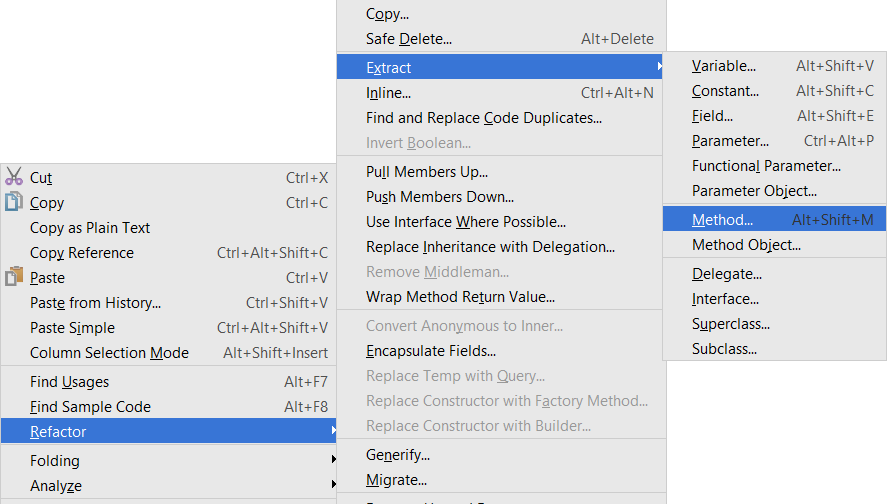
- Right-click on and select the option of Refactor->Extract->Method...:
- Enter a name for a new method:
Proficient users who know their shortcuts by heart will make this even faster.