Table of Contents for
Learn Robotics with Raspberry Pi
 Learn Robotics with Raspberry Pi
Published by
No Starch Press, 2018
Learn Robotics with Raspberry Pi
Published by
No Starch Press, 2018
- Cover Page
- Title Page
- Copyright Page
- Dedication
- CONTENTS
- CONTENTS IN DETAIL
- ACKNOWLEDGMENTS
- FOREWORD
- INTRODUCTION
- CHAPTER 1: GETTING UP AND RUNNING
- CHAPTER 2: ELECTRONICS BASICS
- CHAPTER 3: BUILDING YOUR ROBOT
- CHAPTER 4: MAKING YOUR ROBOT MOVE
- CHAPTER 5: AVOIDING OBSTACLES
- CHAPTER 6: CUSTOMIZING WITH LIGHTS AND SOUND
- CHAPTER 7: LINE FOLLOWING
- CHAPTER 8: COMPUTER VISION: FOLLOW A COLORED BALL
- NEXT STEPS
- RASPBERRY PI GPIO DIAGRAM
- RESISTOR GUIDE
- HOW TO SOLDER
- RUN PROGRAM ON STARTUP
- Learn Robotics with Raspberry Pi®: Build and Code Your Own Moving, Sensing, Thinking Robots
- Learn Robotics with Raspberry Pi®: Build and Code Your Own Moving, Sensing, Thinking Robots
NEXT STEPS
NOW THAT YOU’VE COME TO THE END OF THIS BOOK, IT’S TIME TO GO OUT INTO THE WORLD AND MAKE YOUR OWN ROBOTS AND OTHER RASPBERRY PI PROJECTS! I HOPE YOU’VE LEARNED AND DEVELOPED THE SKILLS NECESSARY TO HELP YOU ON YOUR FUTURE COMPUTER SCIENCE ADVENTURES.
But know that you’re not alone! There are countless resources online and offline that can help take you further in your next steps. Here are some suggestions.
THE RASPBERRY PI GUY
I run the popular Raspberry Pi YouTube channel The Raspberry Pi Guy, where I provide free tutorials and educational videos. Here I have videos that cover all manner of Raspberry Pi–based subjects—from basic robotics to DIY electric skateboarding—in an easy-to-follow and accessible way (see Figure A-1).
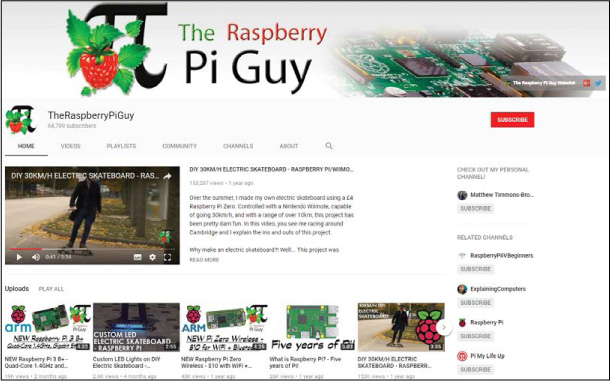
FIGURE A-1 The Raspberry Pi Guy YouTube channel
You can take a look using the following links, and don’t forget to subscribe if you like what you see.
The Raspberry Pi Guy YouTube channel (https://www.youtube.com/TheRaspberryPiGuy/)
The Raspberry Pi Guy website (https://www.theraspberrypiguy.com/)
GET IN TOUCH!
If you’ve enjoyed this book and want to reach out or share your progress, I’d absolutely love to hear from you via Twitter. You can follow and tweet to me @RaspberryPiGuy1. I’ll be sure to see your tweets and reply, especially if you use the hashtag #raspirobots.
OTHER WEBSITES
The Raspberry Pi and the field of robotics both have massive, open, and incredibly welcoming online communities that you can read and contribute to. Here are just a few websites that you can learn and get inspiration from:
The official Raspberry Pi Foundation website (https://www.raspberrypi.org/) This is the site you used to download your Raspberry Pi’s operating system at the start of the book. The Foundation’s website has a plethora of educational resources and projects for all levels and abilities. You’ll also find the Raspberry Pi forums, where you can sign up for an account and interact with other people with similar interests, problems, and questions; this is the perfect place to ask for help if you get stuck with a future project. There is even a dedicated section for “Automation, sensing, and robotics”! The site also includes a regularly updated blog featuring the latest news from the community.
Adafruit Learning System (https://learn.adafruit.com/) This is a collection of resources and online lessons from the electronics community surrounding Adafruit. Here you’ll find detailed tutorials for a huge variety of hardware and software, all with open source code and help. This is a good place to go if you need inspiration for your next project!
The official Python website (https://www.python.org/) While this book has given you a great introduction to coding and the Python programming language, if you want to continue to develop your programming skills, take a look at the official Python website. You’ll find all the documentation and guides you could possibly hope for! Further down the line, you may wish to explore other programming languages, such as C++ or Java, in which case simply search for tutorials on Google—there are quite literally millions!
New Atlas robotics news (https://newatlas.com/robotics/) If you’re interested in the latest news about robotics and progress in the field, check out the robotics section from New Atlas, an online news publication that covers technology. You’ll find some really amazing stuff that might just inspire you to make something awesome and advance the field of robotics even further!
CLUBS AND EVENTS
There’s a lot you can do online to learn about robotics and Raspberry Pi, but nothing can replace face-to-face clubs, events, and meetups. Fortunately, you’ll find lots of opportunities for these in the computer science world. Here are some suggestions, but your location will affect what’s available to you, so make sure you find out what’s going on in your local area for clubs and events relevant to you!
Raspberry Jam (https://www.raspberrypi.org/jam/) Raspberry Jams are independently organized community events for people of all ages to chat, learn, and share projects based around the Raspberry Pi. Jams happen in every corner of the globe and are run by all sorts of people. Raspberry Jams often include workshops for beginners, show-and-tell, and talks given by members of the community. People from all backgrounds and abilities, from beginner to professional, are welcome at these events. Use the Find a Jam Near You tool on the website to locate one in your area. If you ever come to one of the Jams in Cambridge, UK, or an event in Edinburgh, UK, you’ll most likely find me there—please say hi!
Pi Wars (https://piwars.org/) Pi Wars is an awesome challenge-based robotics competition for Raspberry Pi–controlled robots. Teams, both professional and amateur, build robots and then compete against each other in nondestructive tasks, such as obstacle courses, speed tests, and maze solving. It is usually held over a weekend and takes place in Cambridge, UK. You can go to the event as either a competitor or just a spectator; see the website for more information.
Code Club (https://www.codeclubworld.org/) and Coder Dojo (https://coderdojo.com/) Code Club and Coder Dojo are worldwide networks of free, volunteer-led coding clubs for young people. Programmers and other people come together to help the younger generation learn how to program and develop their computer science skills. You can find out if there’s one near you by using the tools on each website.
BOOKS AND PUBLICATIONS
If you’ve enjoyed learning about computer science and Raspberry Pi from this book, you may want to continue this journey with another book or publication. Here are some suggestions:
Python Crash Course, by Eric Matthes (No Starch Press, 2015)
20 Easy Raspberry Pi Projects, by Rui Santos and Sara Santos (No Starch Press, 2018)
Raspberry Pi User Guide, by Eben Upton and Gareth Halfacree (Wiley, 2016)
The MagPi (https://www.raspberrypi.org/magpi/), a free-to-read, monthly Raspberry Pi magazine by the Foundation that contains projects, coding, and other articles