
Although design patterns simply describe solutions to problems, they tend to emphasize solutions that promote reusability and flexibility. To achieve this, they manifest some key object-oriented design principles. We will encounter some of them in this chapter and in more detail throughout the rest of the book.
This chapter will cover the following topics:
Composition: How to use object aggregation to achieve greater flexibility than you could with inheritance alone
Decoupling: How to reduce dependency between elements in a system
The power of the interface: Patterns and polymorphism
Pattern categories: The types of patterns that this book will cover
The Pattern Revelation
I first started working with objects in the Java language. As you might expect, it took a while before some concepts clicked. When it did happen, though, it happened very fast, almost with the force of revelation . The elegance of inheritance and encapsulation bowled me over. I could sense that this was a different way of defining and building systems. I got polymorphism, working with a type and switching implementations at runtime. It seemed to me that this understanding would solve most of my design problems, and help me design beautiful and elegant systems.
All the books on my desk at the time focused on language features and the very many APIs available to the Java programmer. Beyond a brief definition of polymorphism, there was little attempt to examine design strategies.
Language features alone do not engender object-oriented design. Although my projects fulfilled their functional requirements, the kind of design that inheritance, encapsulation and polymorphism had seemed to offer continued to elude me.
My inheritance hierarchies grew wider and deeper as I attempted to build a new class for every eventuality. The structure of my systems made it hard to convey messages from one tier to another without giving intermediate classes too much awareness of their surroundings, binding them into the application and making them unusable in new contexts.
It wasn’t until I discovered Design Patterns: Elements of Reusable Object-Oriented Software (Addison-Wesley Professional, 1995), otherwise known as the Gang of Four book, that I realized I had missed an entire design dimension. By that time, I had already discovered some of the core patterns for myself, but others contributed to a new way of thinking.
I found that I had over-privileged inheritance in my designs, trying to build too much functionality into my classes. But where else can functionality go in an object-oriented system?
I found the answer in composition. Software components can be defined at runtime by combining objects in flexible relationships. The Gang of Four boiled this down into a principle: “favor composition over inheritance.” The patterns described ways in which objects could be combined at runtime to achieve a level of flexibility impossible in an inheritance tree alone.
Composition and Inheritance
Inheritance is a powerful way of designing for changing circumstances or contexts. It can limit flexibility, however, especially when classes take on multiple responsibilities.
The Problem
As you know, child classes inherit the methods and properties of their parents (as long as they are protected or public elements). You can use this fact to design child classes that provide specialized functionality.
Figure 8-1 presents a simple example using the UML.
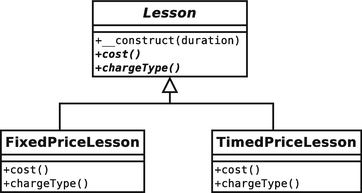
Figure 8-1. A parent class and two child classes
The abstract Lesson class in Figure 8-1 models a lesson in a college. It defines abstract cost() and chargeType() methods . The diagram shows two implementing classes, FixedPriceLesson and TimedPriceLesson, which provide distinct charging mechanisms for lessons.
Using this inheritance scheme, I can switch between lesson implementations. Client code will know only that it is dealing with a Lesson object, so the details of cost will be transparent.
What happens, though, if I introduce a new set of specializations? I need to handle lectures and seminars. Because these organize enrollment and lesson notes in different ways, they require separate classes. Now I have two forces that operate upon my design. I need to handle pricing strategies, and separate lectures and seminars.
Figure 8-2 shows a brute-force solution .
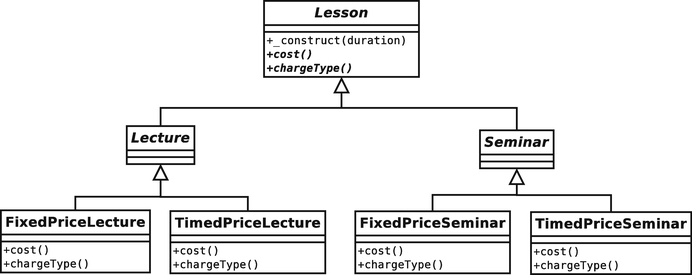
Figure 8-2. A poor inheritance structure
Figure 8-2 shows a hierarchy that is clearly faulty. I can no longer use the inheritance tree to manage my pricing mechanisms without duplicating great swathes of functionality. The pricing strategies are mirrored across the Lecture and Seminar class families.
At this stage, I might consider using conditional statements in the Lesson super class, removing those unfortunate duplications. Essentially, I remove the pricing logic from the inheritance tree altogether, moving it up into the super class. This is the reverse of the usual refactoring, where you replace a conditional with polymorphism. Here is an amended Lesson class :
// listing 08.01abstract class Lesson{protected $duration;const FIXED = 1;const TIMED = 2;private $costtype;public function __construct(int $duration, int $costtype = 1){$this->duration = $duration;$this->costtype = $costtype;}public function cost(): int{switch ($this->costtype) {case self::TIMED:return (5 * $this->duration);break;case self::FIXED:return 30;break;default:$this->costtype = self::FIXED;return 30;}}public function chargeType(): string{switch ($this->costtype) {case self::TIMED:return "hourly rate";break;case self::FIXED:return "fixed rate";break;default:$this->costtype = self::FIXED;return "fixed rate";}}// more lesson methods...}// listing 08.02class Lecture extends Lesson{// Lecture-specific implementations ...}// listing 08.03class Seminar extends Lesson{// Seminar-specific implementations ...}
Here’s how I might work with these classes:
// listing 08.04$lecture = new Lecture(5, Lesson::FIXED);print "{$lecture->cost()} ({$lecture->chargeType()})\n";$seminar = new Seminar(3, Lesson::TIMED);print "{$seminar->cost()} ({$seminar->chargeType()})\n";
And here’s the output:
30 (fixed rate)15 (hourly rate)
You can see the new class diagram in Figure 8-3.
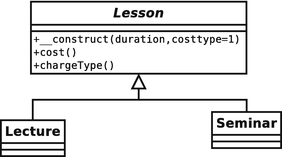
Figure 8-3. Inheritance hierarchy improved by removing cost calculations from subclasses
I have made the class structure much more manageable, but at a cost. Using conditionals in this code is a retrograde step. Usually, you would try to replace a conditional statement with polymorphism. Here, I have done the opposite. As you can see, this has forced me to duplicate the conditional statement across the chargeType() and cost() methods.
I seem doomed to duplicate code.
Using Composition
I can use the Strategy pattern to compose my way out of trouble. Strategy is used to move a set of algorithms into a separate type. By moving cost calculations, I can simplify the Lesson type. You can see this in Figure 8-4.
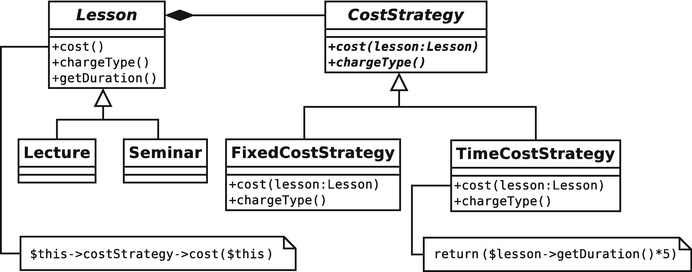
Figure 8-4. Moving algorithms into a separate type
I create an abstract class , CostStrategy, which defines the abstract methods, cost()and chargeType(). The cost() method requires an instance of Lesson, which it will use to generate cost data. I provide two implementations for CostStrategy. Lesson objects work only with the CostStrategy type, not a specific implementation, so I can add new cost algorithms at any time by subclassing CostStrategy. This would require no changes at all to any Lesson classes.
Here’s a simplified version of the new Lesson class illustrated in Figure 8-4:
// listing 08.05abstract class Lesson{private $duration;private $costStrategy;public function __construct(int $duration, CostStrategy $strategy){$this->duration = $duration;$this->costStrategy = $strategy;}public function cost(): int{return $this->costStrategy->cost($this);}public function chargeType(): string{return $this->costStrategy->chargeType();}public function getDuration(): int{return $this->duration;}// more lesson methods...}// listing 08.06class Lecture extends Lesson{// Lecture-specific implementations ...}// listing 08.07class Seminar extends Lesson{// Seminar-specific implementations ...}
The Lesson class requires a CostStrategy object, which it stores as a property. The Lesson::cost() method simply invokes CostStrategy::cost(). Equally, Lesson::chargeType() invokes CostStrategy::chargeType(). This explicit invocation of another object’s method in order to fulfill a request is known as delegation. In my example, the CostStrategy object is the delegate of Lesson. The Lesson class washes its hands of responsibility for cost calculations and passes on the task to a CostStrategy implementation . Here, it is caught in the act of delegation:
public function cost(): int{return $this->costStrategy->cost($this);}
Here is the CostStrategy class, together with its implementing children:
// listing 08.08abstract class CostStrategy{abstract public function cost(Lesson $lesson): int;abstract public function chargeType(): string;}// listing 08.09class TimedCostStrategy extends CostStrategy{public function cost(Lesson $lesson): int{return ($lesson->getDuration() * 5);}public function chargeType(): string{return "hourly rate";}}// listing 08.10class FixedCostStrategy extends CostStrategy{public function cost(Lesson $lesson): int{return 30;}public function chargeType(): string{return "fixed rate";}}
I can change the way that any Lesson object calculates cost by passing it a different CostStrategy object at runtime. This approach then makes for highly flexible code. Rather than building functionality into my code structures statically, I can combine and recombine objects dynamically:
// listing 08.11$lessons[] = new Seminar(4, new TimedCostStrategy());$lessons[] = new Lecture(4, new FixedCostStrategy());foreach ($lessons as $lesson) {print "lesson charge {$lesson->cost()}. ";print "Charge type: {$lesson->chargeType()}\n";}lesson charge 20. Charge type: hourly ratelesson charge 30. Charge type: fixed rate
As you can see, one effect of this structure is that I have focused the responsibilities of my classes. CostStrategy objects are responsible solely for calculating cost, and Lesson objects manage lesson data.
So, composition can make your code more flexible because objects can be combined to handle tasks dynamically in many more ways than you can anticipate in an inheritance hierarchy alone. There can be a penalty with regard to readability, though. Because composition tends to result in more types, with relationships that aren’t fixed with the same predictability as they are in inheritance relationships, it can be slightly harder to digest the relationships in a system.
Decoupling
You saw in Chapter 6 that it makes sense to build independent components. A system with highly interdependent classes can be hard to maintain. A change in one location can require a cascade of related changes across the system.
The Problem
Reusability is one of the key objectives of object-oriented design, and tight coupling is its enemy. You can diagnose tight coupling when you see that a change to one component of a system necessitates many changes elsewhere. You should aspire to create independent components, so that you can make changes without a domino effect of unintended consequences. When you alter a component, the extent to which it is independent is related to the likelihood that your changes will cause other parts of your system to fail.
You saw an example of tight coupling in Figure 8-2. Because the cost logic was mirrored across the Lecture and Seminar types, a change to TimedPriceLecture would necessitate a parallel change to the same logic in TimedPriceSeminar. By updating one class and not the other, I would break my system—without any warning from the PHP engine. My first solution, using a conditional statement, produced a similar dependency between the cost() and chargeType() methods.
By applying the Strategy pattern, I distilled my cost algorithms into the CostStrategy type, locating them behind a common interface and implementing each only once.
Coupling of another sort can occur when many classes in a system are embedded explicitly into a platform or environment. Let’s say that you are building a system that works with a MySQL database , for example. You might use methods such as mysqli::query() to speak to the database server.
Should you be required to deploy the system on a server that does not support MySQL, you could convert your entire project to use SQLite. You would be forced to make changes throughout your code, though, and face the prospect of maintaining two parallel versions of your application.
The problem here is not the system’s dependency on an external platform. Such a dependency is inevitable. You need to work with code that speaks to a database. The problem comes when such code is scattered throughout a project. Talking to databases is not the primary responsibility of most classes in a system, so the best strategy is to extract such code and group it together behind a common interface. In this way, you promote the independence of your classes. At the same time, by concentrating your gateway code in one place, you make it much easier to switch to a new platform without disturbing your wider system. This process, the hiding of implementation behind a clean interface, is known as encapsulation. The Doctrine database library solves this problem with the DBAL (database abstraction layer) project. This provides a single point of access for multiple databases.
The DriverManager class provides a static method called getConnection() that accepts a parameters array. According to the makeup of this array, it returns a particular implementation of an interface called Doctrine\DBAL\Driver. You can see the class structure in Figure 8-5.
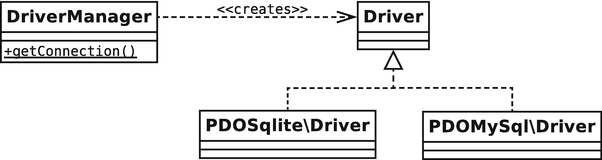
Figure 8-5. The DBAL package decouples client code from database objects
The DBAL package, then, lets you decouple your application code from the specifics of your database platform. You should be able to run a single system with MySQL, SQLite, MSSQL, and others without changing a line of code (apart from your configuring parameters, of course).
Loosening Your Coupling
To handle database code flexibly, you should decouple the application logic from the specifics of the database platform it uses. You will see lots of opportunities for this kind of separation of components in your own projects.
Imagine, for example, that the Lesson system must incorporate a registration component to add new lessons to the system. As part of the registration procedure, an administrator should be notified when a lesson is added. The system’s users can’t agree whether this notification should be sent by mail or by text message. In fact, they’re so argumentative that you suspect they might want to switch to a new mode of communication in the future. What’s more, they want to be notified of all sorts of things, so that a change to the notification mode in one place will mean a similar alteration in many other places.
If you’ve hard-coded calls to a Mailer class or a Texter class, then your system is tightly coupled to a particular notification mode, just as it would be tightly coupled to a database platform by the use of a specialized database API.
Here is some code that hides the implementation details of a notifier from the system that uses it:
// listing 08.12class RegistrationMgr{public function register(Lesson $lesson){// do something with this Lesson// now tell someone$notifier = Notifier::getNotifier();$notifier->inform("new lesson: cost ({$lesson->cost()})");}}// listing 08.13abstract class Notifier{public static function getNotifier(): Notifier{// acquire concrete class according to// configuration or other logicif (rand(1, 2) === 1) {return new MailNotifier();} else {return new TextNotifier();}}abstract public function inform($message);}// listing 08.14class MailNotifier extends Notifier{public function inform($message){print "MAIL notification: {$message}\n";}}// listing 08.15class TextNotifier extends Notifier{public function inform($message){print "TEXT notification: {$message}\n";}}
I create RegistrationMgr, a sample client for my Notifier classes. The Notifier class is abstract, but it does implement a static method, getNotifier(), which fetches a concrete Notifier object (TextNotifier or MailNotifier). In a real project, the choice of Notifier would be determined by a flexible mechanism, such as a configuration file. Here, I cheat and make the choice randomly. MailNotifier and TextNotifier do nothing more than print out the message they are passed along with an identifier to show which one has been called.
Notice how the knowledge of which concrete Notifier should be used has been focused in the Notifier::getNotifier() method . I could send notifier messages from a hundred different parts of my system, and a change in Notifier would only have to be made in that one method.
Here is some code that calls the RegistrationMgr:
// listing 08.16$lessons1 = new Seminar(4, new TimedCostStrategy());$lessons2 = new Lecture(4, new FixedCostStrategy());$mgr = new RegistrationMgr();$mgr->register($lessons1);$mgr->register($lessons2);
And here’s the output from a typical run:
TEXT notification: new lesson: cost (20)MAIL notification: new lesson: cost (30)
Figure 8-6 shows these classes.
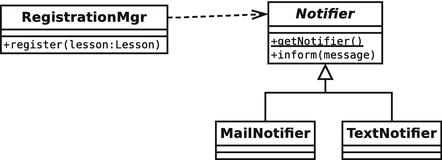
Figure 8-6. The Notifier class separates client code from Notifier implementations
Notice how similar the structure in Figure 8-6 is to that formed by the Doctrine components shown in Figure 8-5.
Code to an Interface, Not to an Implementation
This principle is one of the all-pervading themes of this book. You saw in Chapter 6 (and in the last section) that you can hide different implementations behind the common interface defined in a superclass. Client code can then require an object of the superclass’s type rather than that of an implementing class, unconcerned by the specific implementation it is actually getting.
Parallel conditional statements, like the ones I rooted out from Lesson::cost() and Lesson::chargeType(), are a common sign that polymorphism is needed. They make code hard to maintain because a change in one conditional expression necessitates a change in its siblings. Conditional statements are occasionally said to implement a “simulated inheritance.”
By placing the cost algorithms in separate classes that implement CostStrategy, I remove duplication. I also make it much easier should I need to add new cost strategies in the future.
From the perspective of client code, it is often a good idea to require abstract or general types in your methods’ parameters. By requiring more specific types, you could limit the flexibility of your code at runtime.
Having said that, of course, the level of generality you choose in your argument hints is a matter of judgment. Make your choice too general, and your method may become less safe. If you require the specific functionality of a subtype, then accepting a differently equipped sibling into a method could be risky.
Still, make your choice of argument hint too restricted, and you lose the benefits of polymorphism. Take a look at this altered extract from the Lesson class:
// listing 08.17public function __construct(int $duration, FixedCostStrategy $strategy){$this->duration = $duration;$this->costStrategy = $strategy;}
There are two issues arising from the design decision in this example. First, the Lesson object is now tied to a specific cost strategy, which closes down my ability to compose dynamic components. Second, the explicit reference to the FixedPriceStrategy class forces me to maintain that particular implementation.
By requiring a common interface, I can combine a Lesson object with any CostStrategy implementation:
// listing 08.18public function __construct(int $duration, CostStrategy $strategy){$this->duration = $duration;$this->costStrategy = $strategy;}
I have, in other words, decoupled my Lesson class from the specifics of cost calculation. All that matters is the interface and the guarantee that the provided object will honor it.
Of course, coding to an interface can often simply defer the question of how to instantiate your objects. When I say that a Lesson object can be combined with any CostStrategy interface at runtime, I beg the question, “But where does the CostStrategy object come from?”
When you create an abstract superclass, there is always the issue of how its children should be instantiated. Which child do you choose and according to which condition? This subject forms a category of its own in the Gang of Four pattern catalog, and I will examine this further in the next chapter.
The Concept that Varies
It’s easy to interpret a design decision once it has been made, but how do you decide where to start?
The Gang of Four recommend that you “encapsulate the concept that varies.” In terms of my lesson example, the varying concept is the cost algorithm. Not only is the cost calculation one of two possible strategies in the example, but it is obviously a candidate for expansion: special offers, overseas student rates, introductory discounts-all sorts of possibilities present themselves.
I quickly established that subclassing for this variation was inappropriate, and I resorted to a conditional statement. By bringing my variation into the same class, I underlined its suitability for encapsulation.
The Gang of Four recommend that you actively seek varying elements in your classes and assess their suitability for encapsulation in a new type. Each alternative in a suspect conditional may be extracted to form a class that extends a common abstract parent. This new type can then be used by the class or classes from which it was extracted. This has the following effects:
Focusing responsibility
Promoting flexibility through composition
Making inheritance hierarchies more compact and focused
Reducing duplication
So how do you spot variation? One sign is the misuse of inheritance. This might include inheritance deployed according to multiple forces at one time (e.g., lecture/seminar and fixed/timed cost). It might also include subclassing on an algorithm where the algorithm is incidental to the core responsibility of the type. The other sign of variation suitable for encapsulation is, as you have seen, a conditional expression.
Patternitis
One problem for which there is no pattern is the unnecessary or inappropriate use of patterns. This has earned patterns a bad name in some quarters. Because pattern solutions are neat, it is tempting to apply them wherever you see a fit, whether they truly fulfill a need or not.
The eXtreme Programming (XP) methodology offers a couple of principles that might apply here. The first is, “You aren’t going to need it” (often abbreviated to YAGNI). This is generally applied to application features, but it also makes sense for patterns.
When I build large environments in PHP, I tend to split my application into layers, separating application logic from presentation and persistence layers. I use all sorts of core and enterprise patterns in conjunction with one another.
When I am asked to build a feedback form for a small business web site, however, I may simply use procedural code in a single page script. I do not need enormous amounts of flexibility; I won’t be building on the initial release. I don’t need to use patterns that address problems in larger systems. Instead, I apply the second XP principle: “Do the simplest thing that works.”
When you work with a pattern catalog, the structure and process of the solution are what stick in the mind, consolidated by the code example. Before applying a pattern, though, pay close attention to the problem, or “when to use it,” section, and then read up on the pattern’s consequences. In some contexts, the cure may be worse than the disease.
The Patterns
This book is not a pattern catalog. Nevertheless, in the coming chapters, I will introduce a few of the key patterns in use at the moment, providing PHP implementations and discussing them in the broad context of PHP programming.
The patterns described will be drawn from key catalogs, including Design Patterns: Elements of Reusable Object-Oriented Software, Patterns of Enterprise Application Architecture by Martin Fowler (Addison-Wesley Professional, 2002) and Core J2EE Patterns: Best Practices and Design Strategies (Prentice Hall, 2001) by Alur, et al. I use the Gang of Four’s categorization as a starting point, dividing patterns into five categories, as follows.
Patterns for Generating Objects
These patterns are concerned with the instantiation of objects. This is an important category given the principle, “Code to an interface.” If you are working with abstract parent classes in your design, then you must develop strategies for instantiating objects from concrete subclasses. It is these objects that will be passed around your system.
Patterns for Organizing Objects and Classes
These patterns help you to organize the compositional relationships of your objects. More simply, these patterns show how you combine objects and classes.
Task-Oriented Patterns
These patterns describe the mechanisms by which classes and objects cooperate to achieve objectives.
Enterprise Patterns
I look at some patterns that describe typical Internet programming problems and solutions. Drawn largely from Patterns of EnterpriseApplication Architecture and Core J2EE Patterns: Best Practices and Design Strategies, the patterns deal with presentation and application logic.
Database Patterns
An examination of patterns that help with storing and retrieving data, and with mapping objects to and from databases.
Summary
In this chapter, I examined some of the principles that underpin many design patterns. I looked at the use of composition to enable object combination and recombination at runtime, resulting in more flexible structures than would be available using inheritance alone. I also introduced you to decoupling, the practice of extracting software components from their context to make them more generally applicable. Finally, I reviewed the importance of interface as a means of decoupling clients from the details of implementation.
In the coming chapters, I will examine some design patterns in detail.