Table of Contents for
Mastering Collaboration
 Mastering Collaboration
Published by
O'Reilly Media, Inc., 2019
Mastering Collaboration
Published by
O'Reilly Media, Inc., 2019
Chapter 1. Chapter 1: Enlist Everyone
Now I know what you’re thinking: Everyone? That sounds...messy. In meaningful collaborations “everyone” cannot literally mean everyone, but as a principle it’s worth realizing that the more you include people who are affected by, and invested in, the topic at hand the better your results will be. Enlisting everyone, done right, actually helps.
It’s counterintuitive, but casting a wide net and including more people, actually helps you move faster. Because, consider for a moment that everyone is already “helping” you. They just aren’t doing it in a way that is actually helpful. Group dynamics, especially in competitive corporate culture, lead people to see efforts that exclude them as potential threats or a drain on resources that feel tight. At first, the people that you have not engaged (for whatever reason) might stand off to the side, neither helping or hurting your efforts. But it doesn’t take much for those who’ve been made to feel excluded to stake out a position on the opposite bank, and work against what you are trying to create. Often we assume anyone not working with us are neutral parties, but if those parties think they should be involved, they won’t stay neutral. Often in a rush to just “get to it” we leapfrog over interested parties, only to find that we must spend large amounts of time and energy trying to get their buy-in later. Their participation often takes place after the fact, as combative reviews of “finished” work, or worse, competitive efforts spring up and muddy the waters.
This isn’t necessarily because these people don’t believe in what you are doing. Rather, their reaction is a normal response to having a perspective that isn’t being heard. When we have a real interest in an effort, we can’t help but want to contribute, and if we aren’t given a chance, it can bring up an emotional response that is hard to corral productively. By engaging “everyone” in approaching a problem, you increase their commitment to the end-product and you reduce the drag on momentum.
Including “everyone” doesn’t mean every person is always fully involved, it means widening the funnel of inputs to the process, enlisting varied perspectives to generate solutions, and getting a larger set of people to vett ideas to find their faults and make our case stronger. Everyone can help if you can help make room for different perspectives and ways of engaging. Some people may be dedicating their full attention to the problem, pushing solutions forward, others may be advising or providing feedback on work. The purpose of including everyone is to get a sufficiently diverse set of perspectives on a problem to mitigate risks and drive innovative solutions.
This chapter will show how being more inclusive makes teams stronger by widening their perspective and making them more invested in the team’s success. Managing groups that are very different can present some challenges and create conflict. You can take steps to help teams work through their differences, at least enough to make working together less painful.
Enlist Everyone to Reduce Risks
A recent “innovation” from Doritos stands as a great reminder of how limiting the variety of orientations to a problem can have ridiculous results. The maker of tasty chips completed some customer research, and found a surprising problem. Women reported not feeling comfortable eating Doritos in public, saying that crunching loudly and licking the delicious chemical flavor powder from dainty fingertips just didn’t seem ladylike to many. So the brand announced a plan to address this problem by creating Lady Doritos – a less crunchy, less finger-lickin’ good version of the product. They had successfully dealt with every every issue identified. Or, had they?
Now, mind you, the problem wasn’t that women weren’t buying the chips, but that they had an aversion to eating them publicly. Both the analysis of the findings, and the proposed solution stink of a team that lacks diversity. And I don’t mean women. I suspect that those involved were all “product” people whose only hammer is a new product type, and every nail a gap in the product line. Thankfully, the Internet shame that surrounded this moment kept this idea from moving forward, but Doritos could have avoided the PR gaffe if they’d included people not responsible for product development. Because the issue is a messaging opportunity, not a product-market fit problem. A simple ad campaign showing women gustily enjoying chips in meetings, at the park, on the bus, all while smiling and laughing would have gone a long way, and probably requires a lot less investment.
Blair Reeves, head of product management at SAS and author of Building Products for the Enterprise: Product Management in Enterprise Software, says sometimes, the blind spot comes in defining the very problem itself. Prior to getting into product management, Reeves worked in international development in Cameroon. He recalls how projects to improve infrastructure among communities was often without partnership from the people. People were used to having solutions provided that may not be used or sustained once finished because they weren’t seen as something that they had ownership of. When he began asking communities about their priorities, he found that they were different than had been assumed. AIDS and HIV education weren’t as big issue for them as his organization assumed; instead the people wanted help with combating malaria and building latrines – issues that were more disruptive day-to-day.
Asking a diverse group of those who are closer to the problem is one way to spot potential missteps and avoid them. A group that’s too homogenous may miss incorrect assumptions or apply too narrow a lens to finding solutions. You should also make time to be sure that the team understands, and seeks out the right skills sets, rather than assuming they are present or trying to “make do” blindly.
[sidebar 1.1 Balanced Tam Pie]
Enlist Everyone to Boost Engagement
It turns out that including those who are affected by the outcomes of the work is also a boon to morale. When Reeves not only discovered the community’s real priorities, he also found that when he started asking people about the problem, that they were easier to engage in the solutions. Those we work with are no different. When you can invite more people into a thoughtful consideration of a problem, or enlist their help testing solutions they become more active and interested. It seems obvious that when people are only shown finished work and informed of its existence they care less about it – unless of course they actively hate it. And yet, sharing finished work that can’t be changed much is standard for many office cultures.
Companies know that having more engaged employees is beneficial, it’s why they spend so much time and money measuring engagement. Marc Benioff of Salesforce found his organization faced with a challenge of employee engagement at senior levels of his leadership, something that corporations pay a great deal of attention to. Higher engagement can multiply productivity and quality so much that substantial amounts of time and money is spent monitoring and supporting people’s experience at work. Benioff wanted to nip his engagement problem in the bud, so he took pains to create a virtual space to understand what fueled the issue and define the problem and address it. “In the end the dialogue lasted for weeks beyond the actual meeting. More important, by fostering a discussion across the entire organization, [he] has been able to better align the whole workforce around its mission. The event served as a catalyst for the creation of a more open and empowered culture at the company.” Clearly senior leaders at Salesforce are busy people whose typical focus is on the products and services they create, but without spending time to come together widely as a group and establish shared understanding and priorities their day-to-day efforts would have been affected.
Collaboration is an approach to problem solving, but it’s just as valuable as a cultural force that helps employees engage with purpose and meaning in their jobs, not just productivity.
Enlisting Everyone Brings Up Cultural Differences
So, maybe enlisting “everyone” has some advantages, but employing this principle can also bring up issues around diversity and inclusion for the group, and as a master of collaboration, it is important that you stay aware of dynamics that can reduce the benefits.
In studying cultural differences, there’s a force known as the Power-Distance Index, first identified by Geert Hofstede, which measures the degree to which a group values hierarchy and ascribes power to leaders. A country like the US has relatively low Power Distance because we value flatter organization and independence over bowing to authority. Japan, on the other hand, rates very high, as the culture demands a great deal of respect for elders and authority.
Malcolm Gladwell in his book, Outliers, tells the story of Korean Air’s “cockpit culture” during the late 90s when the airline was experiencing more plane crashes than any other airline. Analysis showed that the cultural norm of giving into superiors and avoiding challenging them meant that junior pilots who spotted problems failed to raise them, In Forbes, Gladwell said, “What they were struggling with was a cultural legacy, that Korean culture is hierarchical. You are obliged to be deferential toward your elders and superiors in a way that would be unimaginable in the U.S.
But Boeing and Airbus design modern, complex airplanes to be flown by two equals. That works beautifully in low-power-distance cultures [like the U.S., where hierarchies aren’t as relevant]. But in cultures that have high power distance, it’s very difficult.”
When the airline made some adjustments, their problem went away. They flattened out the power-distance index by reinforcing the value of junior aviators, and, “a small miracle happened,” Gladwell writes. “Korean Air turned itself around. Today, the airline is a member in good standing of the prestigious SkyTeam alliance. Its safety record since 1999 is spotless. In 2006, Korean Air was given the Phoenix Award by Air Transport World in recognition of its transformation. Aviation experts will tell you that Korean Air is now as safe as any airline in the world.”
How we react to power isn’t the only cultural difference you’re likely to run into. If you’re beginning to see how widening the circle of collaborators and making sure they are active, respected participants, you might be wondering how to define the right level of everyone for your teams. Getting diversity means including those with a variety of:
Experiences in industry and skills
Cultural backgrounds
Introversion and extroversion
Working styles
Primary languages
Ownership, from end-users to senior leaders and everyone in-between
Helping teams deal with cultural differences requires being open to talking about differences, creating norms that bridge gaps, and having productive conflict. When people can acknowledge to themselves and others where their perspective is coming from, it makes it easier for the group to not reject it because it’s an outlier. Discussion about how the group will handle certain differences is also a healthy thing to promote. Creating explicit norms about everything from group vs. individual working time to how decisions get made gives the group common ground. It’s important to model respecting team norms, and hold each other accountable when they aren’t respected.
[Sidebars 1.2 and 1.3]
Cross Cultures, Don’t Overthrow Them
At some point in your journey to master collaboration, you will have a realization - people are a problem. Working with power structures can be challenging, especially if you don’t happen to have a lot of authority in the system. And people are irrational and messy, which is why organizations create structures in the first place, to help guide our decisions and establish ways to control and command. Cyd Harrell knows all about these kinds of structures as someone who has made a big push in the last few years to bring innovation and inclusivity to the US Government. As a leader at 18F, the digital services arm of the government, Harrell has worked with huge governmental agencies, elected officials, and political appointees, and she’s seen first-hand the challenges of bringing a collaborative approach to command and control cultures.
“Some kinds of hierarchy are not conducive to good collaboration,” she says, “but you have to find a way through anyway. That culture exists for a reason, and many of your stakeholders have a great deal invested in it.” It’s important to note that not all organizations are chasing less hierarchy and flatter structures. Civil servants and government agencies typically have a much longer tenure than you find in Silicon Valley, and many people work hard for years to attain a level of authority and power that they aren’t eager to shove aside in the interests of being “transparent” and non-hierarchical. These organizations have succeeded in large-scale often high-risk situations because they employ what Harrell calls a “submit and review” approach where ideas are taken to a final state where a gatekeeper has the power to approve or reject the work in a single blow. In that model, more senior people are seen as experts whose point of view is critical to be aligned with. Conversely, those who are elected or appointed, might serve short tenures, with a great deal of authority, and priorities and perspectives change once that person has been replaced or voted out of office. Both of these forces tend to make collaboration hard, or nearly impossible.
But, Harrell says, at the same time, you can’t get around these cultural forces. Approaching collaboration in this setting without respecting the system and structures is likely to have bad effects. When I offered some ideas I’ve seen used to break through power imbalances and help create a different vibe in a team, Harrell was quick to correct me. “You can’t make changing the culture central to your success” in an environment where so many are so invested in its structure. And trying to go around it might end you up in hot water, having violated the chain of command by going to a senior influencer. Asking people lower on the totem pole to speak up in front of more senior people can also backfire, since the system doesn’t reward new ideas as much as it rewards supporting the hierarchy.
The US Government is one specific culture, and Harrell has learned how to navigate it, rather than fight it during her tenure. Her approach is a simple one, bring great deal of empathy for your stakeholders, however reluctant, and don’t force it. Rather, create a space where the rules and systems are paused or changed temporarily and invite them in. Or ,run your collaborations cloaked within a command and control mode where you slow down to the pace required to continually seek reviews and approvals from those who matter more than others. The trick is to acknowledge to yourself and the team, that the situation simply requires another iteration or two to bring the sticky stakeholder along. Since you are always showing “finished” work, you must be willing to be “wrong” so that a meaningful conversation can be had about what’s not working and how it might be fixed.
But cultural differences can also be more geographically influenced, in teams that are large and international or dispersed. Erin Meyer is an author and researcher who’s done a lot to map out the ways in which cultures differ which in turn helps you navigate them. Her work is useful for those who are navigating national cultural differences in teams, from how negative feedback is given to how scheduling happens. More typically, teams are made up of many different cultures, so it may be more useful to focus on mapping individual behaviors than focus on countries of origin.
Some companies have collaboration build into their cultures from the start. Netflix began with an unusual business model, mailing customers DVDs of movies from their queue, and made the transition to streaming media at a time when physical media was losing adoption. The company has recently undergone another transition and begun creating it’s own movies and TV shows to stream. The resilience of their business model and technology are impressive, and much of the credit for the company’s success is attributed to their strong culture that values collaboration highly. This culture is embodied in a famous “deck” of slides that was shared openly on the internet and is now published on the company’s website. Andrea Mangini, Director of Product Design, shared her observations about how that culture works on the inside, as someone relatively new to the org. She says that people are constantly showing their work and inviting people to weigh in. People value getting feedback, and in fact not seeking out the opinions of others is frowned upon. Because the emphasis on collaboration has been at the core of the company since the start, it’s second nature to many people. The company sees so much value in breaking down silos, they worry less about duplication of efforts and optimizing the creation of new ideas.
No matter what environment you exist in, by being intentional about involving “everyone” and making it possible for differences to become productive through norms, you get the diversity you need, while maintaining the sanity you deserve. By understanding power differences, and openly discussing cultural differences, whether they are based on nationality, or background, or skill set, you will help create a more harmonious collaboration.
Troubleshooting Issues with Enlisting Everyone
Bringing many different people together can bring up many emotional and interpersonal issues in the team and with stakeholders. Below are some ideas you can use to mitigate these issues and keep the team focused.
Dealing With Difficult People in Teams
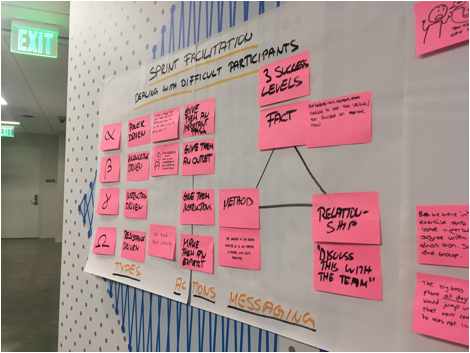
However you’ve decided to set up your core team, it’s likely that at some point, one or more of them will turn out to be trouble. Whether it’s someone who dominates, or those you can’t seem to get to speak up, difficult people are a fact of collaborative life. Thorsten Borek and his team at Neon Sprints in Hamburg, Germany have created a simple framework to understand the problematic people who show up to collaborate (or not, as we will see). I have recreated their framework here with permission because it’s simply too useful not to share. The framework has four main types of difficult people, and ways you can handle them gracefully:
The Leader
The Know-it-All
The Introvert
The Negativist
The Indecisive
The Leader. This person is someone who can’t help but take over in a meeting, controlling conversations, dominating ideas. Whether they are literally the boss or just act like it, their presence is likely stifling to others and a pain to facilitate. The key to this person is to understand that their motivations are power-driven, meaning that they seek to be seen as powerful by others. To handle an Leader, Borek suggests giving them an important task. The key word being, important. These folks should be asked to lead a discussion about key decision criteria, or to be asked to make critical decisions.
The Know-it-All. Know-it-alls show up as those who constantly drag the discussion in a specific direction or bring up what seems like minutia when the group is talking about the big picture. They make other participants cringe because they take things off-track even though they may be saying important things. Understand that they are knowledge-driven, and need a way to channel and share their expertise with the group, productively. Handling betas means giving them an outlet in a collaboration. Consider giving them a chance to present their knowledge of constraints as part of framing a problem, or let them share insights about a specific technology you are considering. Truly disruptive people may need to be handled with care, and only included in places where they won’t drown everyone else out all the time.
Figure 1-1. Here’s how Thorsten Borek mapped out this model at Google Sprint ‘18 conference. Credit: Neon Sprints/Thorsten & Tomaz Borek
The Introvert. You may not always notice introverts as problems in your team, because gammas tend to be nice and quiet, eagerly following along, and agreeing with whatever the last person said. Introverts are instruction-driven, meaning they may not be extroverted or confident enough to participate in messy, free-form discussions. Giving them very clear instructions, or doing an example of an exercise together before asking them to do it on their own will help build up their comfort level and confidence. They can also be enlisted to help out the group in many ways, since they highly value helping the group get along.
The Negativist. Finally come those who no matter what, can’t help but resist what is happening every step of the way. These people will question the process being used ad nauseum, or insist that every idea offered has already been tried. Often these folks are resistance-driven because they’ve not been listened to, either by you, or others in the past. Handle negative people with care, making them into valued experts, and enlisting them to prepare and strategize ahead of time. But these people may also prove difficult to change, so consider asking them to serve as a critic of the effort, rather than an idea generator to best take advantage of their energy.
The Indecisive. This type of team member typically is well integrated in how the team works and eager to participate in discussions. Frequently they will introduce different perspectives on a subject or ask to consider more aspects of the matter at hand. However, when asked to make a decision they have really hard time to make up their mind. And once they do decide in 9 of 10 cases they will ask to change that decision after a few minutes. Potentially asking the team for more input “just to be sure”. The Indecisive team member is safety-driven and they need constant reassurance with regards to proceedings and decisions made.
Messaging. Borek also breaks down how to position what you want to different types of people, depending on their orientation to what they value.He posits three ways to succeed in your messaging (Figure 1.1). Those who value facts respond well to descriptions of the outcomes that the joint effort will produce These people want to know what will be different in the future if all goes well. Others are more interested in methods; they want to know what an approach has a great pedigree, and respond well to hearing a step-by-step plan of how to get there. Those who value relationships are likely to want to “ask the team” what they think about a topic, seeking a more democratic and people-oriented approach.
It’s worth getting to know your team members and stakeholders well enough to understand what they value, and what drives them. You can do this in a variety of ways, from 1:1 interviews, to asking people who have experience with individuals what they think, to trying out different approaches and seeing what works.
A Critical Stakeholder Won’t Engage
This is the person who despite your invitations, just won’t show interest or participate in the effort. Many I spoke to described this experience of an important stakeholder, or person with subject-matter expertise fail to attend even short sessions, and sometimes expressing deep skepticism of the enterprise.
The cause of this lack of engagement can vary. Often it is just that they have competing priorities, and yours doesn’t rise to the top of the pile. This happens with people whose expertise is in high demand; and when I dug in with one such person I learned that their days had a Groundhog Day quality where they were called upon over and over again to deliver the same perspective, the same information across many groups, and each new request felt even less interesting and valuable than the last.
So What Can I Do?
Understand their priorities. When you can’t get the attention of someone critical to the effort, it’s worth spending some time trying to understand what they are devoting attention to. You can frame your project in ways to align with what they care about to get more support. You can do this by speaking with them directly, but if they aren’t engaging with you, try speaking to those around them who are likely to know what their focus is. And it may be necessary to acknowledge that their other priorities are more important. You may need to wait until they have the time and space to devote to your effort.
Burn a cycle. When a key stakeholder won’t give you the time of day because they don’t believe the work is needed, it probably won’t do to try to force them to play ball. My advice is to run through a cycle of exploration to get quickly from the fuzzy front-end questions and assumptions to asserting a hypothesis about the solution, or creating a prototype. This answer need not be (and probably won’t be) the right one, so beware of investing a lot of time or making it very high-fidelity. But, what you might find is that once you assert a “truth” developed by the collaboration, you will suddenly get their attention. And beware, it’s likely to be negative. But, this is the time to make sure that person feels like their input and guidance is what will make the difference in solving the problem. When I work with people in complex domains, I often show them things early on that are wrong or incomplete so that they will be compelled to step in to provide guidance and fill in what’s missing. If you prepare yourself to take an extra cycle or two to draw people in, you save yourself the frustration of having more finished work “rejected” by someone who could have been helpful earlier on.
Join forces or have a runoff. As a consultant, it’s shocking the number of times I’ve been hired by large organizations to work on problems that had redundant efforts going on. When you discover this consider merging or aligning your efforts with the other team, in the spirit of sharing the load to move faster. Or, alert leadership about the duplication, because it may be something they aren’t aware of. In my experience however, this isn’t always a case of the right hand not knowing what the left hand is doing. In some companies, they are intentionally setting up different teams to see what different solutions they can get. In this case, you should know your work is in a runoff, and proceed anyway. It may be a good idea to make sure that the comparison of the ideas is on an equal footing though. Try to ensure that leaders aren’t going to end up comparing the cookie dough from one team with the fresh out of the oven cookies from another.
Someone is Spread Too Thin
Having team members who are spread too thin will stress any team. One of the strengths of Agile / Sprint methodology is the insistence on 100% dedication to the team. This is a great goal, but all too often I run into people who have too much on their plates. When your collaborators have varying levels of dedication to the cause, you may run into resentment (“x isn’t pulling their weight”) or dismay (“I want to do more, but I can’t!”).
So What Can I Do?
Speak to a manager. You can try to ask the person who oversees the employee to help clear the person’s plate, for everyone’s sanity. Don’t do this behind the employee’s back, but rather include them in the discussion about how everyone wants to make sure priorities are aligned. This isn’t the employee’s problem, it’s the resource manager’s.
Spread the gospel for them. When a key player is trapped in a cycle of being the subject-matter expert, you can help them by aggregating some of their requests for them, and aligning their input sessions (at least up front) into a single learning session so they can get off the hamster wheel. You could also offer to attend meetings with other groups to consolidate. And, while you are there, consider taking video, and compiling great notes that they can use as a first line of defense for requests for their time. This should also serve to create a bond that hopefully they feel the need to repay you for but giving you just enough attention later.
Change their status. If someone really can’t be spared the needed time to focus on your collaboration, then it’s a good idea to be explicit about making them an advisor who can review and weigh in, but who isn’t part of the core team. It’s also worth seeing if they have a protegé or colleague who might be better able to participate, even if at a lower-level of expertise.
Cultural Conflicts Get In the Way
The main objective of many personnel managers is to minimize dust-ups between employees and promote healthy teams. The irony being, of course, that avoiding conflict ends up creating more issues than it solves. If the business of business were really without contention, and everyone agreed, then we could have delegated it all to the robots and retired in our utopia long ago. But the reality is, we need to express and work through differences of opinion to get to better answers – the very heart of what this book is about.
But what happens when your teams, whether intrinsically, or based on coaching, won’t fully engage in healthy debate? If you notice that there are few points of disagreement in your team, it’s time to stir the pot. Otherwise, productivity will actually suffer, as energy spent not-arguing takes away from accomplishing goals.
You need to strike a balance among team members where there is productive tension and conflict about specific ideas not individual people.
So What Can I Do?
Talk cross-culturally. A lot of what underlies the willingness to speak up, or not, may be cultural. In the spirit of openness, it might be a good idea for your team to spend time together talking openly about what their expectations are, and sharing their previous experiences. Erin Meyer has fantastic advice in her book, The Culture Map, and online about helping teams embrace productive conflict despite cultural differences. She suggests using specific language like, “help me understand your point” in place of, “I disagree with that” to depersonalize and invite intellectual dsicussion among those who might otherwise give in. https://www.erinmeyer.com/2012/04/managing-confrontation-in-multi-cultural-teams/
Map it out. Meyer also suggests mapping out the differences in the team explicitly. The diagram below is specific to national cultural differences, which may be both irrelevant and overly simplistic for your purposes. But if you replace the nationalities with specific team members and their individual predispositions, you can use this tool to help the team better understand where each other are coming from.
Remove the boss. Some people may be more reticent to express themselves when someone of authority is in the room. Help your diverse teams feel comfortable by making sure they have space to engage with each other where they don’t feel like they are being watched or need to align with a superior.
Team norms. Establishing team norms about things like when meetings will be held, or what the “definition of done” is, is a key practice. For managing conflict, it can be good to discuss and decide what the team considers healthy, and not, when facing a conflict. I’ve seen teams with norms such as, “Ask for explanations over offering attacks” that are the result of a diverse team striving to be inclusive of different views.
Work asynchronously. Some conflict comes when people try to do too much all together. Keep an eye on people’s energy levels, and be aware of those who may do better work on their own, and then come back to share and critique. Make time and space for people to be away from one another and keep their discussion focused on the content of work and decisions.
Conclusion
Collaboration at the core is about including diverse perspectives and people. Being inclusive makes teams stronger; you have more to draw on and get more people invested in success of the effort. But groups often need help bringing their differences together productively. You can help teams be open with each other and develop shared norms to govern behaviors. You can also model what respecting differences and healthy tension looks like so that the group doesn’t just stick to what’s “safe” because it’s easier. In the next chapter, we’ll look at how to give people clear roles to channel their energies and contribute to a healthier environment.
Key Takeways
Being inclusive of many different kinds of people, skillsets, and perspectives is a core part of collaboration that helps mitigate risks, engage the team, and find blindspots before they become a problem
Inclusivity can challenge the status quo of how people interact and may bring about interpersonal conflicts that are destructive to the team
Working in different cultures that aren’t naturally conducive to collaboration is challenging, but don’t get causght up in making changing the culture your mission. Instead, focus on keeping the team productive to deliver results. Culture change will happen as a by-product of good results over time.