Table of Contents for
CSS Refactoring
 CSS Refactoring
Published by
O'Reilly Media, Inc., 2016
CSS Refactoring
Published by
O'Reilly Media, Inc., 2016
Colophon
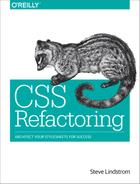
The animal on the cover of CSS Refactoring is an African palm civet (Nandinia binotata), also called the two-spotted palm civet. This is a small omnivorous mammal closely related to the weasel and mongoose. Most of the palm civet’s range is in eastern Africa, but it has also been found in central and western regions of the continent. It prefers a habitat of lowland forests or tropical jungles.
The African palm civet has short legs, a long tail, and tan fur mottled with darker spots. It somewhat resembles the domestic cat, moreso than other civet species, and so it is the only member of the Nandinia genus. On average, they weigh between 3 to 5 pounds. This is a solitary animal that spends most daylight hours resting in the safety of a tree. At night, it emerges to eat: while the civet’s diet is largely made up of fruit, it also hunts insects, lizards, birds, bats, and small rodents.
African palm civets breed twice a year, in May and October (these are times when more food is usually available). After her litter is born, the mother’s mammary glands produce an orange-yellow liquid that stains both her belly and her offspring’s fur. The purpose of this is not entirely clear, though it could signal that she is not available to mate and/or warn off males who may try to harm her young.
Civet is also the name of the musk these animals excrete to mark their territory and find mates. Diluted, it has been used as a perfume ingredient for centuries. A synthetic version is used in many modern products, but several species of civet are still illegally trapped for their meat and scent glands.
Many of the animals on O’Reilly covers are endangered; all of them are important to the world. To learn more about how you can help, go to animals.oreilly.com.
The cover image is from Lydekker’s Royal Natural History. The cover fonts are URW Typewriter and Guardian Sans. The text font is Adobe Minion Pro; the heading font is Adobe Myriad Condensed; and the code font is Dalton Maag’s Ubuntu Mono.