Table of Contents for
sed & awk, 2nd Edition
 sed & awk, 2nd Edition
Published by
O'Reilly Media, Inc., 1997
sed & awk, 2nd Edition
Published by
O'Reilly Media, Inc., 1997
- sed & awk, 2nd Edition
- Cover
- sed & awk, 2nd Edition
- A Note Regarding Supplemental Files
- Dedication
- Preface
- Scope of This Handbook
- Availability of sed and awk
- Obtaining Example Source Code
- Conventions Used in This Handbook
- About the Second Edition
- Acknowledgments from the First Edition
- Comments and Questions
- 1. Power Tools for Editing
- 1.1. May You Solve Interesting Problems
- 1.2. A Stream Editor
- 1.3. A Pattern-Matching Programming Language
- 1.4. Four Hurdles to Mastering sed and awk
- 2. Understanding Basic Operations
- 2.1. Awk, by Sed and Grep, out of Ed
- 2.2. Command-Line Syntax
- 2.3. Using sed
- 2.4. Using awk
- 2.5. Using sed and awk Together
- 3. Understanding Regular Expression Syntax
- 3.1. That’s an Expression
- 3.2. A Line-Up of Characters
- 3.3. I Never Metacharacter I Didn’t Like
- 4. Writing sed Scripts
- 4.1. Applying Commands in a Script
- 4.2. A Global Perspective on Addressing
- 4.3. Testing and Saving Output
- 4.4. Four Types of sed Scripts
- 4.5. Getting to the PromiSed Land
- 5. Basic sed Commands
- 5.1. About the Syntax of sed Commands
- 5.2. Comment
- 5.3. Substitution
- 5.4. Delete
- 5.5. Append, Insert, and Change
- 5.6. List
- 5.7. Transform
- 5.8. Print
- 5.9. Print Line Number
- 5.10. Next
- 5.11. Reading and Writing Files
- 5.12. Quit
- 6. Advanced sed Commands
- 6.1. Multiline Pattern Space
- 6.2. A Case for Study
- 6.3. Hold That Line
- 6.4. Advanced Flow Control Commands
- 6.5. To Join a Phrase
- 7. Writing Scripts for awk
- 7.1. Playing the Game
- 7.2. Hello, World
- 7.3. Awk’s Programming Model
- 7.4. Pattern Matching
- 7.5. Records and Fields
- 7.6. Expressions
- 7.7. System Variables
- 7.8. Relational and Boolean Operators
- 7.9. Formatted Printing
- 7.10. Passing Parameters Into a Script
- 7.11. Information Retrieval
- 8. Conditionals, Loops, and Arrays
- 8.1. Conditional Statements
- 8.2. Looping
- 8.3. Other Statements That Affect Flow Control
- 8.4. Arrays
- 8.5. An Acronym Processor
- 8.6. System Variables That Are Arrays
- 9. Functions
- 9.1. Arithmetic Functions
- 9.2. String Functions
- 9.3. Writing Your Own Functions
- 10. The Bottom Drawer
- 10.1. The getline Function
- 10.2. The close( ) Function
- 10.3. The system( ) Function
- 10.4. A Menu-Based Command Generator
- 10.5. Directing Output to Files and Pipes
- 10.6. Generating Columnar Reports
- 10.7. Debugging
- 10.8. Limitations
- 10.9. Invoking awk Using the #! Syntax
- 11. A Flock of awks
- 11.1. Original awk
- 11.2. Freely Available awks
- 11.3. Commercial awks
- 11.4. Epilogue
- 12. Full-Featured Applications
- 12.1. An Interactive Spelling Checker
- 12.2. Generating a Formatted Index
- 12.3. Spare Details of the masterindex Program
- 13. A Miscellany of Scripts
- 13.1. uutot.awk—Report UUCP Statistics
- 13.2. phonebill—Track Phone Usage
- 13.3. combine—Extract Multipart uuencoded Binaries
- 13.4. mailavg—Check Size of Mailboxes
- 13.5. adj—Adjust Lines for Text Files
- 13.6. readsource—Format Program Source Files for troff
- 13.7. gent—Get a termcap Entry
- 13.8. plpr—lpr Preprocessor
- 13.9. transpose—Perform a Matrix Transposition
- 13.10. m1—Simple Macro Processor
- A. Quick Reference for sed
- A.1. Command-Line Syntax
- A.2. Syntax of sed Commands
- A.3. Command Summary for sed
- B. Quick Reference for awk
- B.1. Command-Line Syntax
- B.2. Language Summary for awk
- B.3. Command Summary for awk
- C. Supplement for Chapter 12
- C.1. Full Listing of spellcheck.awk
- C.2. Listing of masterindex Shell Script
- C.3. Documentation for masterindex
- masterindex
- C.3.1. Background Details
- C.3.2. Coding Index Entries
- C.3.3. Output Format
- C.3.4. Compiling a Master Index
- Index
- About the Authors
- Colophon
- Copyright
That’s an Expression
You are probably familiar with the kinds of expressions that a calculator interprets. Look at the following arithmetic expression:
2 + 4
“Two plus four” consists of several constants or literal values and an operator. A calculator program must recognize, for instance, that “2” is a numeric constant and that the plus sign represents an operator, not to be interpreted as the “+” character.
An expression tells the computer how to produce a result. Although it is the result of “two plus four” that we really want, we don’t simply tell the computer to return a six. We instruct the computer to evaluate the expression and return a value.
An expression can be more complicated than “2 + 4”; in fact, it might consist of multiple simple expressions, such as the following:
2 + 3 * 4
A calculator normally evaluates an expression from left to right. However, certain operators have precedence over others: that is, they will be performed first. Thus, the above expression will evaluate to 14 and not 20 because multiplication takes precedence over addition. Precedence can be overridden by placing the simple expression in parentheses. Thus, “(2 + 3) * 4” or “the sum of two plus three times four” will evaluate to 20. The parentheses are symbols that instruct the calculator to change the order in which the expression is evaluated.
A regular expression, by contrast, describes a pattern or sequence of characters. Concatenation is the basic operation implied in every regular expression. That is, a pattern matches adjacent characters. Look at the following regular expression:
ABE
Each literal character is a regular expression that matches only that single character. This expression describes an “A followed by a B then followed by an E” or simply “the string ABE”. The term “string” means each character concatenated to the one preceding it. That a regular expression describes a sequence of characters can’t be emphasized enough. (Novice users are inclined to think in higher-level units such as words, and not individual characters.) Regular expressions are case-sensitive; “A” does not match “a”.[1]
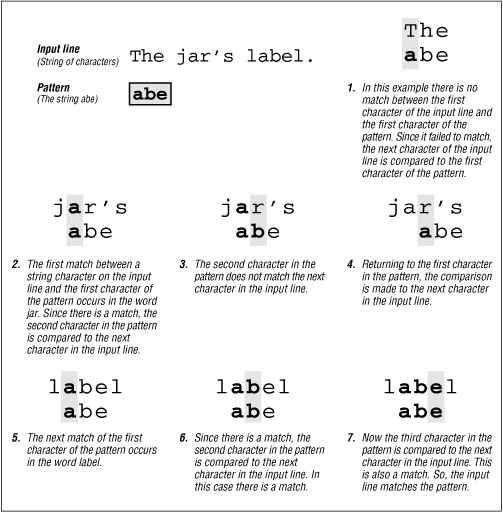
Programs such as grep that accept regular expressions must first evaluate the syntax of the regular expression to produce a pattern. They then read the input line-by-line trying to match the pattern. An input line is a string, and to see if a string matches the pattern, a program compares the first character in the string to the first character of the pattern. If there is a match, it compares the second character in the string to the second character of the pattern. Whenever it fails to make a match, it goes back and tries again, beginning one character later in the string. Figure 3.1 illustrates this process, trying to match the pattern “abe” on an input line.
A regular expression is not limited to literal characters. There is, for instance, a metacharacter—the dot (.)—that can be used as a “wildcard” to match any single character. You can think of this wildcard as analogous to a blank tile in Scrabble where it means any letter. Thus, we can specify the regular expression “A.E” and it will match “ACE,” “ABE”, and “ALE”. It will match any character in the position following “A”.
The metacharacter *,
the asterisk, is used to match zero or more occurrences of the
preceding regular expression, which typically is a
single character. You may be familiar with * as a shell
metacharacter, where it means “zero or more characters.” But that
meaning is very different from * in a
regular expression. By itself, the asterisk metacharacter does not match
anything; it modifies what goes before it. The regular expression
.* matches any number of characters,
whereas in the shell, * has that
meaning. (For instance, in the shell, ls * will list all the files in the
current directory.) The regular expression “A.*E” matches any string that matches “A.E” but
it will also match any number of characters between “A” and “E”:
“AIRPLANE,” “A FINE,” “AFFABLE,” or “A LONG WAY HOME,” for example. Note
that “any number of characters” can even be zero!
If you understand the difference between “.” and “*” in regular expressions, you already know about the two basic types of metacharacters: those that can be evaluated to a single character, and those that modify how preceding characters are evaluated.
It should also be apparent that by use of metacharacters you can expand or limit the possible matches. You have more control over what’s matched and what’s not.
[1] Some other programs that use regular expressions offer the option of having them be case-insensitive, but sed and awk do not.