Table of Contents for
sed & awk, 2nd Edition
 sed & awk, 2nd Edition
Published by
O'Reilly Media, Inc., 1997
sed & awk, 2nd Edition
Published by
O'Reilly Media, Inc., 1997
- sed & awk, 2nd Edition
- Cover
- sed & awk, 2nd Edition
- A Note Regarding Supplemental Files
- Dedication
- Preface
- Scope of This Handbook
- Availability of sed and awk
- Obtaining Example Source Code
- Conventions Used in This Handbook
- About the Second Edition
- Acknowledgments from the First Edition
- Comments and Questions
- 1. Power Tools for Editing
- 1.1. May You Solve Interesting Problems
- 1.2. A Stream Editor
- 1.3. A Pattern-Matching Programming Language
- 1.4. Four Hurdles to Mastering sed and awk
- 2. Understanding Basic Operations
- 2.1. Awk, by Sed and Grep, out of Ed
- 2.2. Command-Line Syntax
- 2.3. Using sed
- 2.4. Using awk
- 2.5. Using sed and awk Together
- 3. Understanding Regular Expression Syntax
- 3.1. That’s an Expression
- 3.2. A Line-Up of Characters
- 3.3. I Never Metacharacter I Didn’t Like
- 4. Writing sed Scripts
- 4.1. Applying Commands in a Script
- 4.2. A Global Perspective on Addressing
- 4.3. Testing and Saving Output
- 4.4. Four Types of sed Scripts
- 4.5. Getting to the PromiSed Land
- 5. Basic sed Commands
- 5.1. About the Syntax of sed Commands
- 5.2. Comment
- 5.3. Substitution
- 5.4. Delete
- 5.5. Append, Insert, and Change
- 5.6. List
- 5.7. Transform
- 5.8. Print
- 5.9. Print Line Number
- 5.10. Next
- 5.11. Reading and Writing Files
- 5.12. Quit
- 6. Advanced sed Commands
- 6.1. Multiline Pattern Space
- 6.2. A Case for Study
- 6.3. Hold That Line
- 6.4. Advanced Flow Control Commands
- 6.5. To Join a Phrase
- 7. Writing Scripts for awk
- 7.1. Playing the Game
- 7.2. Hello, World
- 7.3. Awk’s Programming Model
- 7.4. Pattern Matching
- 7.5. Records and Fields
- 7.6. Expressions
- 7.7. System Variables
- 7.8. Relational and Boolean Operators
- 7.9. Formatted Printing
- 7.10. Passing Parameters Into a Script
- 7.11. Information Retrieval
- 8. Conditionals, Loops, and Arrays
- 8.1. Conditional Statements
- 8.2. Looping
- 8.3. Other Statements That Affect Flow Control
- 8.4. Arrays
- 8.5. An Acronym Processor
- 8.6. System Variables That Are Arrays
- 9. Functions
- 9.1. Arithmetic Functions
- 9.2. String Functions
- 9.3. Writing Your Own Functions
- 10. The Bottom Drawer
- 10.1. The getline Function
- 10.2. The close( ) Function
- 10.3. The system( ) Function
- 10.4. A Menu-Based Command Generator
- 10.5. Directing Output to Files and Pipes
- 10.6. Generating Columnar Reports
- 10.7. Debugging
- 10.8. Limitations
- 10.9. Invoking awk Using the #! Syntax
- 11. A Flock of awks
- 11.1. Original awk
- 11.2. Freely Available awks
- 11.3. Commercial awks
- 11.4. Epilogue
- 12. Full-Featured Applications
- 12.1. An Interactive Spelling Checker
- 12.2. Generating a Formatted Index
- 12.3. Spare Details of the masterindex Program
- 13. A Miscellany of Scripts
- 13.1. uutot.awk—Report UUCP Statistics
- 13.2. phonebill—Track Phone Usage
- 13.3. combine—Extract Multipart uuencoded Binaries
- 13.4. mailavg—Check Size of Mailboxes
- 13.5. adj—Adjust Lines for Text Files
- 13.6. readsource—Format Program Source Files for troff
- 13.7. gent—Get a termcap Entry
- 13.8. plpr—lpr Preprocessor
- 13.9. transpose—Perform a Matrix Transposition
- 13.10. m1—Simple Macro Processor
- A. Quick Reference for sed
- A.1. Command-Line Syntax
- A.2. Syntax of sed Commands
- A.3. Command Summary for sed
- B. Quick Reference for awk
- B.1. Command-Line Syntax
- B.2. Language Summary for awk
- B.3. Command Summary for awk
- C. Supplement for Chapter 12
- C.1. Full Listing of spellcheck.awk
- C.2. Listing of masterindex Shell Script
- C.3. Documentation for masterindex
- masterindex
- C.3.1. Background Details
- C.3.2. Coding Index Entries
- C.3.3. Output Format
- C.3.4. Compiling a Master Index
- Index
- About the Authors
- Colophon
- Copyright
Command-Line Syntax
You invoke sed and awk in much the same way. The command-line syntax is:
command[options]scriptfilename
Like almost all UNIX programs, sed and awk can take input from standard input and send the output to standard output. If a filename is specified, input is taken from that file. The output contains the processed information. Standard output is the display screen, and typically the output from these programs is directed there. It can also be sent to a file, using I/O redirection in the shell, but it must not go to the same file that supplies input to the program.
The options for each command are different. We will demonstrate many of these options in upcoming sections. (The complete list of command-line options for sed can be found in Appendix A; the complete list of options for awk is in Appendix B.)
The script specifies what instructions to perform. If specified on the command line, the script must be surrounded in single quotes if it contains a space or any characters that might be interpreted by the shell ($ and * for instance).
One option common to both sed and awk is the
-f option that allows you to specify the name of a
script file. As a script grows in size, it is convenient to place it in
a file. Thus, you might invoke sed as follows:
sed -fscriptfileinputfile
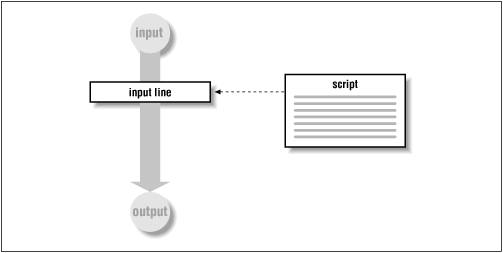
Figure 2.1 shows the basic operation of sed and awk. Each program reads one input line at a time from the input file, makes a copy of the input line, and executes the instructions specified in the script on that copy. Thus, changes made to the input line do not affect the actual input file.
Scripting
A script is where you tell the program what to do. At least one line of instruction is required. Short scripts can be specified on the command line; longer scripts are usually placed in a file where they can easily be revised and tested. In writing a script, keep in mind the sequence in which instructions will be executed and how each instruction changes the input line.
In sed and awk, each instruction has two parts: a pattern and a procedure. The pattern is a regular expression delimited with slashes (/). A procedure specifies one or more actions to be performed.
As each line of input is read, the program reads the first instruction in the script and checks the pattern against the current line. If there is no match, the procedure is ignored and the next instruction is read. If there is a match, then the action or actions specified in the procedure are followed. All of the instructions are read, not just the first instruction that matches the input line.
When all the applicable instructions have been interpreted and applied for a single line, sed outputs the line and repeats the cycle for each input line. Awk, on the other hand, does not automatically output the line; the instructions in your script control what is finally done with it.
The contents of a procedure are very different in sed and awk. In sed, the procedure consists of editing commands like those used in the line editor. Most commands consist of a single letter.
In awk, the procedure consists of programming statements and functions. A procedure must be surrounded by braces.
In the sections that follow, we’ll look at a few scripts that process a sample mailing list.
Sample Mailing List
In the upcoming sections, the examples use a sample file, named list. It contains a list of names and addresses, as shown below.
$ cat list
John Daggett, 341 King Road, Plymouth MA
Alice Ford, 22 East Broadway, Richmond VA
Orville Thomas, 11345 Oak Bridge Road, Tulsa OK
Terry Kalkas, 402 Lans Road, Beaver Falls PA
Eric Adams, 20 Post Road, Sudbury MA
Hubert Sims, 328A Brook Road, Roanoke VA
Amy Wilde, 334 Bayshore Pkwy, Mountain View CA
Sal Carpenter, 73 6th Street, Boston MA
If you like, create this file on your system or use a similar one of your own making. Because many of the examples in this chapter are short and interactive, you can enter them at your keyboard and verify the results.