Table of Contents for
Network Security with OpenSSL
 Network Security with OpenSSL
Published by
O'Reilly Media, Inc., 2002
Network Security with OpenSSL
Published by
O'Reilly Media, Inc., 2002
- Cover
- Network Security with OpenSSL
- Network Security with OpenSSL
- Dedication
- A Note Regarding Supplemental Files
- Preface
- 1. Introduction
- 2. Command-Line Interface
- 3. Public Key Infrastructure (PKI)
- 4. Support Infrastructure
- 5. SSL/TLS Programming
- 6. Symmetric Cryptography
- 7. Hashes and MACs
- 8. Public Key Algorithms
- 9. OpenSSL in Other Languages
- 10. Advanced Programming Topics
- A. Command-Line Reference
- asn1parse
- ca
- ciphers
- crl
- crl2pkcs7
- dgst
- dhparam
- dsa
- dsaparam
- enc
- errstr
- gendsa
- genrsa
- nseq
- passwd
- pkcs7
- pkcs8
- pkcs12
- rand
- req
- rsa
- rsautl
- s_client
- s_server
- s_time
- sess_id
- smime
- speed
- spkac
- verify
- version
- x509
- Index
- About the Authors
- Colophon
- Copyright
Colophon
Our look is the result of reader comments, our own experimentation, and feedback from distribution channels. Distinctive covers complement our distinctive approach to technical topics, breathing personality and life into potentially dry subjects.
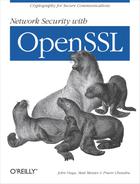
The animals on the cover of Network Security with OpenSSL are seals and sea lions. Seals and sea lions are related; both are marine mammals belonging to the order Pinnipedia. Sea lions, along with fur seals, are members of the eared seal family. Eared seals, as their name implies, have external ears on either side of the head. These ears are covered by small flaps. All other seals, or true seals, lack external ears, having only small, wrinkled openings where their ears would otherwise be. Another principle difference between eared seals and true seals is the functionality of their rear flippers. Eared seals can turn their rear flippers forward to move about on land. True seals cannot, and can move on land only by rolling, sliding, or wriggling from place to place. Despite the awkwardness of both seals and sea lions on land, both swim very gracefully using undulating motions of their front flippers. Fish and squid are the main staples of the seal and sea lion diet. These mammals can dive to great depths—up to 2,000 feet in some species—in search of food.
Seals and sea lions have long been hunted for their blubber and their fur. There are eighteen living species of seal and four major species of sea lion in existence. Some species are endangered or threatened. All are currently protected.
Colleen Gorman was the production editor and the copyeditor for Network Security with OpenSSL. Matt Hutchinson, Linley Dolby, and Jane Ellin provided quality control. Sue Willing, Sarah Sherman, and Phil Dangler provided production support. John Bickelhaupt wrote the index.
Ellie Volckhausen designed the cover of this book, based on a series design by Edie Freedman. The cover image is a 19th-century engraving from the Dover Pictorial Archive. Emma Colby produced the cover layout with QuarkXPress 4.1 using Adobe’s ITC Garamond font.
David Futato designed the interior layout. This book was converted into FrameMaker 5.5.6 with a format conversion tool created by Erik Ray, Jason McIntosh, Neil Walls, and Mike Sierra that uses Perl and XML technologies. The text font is Linotype Birka; the heading font is Adobe Myriad Condensed; and the code font is LucasFont’s TheSans Mono Condensed. The illustrations that appear in the book were produced by Robert Romano and Jessamyn Read using Macromedia FreeHand 9 and Adobe Photoshop 6. The tip and warning icons were drawn by Christopher Bing. This colophon was written by Clairemarie Fisher O’Leary.
The online edition of this book was created by the Safari production group (John Chodacki, Becki Maisch, and Madeleine Newell) using a set of Frame-to-XML conversion and cleanup tools written and maintained by Erik Ray, Benn Salter, John Chodacki, and Jeff Liggett.