Table of Contents for
PostgreSQL: Up and Running, 3rd Edition
 PostgreSQL: Up and Running, 3rd Edition
Published by
O'Reilly Media, Inc., 2017
PostgreSQL: Up and Running, 3rd Edition
Published by
O'Reilly Media, Inc., 2017
- nav
- Cover
- PostgreSQL: Up and Running
- PostgreSQL: Up and Running
- Preface
- 1. The Basics
- 2. Database Administration
- 3. psql
- 4. Using pgAdmin
- 5. Data Types
- 6. Tables, Constraints, and Indexes
- 7. SQL: The PostgreSQL Way
- 8. Writing Functions
- 9. Query Performance Tuning
- 10. Replication and External Data
- A. Installing PostgreSQL
- B. PostgreSQL Packaged Command-Line Tools
- Index
- About the Authors
- Colophon
Colophon
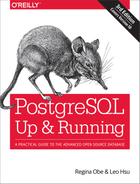
The animal on the cover of PostgreSQL: Up and Running is an elephant shrew (Macroscelides proboscideus), an insectivorous mammal native to Africa named for its lengthy trunk, which resembles that of an elephant. They are distributed across southern Africa in many types of habitat, from the Namib Desert to boulder-covered terrain in South Africa and thick forests.
The elephant shrew is small and quadrupedal; they resemble rodents and opossums with their scaly tails. Their legs are long for their size, allowing them to move around in a hopping fashion similar to a rabbit. The trunk varies in size depending on species, but are all able to twist around in search of food.
They are diurnal and active, though they are hardly seen due to being wary animals, which makes them difficult to trap. They are well camouflaged and quick at dashing away from threats.
Though elephant shrews are not very social, many of them live in monogamous pairs, sharing and defending their home territory. Female elephant shrews experience a menstrual cycle similar to that of human females; their mating period lasts for several days. Gestation lasts from 45 to 60 days, and the female gives birth to litters of one to three young, which are born fairly developed and remain in the nest for several days before venturing out. This can happen several times a year.
Five days after birth, young elephant shrews add mashed insects—which their mother collects and transports in her cheeks—to their milk diet. The young begin their migratory phase after about 15 days, lessening their dependency on the mother. They subsequently establish their own home range and become sexually active within 41 to 46 days.
Adult elephant shrews feed on invertebrates, such as insects, spiders, centipedes, millipedes, and earthworms. Eating larger prey can be somewhat messy. The elephant shrew must pin down the prey using its feet, then chews pieces with its cheek teeth, which can result in many dropped bits. The elephant shrew then uses its tongue to flick small food into its mouth, similar to an anteater. When available, some also eat small amounts of plant matter, such as new leaves, seeds, and small fruits.
Many of the animals on O’Reilly covers are endangered; all of them are important to the world. To learn more about how you can help, go to animals.oreilly.com.
The cover image is from Meyers Kleines Lexicon. The cover fonts are URW Typewriter and Guardian Sans. The text font is Adobe Minion Pro; the heading font is Adobe Myriad Condensed; and the code font is Dalton Maag’s Ubuntu Mono.