Table of Contents for
Site Reliability Engineering
 Site Reliability Engineering
Published by
O'Reilly Media, Inc., 2016
Site Reliability Engineering
Published by
O'Reilly Media, Inc., 2016
- nav
- Cover
- Praise for Site Reliability Engineering
- Site Reliability Engineering
- Site Reliability Engineering
- Foreword
- Preface
- I. Introduction
- 1. Introduction
- 2. The Production Environment at Google, from the Viewpoint of an SRE
- II. Principles
- 3. Embracing Risk
- 4. Service Level Objectives
- 5. Eliminating Toil
- 6. Monitoring Distributed Systems
- 7. The Evolution of Automation at Google
- 8. Release Engineering
- 9. Simplicity
- III. Practices
- 10. Practical Alerting from Time-Series Data
- 11. Being On-Call
- 12. Effective Troubleshooting
- 13. Emergency Response
- 14. Managing Incidents
- 15. Postmortem Culture: Learning from Failure
- 16. Tracking Outages
- 17. Testing for Reliability
- 18. Software Engineering in SRE
- 19. Load Balancing at the Frontend
- 20. Load Balancing in the Datacenter
- 21. Handling Overload
- 22. Addressing Cascading Failures
- 23. Managing Critical State: Distributed Consensus for Reliability
- 24. Distributed Periodic Scheduling with Cron
- 25. Data Processing Pipelines
- 26. Data Integrity: What You Read Is What You Wrote
- 27. Reliable Product Launches at Scale
- IV. Management
- 28. Accelerating SREs to On-Call and Beyond
- 29. Dealing with Interrupts
- 30. Embedding an SRE to Recover from Operational Overload
- 31. Communication and Collaboration in SRE
- 32. The Evolving SRE Engagement Model
- V. Conclusions
- 33. Lessons Learned from Other Industries
- 34. Conclusion
- A. Availability Table
- B. A Collection of Best Practices for Production Services
- C. Example Incident State Document
- D. Example Postmortem
- E. Launch Coordination Checklist
- F. Example Production Meeting Minutes
- Bibliography
- Index
- About the Authors
- Colophon
Colophon
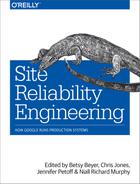
The animal on the cover of Site Reliability Engineering is the ornate monitor lizard, a reptile native to West and Middle Africa. Until 1997, it was considered a subspecies of the Nile monitor lizard (Varanus niloticus), but is now classified as a polymorph of both Varanus stellatus and Varanus niloticus due to its different skin patterns. It also has a smaller range than the Nile monitor, preferring a habitat of lowland rainforest.
Ornate monitors are large lizards, able to grow up to 6–7 feet long. They are more brightly colored than Nile monitors, with darker olive skin and fewer bands of bright yellow spots running from the shoulder to the tail. Like all monitor lizards, this animal has a muscular stout body, sharp claws, and an elongated head. Their nostrils are placed high on their snout, permitting them to spend time in the water. They are excellent swimmers and climbers, which allows them to sustain a diet of fish, frogs, eggs, insects, and small mammals.
Monitor lizards are often kept as pets, though they require a lot of care and are not suitable for beginners. They can be dangerous when they feel threatened (lashing their powerful tails, scratching, or biting), but it is possible to tame them somewhat with regular handling and teaching them to associate their keeper’s presence with the delivery of food.
Many of the animals on O’Reilly covers are endangered; all of them are important to the world. To learn more about how you can help, go to animals.oreilly.com.
The cover image is from Brockhaus Lexicon. The cover fonts are URW Typewriter and Guardian Sans. The text font is Adobe Minion Pro; the heading font is Adobe Myriad Condensed; and the code font is Dalton Maag’s Ubuntu Mono.